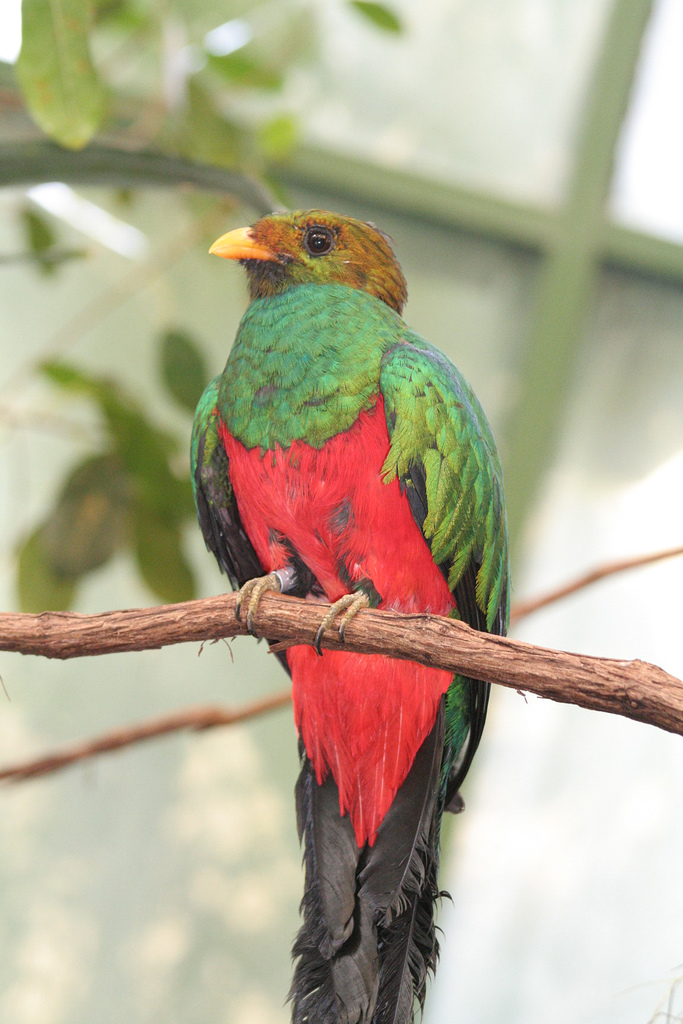
Pavonine Quetzal
Pharomachrus pavoninus
Order: Trogoniformes / Family: Trogonidae

Wikimedia Commons
About the Pavonine Quetzal
The Pavonine Quetzal, Pharomachrus pavoninus, is an extraordinary avian species belonging to the family Trogonidae, which is renowned for its vibrant plumage and striking appearance. Found primarily in the dense, humid rainforests of the Amazon Basin, this bird captivates with its shimmering green and red feathers. The Pavonine Quetzal plays a vital role in its ecosystem as both a seed disperser and a predator of insects, contributing to the health and regeneration of the forest. Its presence is a strong indicator of forest integrity and biodiversity. Predominantly located in countries such as Brazil, Peru, Bolivia, and Colombia, the Pavonine Quetzal thrives in lowland and montane forests. Its habitat preference includes areas with high humidity and abundant epiphytes, which provide ample foraging opportunities. During the breeding season, these birds are known to perform elaborate courtship displays, which are vital for mate selection and species continuation. Seasonal movements are generally minimal, as the Pavonine Quetzal remains within its tropical forest habitat year-round. This sedentary nature is due to the consistent availability of food resources and suitable nesting sites. The Pavonine Quetzal's ecological significance extends beyond its aesthetic allure. As a keystone species, its activities in seed dispersal and insect control are crucial to maintaining the ecological balance within its habitat. Despite its resilience, the Pavonine Quetzal faces threats from deforestation and habitat fragmentation, making conservation efforts essential to ensure its survival.
The Pavonine Quetzal belongs to the family Trogonidae, within the order Trogoniformes. These birds typically live typically 5-6 years, with some reaching up to 10 years..
How to Identify a Pavonine Quetzal
The Pavonine Quetzal is easily recognizable by its iridescent green and red plumage. Adult males display a vibrant emerald green back and head, with a striking crimson belly. Their long tail feathers, which can extend up to 30 cm, add to their visually stunning appearance. Females are slightly less colorful, with more subdued tones and shorter tail feathers, yet they share the same basic plumage pattern. Juveniles resemble females but lack the full intensity of adult coloration, taking several years to reach their mature plumage. In flight, the Pavonine Quetzal presents a silhouette characterized by broad, rounded wings and a distinctive long tail. When perched, they exhibit an upright posture, often remaining motionless for extended periods, which can make them challenging to spot amidst the dense foliage. Similar species within the same range include other members of the trogon family, yet none match the resplendent hues of the Pavonine Quetzal. Their unique coloration and elongated tail feathers serve as key identifiers when distinguishing them from other forest-dwelling birds.
Having trouble telling birds apart? Upload a photo to our bird identification tool for an instant species match.
Pavonine Quetzal Habitat and Range
Preferred Habitat
The Pavonine Quetzal primarily inhabits the dense, humid rainforests of the Amazon Basin, thriving in both lowland and montane forests. These areas are characterized by high rainfall, thick vegetation, and a rich diversity of flora. The bird prefers regions with abundant epiphytes, which provide essential food sources and nesting sites. While it is primarily a forest dweller, the Pavonine Quetzal occasionally ventures into adjacent secondary forests or forest edges. This species occupies elevations ranging from sea level to about 1,500 meters, with a particular preference for undisturbed primary forests. Unlike some bird species, the Pavonine Quetzal does not exhibit significant seasonal habitat shifts, as its tropical environment provides a stable climate and consistent food availability throughout the year.
Geographic Range
The Pavonine Quetzal is native to South America, with its range concentrated in the vast expanse of the Amazon Basin. It is found in Brazil, Peru, Bolivia, and Colombia, where it inhabits the dense tropical forests. Due to its preference for specific forest habitats, the bird's distribution is patchy, with higher population densities in areas of undisturbed primary forest. Unlike many birds, the Pavonine Quetzal is largely sedentary, with minimal migratory behavior. Its range does not extend beyond the tropical regions of South America, and it is absent from more temperate areas. The bird's presence is strongly associated with the availability of suitable forest habitats, making it vulnerable to habitat loss and fragmentation.
Want to know which birds visit your area? Browse our backyard birds by location guides for region-specific species lists.
What Does the Pavonine Quetzal Eat?
The Pavonine Quetzal primarily feeds on fruits, particularly those of the Lauraceae family, which form the bulk of its diet. This dietary preference plays a crucial role in seed dispersal within its habitat. Additionally, the bird consumes a variety of insects and small vertebrates, supplementing its diet with proteins. Seasonal variations in fruit availability influence its foraging behavior, leading to occasional shifts in dietary composition. The Pavonine Quetzal typically forages alone or in pairs, searching for food in the middle to upper canopy levels of the forest. Its foraging technique involves a combination of sallying from perches to catch insects in flight and gleaning fruits from trees. The bird's diet reflects its adaptability to the fluctuating resources of the rainforest environment.
Pavonine Quetzal Behavior and Social Structure
The Pavonine Quetzal exhibits fascinating behavioral patterns, particularly during the breeding season. Males engage in elaborate courtship displays that involve intricate aerial maneuvers and vocalizations to attract females. These displays are crucial for mate selection and successful reproduction. Socially, the Pavonine Quetzal is generally solitary or found in pairs, with limited flocking behavior outside of the breeding season. The bird is territorial, defending its chosen area from intruders. When faced with predators, the Pavonine Quetzal relies on its cryptic coloration to blend into the dense foliage, avoiding detection. Its daily activity patterns include active foraging during the early morning and late afternoon, with periods of rest during the hottest parts of the day.
Pavonine Quetzal Nesting and Reproduction
The Pavonine Quetzal nests in natural cavities, often using abandoned woodpecker holes or crevices in trees. Nest sites are typically located in the middle to upper canopy, providing protection from ground predators. The bird's nesting materials consist mainly of leaves and other plant matter, which it arranges within the chosen cavity. Clutch size ranges from two to three eggs, with both parents sharing incubation duties. The incubation period lasts approximately 18 to 20 days, followed by a fledging period of about 25 to 30 days. Typically, the Pavonine Quetzal raises one brood per year, although in areas with abundant resources, a second brood may occur. Parental care extends beyond fledging, as adults continue to feed and protect their young until they become independent.
Pavonine Quetzal Sounds and Vocalizations
The Pavonine Quetzal produces a distinctive series of high-pitched whistles, often described as melodious and flute-like. Its primary song consists of short phrases repeated at regular intervals, used predominantly during the breeding season to establish territory and attract mates. Call notes are softer and include a variety of chirps and whistles used for communication between mates and family members. Alarm calls are sharp and abrupt, signaling the presence of potential threats. The Pavonine Quetzal participates in the dawn chorus, with its vocalizations contributing to the rich acoustic environment of the forest. Its sound repertoire, while not as extensive as some songbirds, is nonetheless a key aspect of its behavioral ecology.
Interesting Facts About the Pavonine Quetzal
- 1The Pavonine Quetzal's iridescent plumage appears to change color depending on the angle of light, a trait caused by the microscopic structure of its feathers.
- 2Despite their bright colors, Pavonine Quetzals are remarkably elusive, often remaining hidden in the dense canopy of the rainforest.
- 3Both male and female Pavonine Quetzals share in the care of their young, with both parents participating in feeding and protecting the chicks.
- 4The Pavonine Quetzal's diet primarily consists of fruits, making it an important seed disperser within its ecosystem.
- 5The long tail feathers of the male Pavonine Quetzal can measure up to 30 centimeters, significantly aiding in courtship displays.
- 6Pavonine Quetzals are part of the Trogonidae family, which includes some of the most brightly colored birds in the world.
- 7The Pavonine Quetzal's call is often described as a series of melodious whistles, adding to the rich soundscape of its forest home.
Pavonine Quetzal Conservation Status
The Pavonine Quetzal is currently classified as Near Threatened according to the IUCN Red List. Its population trend is generally decreasing, primarily due to habitat loss and fragmentation driven by deforestation and agricultural expansion. Conservation efforts focus on habitat protection and restoration, with several protected areas established within its range to safeguard critical habitats. Historically, the Pavonine Quetzal's population has experienced declines corresponding with increased human activity in the Amazon Basin. Conservation organizations emphasize the importance of sustainable land-use practices and the establishment of ecological corridors to maintain population connectivity. Continued research and monitoring are essential to ensure the long-term survival of this iconic species.
Other Trogonidae Species


Birds Similar to the Pavonine Quetzal
These species are often confused with the Pavonine Quetzal due to similar appearance or overlapping range.