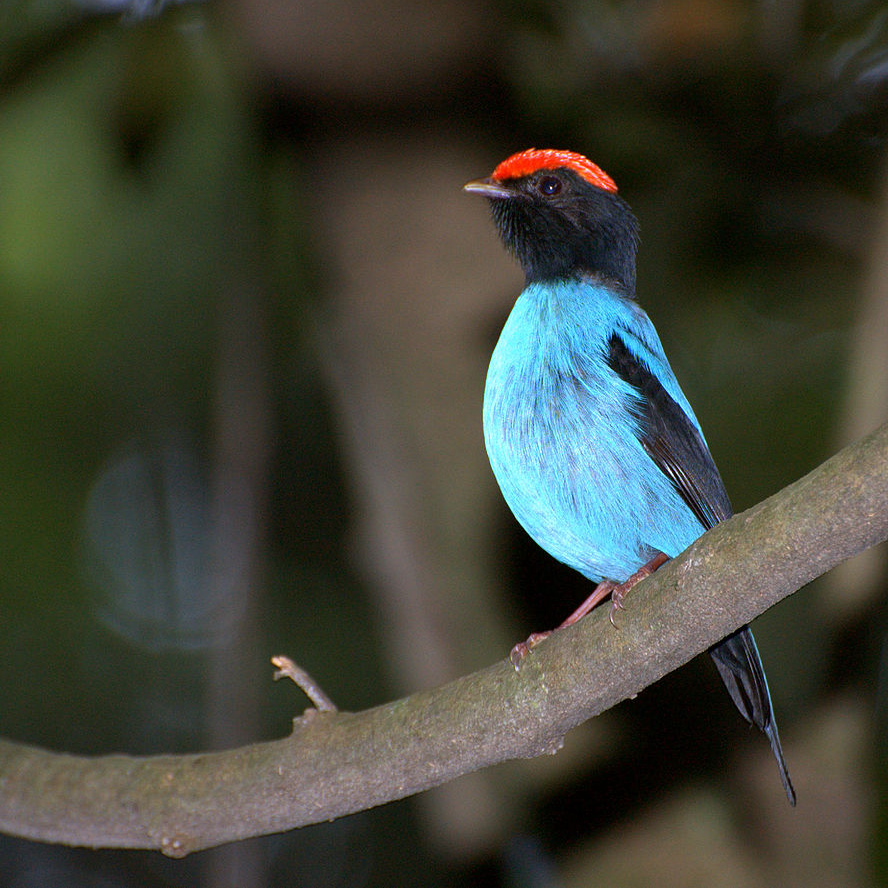
Pin-tailed Manakin
Ilicura militaris
Order: Passeriformes / Family: Pipridae

Wikimedia Commons
About the Pin-tailed Manakin
The Pin-tailed Manakin, known scientifically as Ilicura militaris, is a captivating bird species belonging to the Pipridae family. This species is endemic to the Atlantic Forest of Brazil, a biodiversity hotspot home to a plethora of unique flora and fauna. The Pin-tailed Manakin is notable for its sexual dimorphism, with males boasting a striking combination of black, white, and bright red plumage, which plays a crucial role in courtship displays. In contrast, females present a more subdued appearance, with olive-green tones that blend seamlessly into their forest habitat.
The ecological significance of the Pin-tailed Manakin cannot be overstated. As a frugivore, this bird plays a pivotal role in seed dispersal, contributing to the regeneration and maintenance of its forest ecosystem. The species predominantly inhabits the understory and mid-story layers of the forest, where it forages for small fruits and berries. This feeding behavior not only supports the bird's dietary needs but also aids in the propagation of plant species, ensuring the continuity of the forest's complex ecological networks.
Seasonal behaviors of the Pin-tailed Manakin are influenced by breeding activities. During the breeding season, males engage in elaborate courtship displays, which include acrobatic flights and vocalizations designed to attract females. These displays are often competitive, with multiple males performing in proximity to one another. Outside the breeding season, the Pin-tailed Manakin exhibits more solitary behavior, focusing on foraging and survival. Despite its reliance on specific forest habitats, the species demonstrates some adaptability, occasionally venturing into secondary forests and edge habitats, though it is less common in heavily altered landscapes.
Conservation of the Pin-tailed Manakin is essential, given its restricted range and the ongoing threats to the Atlantic Forest. Habitat destruction, particularly due to logging, agriculture, and urbanization, poses significant risks to the species' survival. Conservation efforts aimed at preserving and restoring forest habitats are crucial for ensuring the long-term viability of Ilicura militaris and the myriad other species that share its environment.
The Pin-tailed Manakin belongs to the family Pipridae, within the order Passeriformes. These birds typically live 4 years on average, with some individuals reaching up to 7 years..
How to Identify a Pin-tailed Manakin
Identifying the Pin-tailed Manakin in the field involves observing several distinct characteristics. Adult males are particularly striking, showcasing a vivid red crown, a stark white throat and belly, and contrasting black wings and back. The most distinctive feature of the male is its elongated central tail feathers, which form the namesake 'pin-tail.' These feathers are not only visually impressive but also play a role in the bird's courtship displays.
Females, however, present a more cryptic appearance, with predominantly olive-green plumage. This coloration provides excellent camouflage in the dense foliage of their forest habitat. Juveniles resemble females in coloration until they mature and males develop their characteristic bright plumage. This sexual dimorphism is typical among manakins, where the males' conspicuous colors serve to attract mates, whereas females remain less conspicuous to avoid predation while nesting.
The Pin-tailed Manakin can be confused with other manakin species due to overlapping ranges and similar sizes. However, its unique tail feathers and coloration make it distinguishable with careful observation. In flight, the bird presents a compact silhouette, with rapid, buzzing wingbeats that are characteristic of the family. When perched, the Pin-tailed Manakin often adopts an upright posture, showcasing its vibrant plumage.
Having trouble telling birds apart? Upload a photo to our bird identification tool for an instant species match.
Pin-tailed Manakin Habitat and Range
Preferred Habitat
The Pin-tailed Manakin inhabits the Atlantic Forest, a moist, tropical forest ecosystem along the eastern coast of Brazil. This forest type, characterized by high biodiversity and endemism, offers the dense understory and mid-story layers that the species favors for foraging and nesting. The bird typically resides at elevations ranging from sea level to about 1,000 meters, although it is more commonly found in the lower and middle elevations where fruiting trees and shrubs are abundant.
While primarily associated with primary forest habitats, the Pin-tailed Manakin can occasionally be found in secondary forests and forest edges. These areas provide alternative resources, particularly in regions where primary forests have been reduced due to human activities. Despite its adaptability, the species is less frequently observed in urban or heavily disturbed areas, indicating a preference for more natural settings.
Seasonal habitat shifts in the Pin-tailed Manakin are minimal, as the species is non-migratory and remains within its home range throughout the year. However, local movements in search of food resources, particularly during periods of fruit scarcity, can lead to temporary changes in habitat usage.
Geographic Range
The range of the Pin-tailed Manakin is confined to the Atlantic Forest of Brazil, extending from southern Bahia through Espírito Santo and into eastern Minas Gerais and northern Rio de Janeiro. This distribution corresponds with the remaining fragments of this once vast forest, which has been significantly reduced by human activities.
Breeding occurs throughout this range, with males establishing territories and performing courtship displays in forest clearings or along edges where females can easily observe the performances. The species does not undertake long-distance migrations, maintaining a relatively stable presence within its home range year-round.
Population density hotspots for the Pin-tailed Manakin are generally found in regions where forest habitat remains relatively intact and continuous. Such areas include national parks and reserves where conservation efforts have been implemented to protect the remaining forest fragments. Despite this, the species' overall range has contracted due to habitat loss, making the preservation of existing forest areas critical for its survival.
Want to know which birds visit your area? Browse our backyard birds by location guides for region-specific species lists.
What Does the Pin-tailed Manakin Eat?
The Pin-tailed Manakin primarily feeds on fruit, playing a vital role as a seed disperser in its ecosystem. Its diet consists mainly of small berries and figs, which are abundant in the understory and mid-story of the Atlantic Forest. The bird's strong, slightly curved bill is well-suited for grasping and consuming small fruits.
Seasonal changes in fruit availability influence the diet of the Pin-tailed Manakin. During periods of fruit abundance, it may become more selective, favoring nutrient-rich options. Conversely, in times of scarcity, the bird may expand its diet to include a wider variety of fruits and occasionally small insects, which provide additional protein.
Foraging techniques involve short flights between fruiting trees and shrubs, with the bird using its agility to navigate dense foliage. The Pin-tailed Manakin typically feeds during daylight hours, with peak activity occurring in the early morning and late afternoon when temperatures are cooler and fruit is more accessible.
Pin-tailed Manakin Behavior and Social Structure
The social structure of the Pin-tailed Manakin is influenced by its breeding behaviors. Males are known for their lekking behavior, where groups of males gather to display and compete for female attention. These displays include a combination of acrobatic flights, vocalizations, and the exhibition of their distinctive tail feathers. Males perform individually within these group settings, with the most attractive displays often resulting in successful mating opportunities.
Outside of the breeding season, Pin-tailed Manakins tend to be solitary or form small, loose associations. They do not typically form large flocks, but may be seen foraging with other frugivorous bird species in mixed-species feeding flocks. This behavior increases foraging efficiency and provides some protection against predators.
The Pin-tailed Manakin exhibits territorial behavior, with males defending display sites during the breeding season. Although they are not aggressive, they will chase away intruders from their immediate display area. Daily activity patterns are diurnal, with the birds being most active during the early morning and late afternoon, coinciding with optimal foraging conditions.
Pin-tailed Manakin Nesting and Reproduction
Nesting for the Pin-tailed Manakin involves constructing a small, cup-shaped nest, often situated in the fork of a branch within the dense understory vegetation. The nest is typically made from woven plant fibers, leaves, and spider silk, providing a secure and camouflaged environment for the eggs.
Females are solely responsible for nest construction, incubation, and the care of the young. A typical clutch consists of two eggs, which are incubated for approximately 18 to 20 days. During this time, the female remains on the nest, leaving only briefly to forage.
Once hatched, the chicks are altricial and require considerable parental care. The female feeds the chicks a diet primarily consisting of small fruits and insects, ensuring they receive adequate nutrition for growth. The fledging period lasts about three weeks, after which the young birds gradually become independent. The Pin-tailed Manakin typically raises one brood per year, though in favorable conditions, a second brood may be attempted.
Pin-tailed Manakin Sounds and Vocalizations
The Pin-tailed Manakin's primary song consists of a series of high-pitched, melodic notes delivered in a rapid succession. These notes vary slightly in pitch and rhythm, creating a distinctive musical quality that can be heard throughout its forest habitat. The song serves as a key component of the male's courtship display, attracting females and asserting territory.
In addition to its song, the Pin-tailed Manakin produces a variety of call notes, including sharp 'chip' calls used for communication between individuals. Alarm calls, which are harsher and more urgent in tone, are used to warn of potential threats.
During the dawn chorus, the Pin-tailed Manakin is one of many species contributing to the symphony of sounds that fill the forest. Its song can be distinguished by its clarity and repetition, making it a favorite among birdwatchers and naturalists exploring the Atlantic Forest.
Interesting Facts About the Pin-tailed Manakin
- 1The Pin-tailed Manakin's elongated tail feathers are used in courtship displays, a trait that attracts females and rivals alike.
- 2Unlike many birds, female Pin-tailed Manakins bear the full responsibility of nest building, incubation, and chick rearing.
- 3Pin-tailed Manakins are frugivorous and play a crucial role in seed dispersal within the Atlantic Forest ecosystem.
- 4The species' lekking behavior involves males displaying together to attract females, showcasing their vibrant plumage and acrobatics.
- 5The Atlantic Forest, home to the Pin-tailed Manakin, is one of the most biodiverse regions in the world, hosting numerous endemic species.
- 6Despite being non-migratory, the Pin-tailed Manakin may undertake localized movements to track fruit availability within its forest home.
- 7The song of the Pin-tailed Manakin is a series of melodic notes, making it a standout performer in the dawn chorus of the Atlantic Forest.
Pin-tailed Manakin Conservation Status
The Pin-tailed Manakin is currently classified as Least Concern by the International Union for Conservation of Nature (IUCN), yet its population is decreasing due to habitat loss. The primary threat to this species is the ongoing deforestation of the Atlantic Forest, driven by agricultural expansion, urban development, and logging activities. Conservation efforts targeted at the Atlantic Forest, including reforestation and the establishment of protected areas, are crucial for the survival of the Pin-tailed Manakin. These efforts not only benefit the manakin but also the many other species that depend on this unique ecosystem. Historically, the Pin-tailed Manakin's population has declined in tandem with the reduction of its forest habitat. While conservation initiatives have slowed this decline in certain areas, continued vigilance and action are necessary to ensure the species' long-term survival.