
Pipra peruviana
Pipra peruviana
Order: Passeriformes / Family: Pipridae
About the Pipra peruviana
The Pipra peruviana, commonly known as the Band-tailed Manakin, represents a fascinating member of the Pipridae family, famed for its vibrant coloration and complex courtship behaviors. Inhabiting the lush tropical forests of the Amazon Basin, this bird is found across countries such as Peru, Brazil, and Colombia. Its presence in these biodiverse ecosystems highlights its ecological significance, contributing to the intricate web of forest life through seed dispersal and insect population control.
The Band-tailed Manakin plays a crucial role in its habitat by aiding in the dispersal of seeds from the fruits it consumes, thus supporting forest regeneration. This bird thrives in humid, lowland rainforests, often residing in dense understory vegetation where it finds protection and food resources. Seasonal shifts may influence its activities slightly, but it remains largely within its tropical range throughout the year.
While the Pipra peruviana is not as widely known as some other avian species, its vibrant appearance and distinctive behaviors make it an important subject for ornithological studies. Observing its impact on ecosystem dynamics enhances our understanding of tropical forest ecology. As a non-migratory bird, it remains a permanent resident, contributing to the long-term stability of its environment.
The Band-tailed Manakin's ecological role extends beyond mere seed dispersal. By preying on various insects, it helps maintain a balance within the forest's food web. This balance is crucial for the health of the rainforest and the myriad species that depend on it. Its presence in these areas is a testament to the rich biodiversity that tropical regions like the Amazon Basin sustain.
The Pipra peruviana belongs to the family Pipridae, within the order Passeriformes. These birds typically live average 8 years, with a maximum recorded of 11 years.
How to Identify a Pipra peruviana
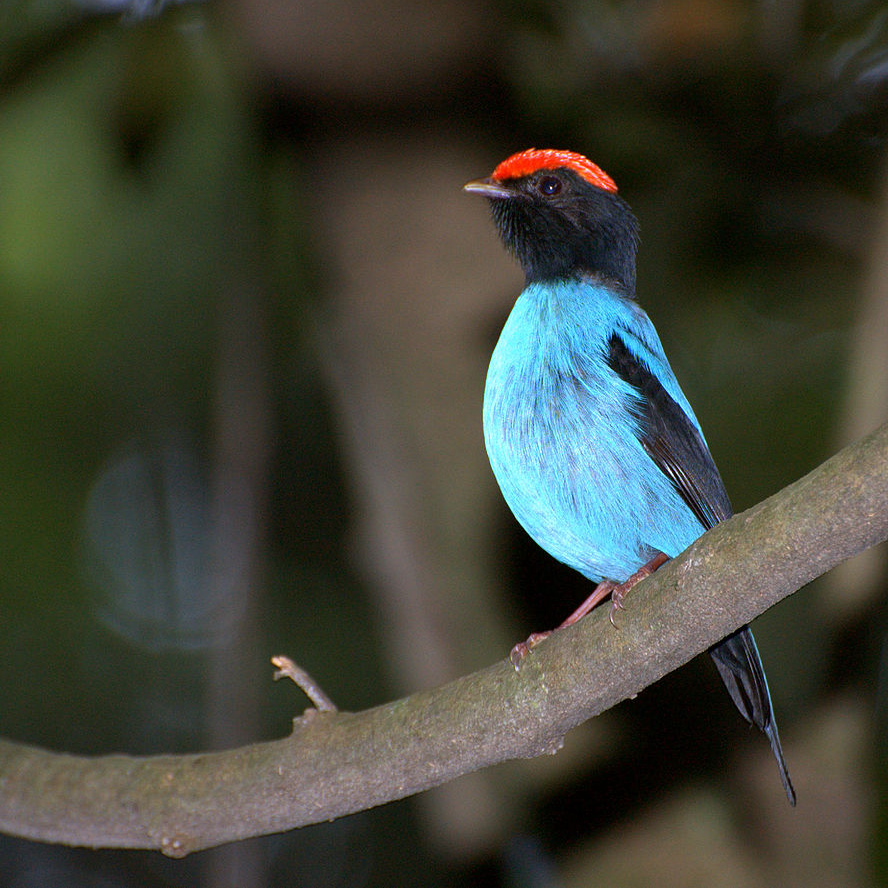
The Band-tailed Manakin is a small bird, approximately 10 centimeters in length, with distinct sexual dimorphism. Males are particularly striking, boasting bright red crowns and upperparts, contrasting with their greenish wings and tail, which features a characteristic band. The underparts of the male are predominantly black, adding to its vibrant appearance. Females, however, are more subdued, with olive-green plumage that provides effective camouflage among the dense foliage of their forest habitat.
Juvenile Band-tailed Manakins resemble the females, which aids in their concealment from predators. As they mature, young males gradually acquire the vivid plumage of adult males, a process that can take several years. This delayed plumage maturation is typical among manakins and plays a role in their social structure and mating dynamics.
In terms of flight, the Band-tailed Manakin exhibits quick, agile movements often characterized by short bursts of rapid wingbeats. When perched, they tend to sit upright on thin branches, often in the lower strata of the rainforest, making their distinctive coloration and posture key identification features. While there may be some confusion with other manakin species, the Band-tailed Manakin's unique tail band and vibrant red crown are distinguishing traits.
Having trouble telling birds apart? Upload a photo to our bird identification tool for an instant species match.
Pipra peruviana Habitat and Range
Preferred Habitat
The Band-tailed Manakin primarily inhabits tropical lowland rainforests, particularly those within the Amazon Basin. This bird favors dense, humid environments where the understory vegetation is thick and provides ample food resources and cover. Such habitats are typically found at elevations ranging from sea level up to 1,000 meters. Although their habitat is not prone to dramatic seasonal shifts, slight changes in habitat usage may occur in response to resource availability. Unlike some avian species, the Band-tailed Manakin does not commonly venture into urban areas, preferring the rich, biodiverse settings of primary and secondary forests. Its reliance on these specific habitats underscores the importance of forest conservation efforts.
Geographic Range
The Band-tailed Manakin is primarily found in the vast expanse of the Amazon Basin, with its range covering parts of Peru, Brazil, Colombia, and Ecuador. This range is largely restricted to tropical rainforest regions and does not extend into non-forest habitats. As a non-migratory species, the Pipra peruviana remains within its established range year-round, emphasizing the significance of habitat preservation in the Amazon. Population density hotspots are often located in areas where forest cover is largely intact, allowing for stable populations. Although the bird's range is somewhat limited geographically, within these regions, it is considered relatively common.
Want to know which birds visit your area? Browse our backyard birds by location guides for region-specific species lists.
What Does the Pipra peruviana Eat?
The diet of the Band-tailed Manakin consists primarily of fruits, supplemented by insects and other invertebrates. This frugivorous diet plays a critical role in seed dispersal, as the bird consumes and later excretes seeds, aiding in the propagation of forest plants. Insects and other small invertebrates provide necessary protein, and the bird actively forages through the understory to catch its prey. Seasonal variations in fruit availability can influence its diet, with the Band-tailed Manakin adjusting its feeding habits to the most abundant food sources. Foraging typically occurs during the day, with peak activity in the early morning and late afternoon when the forest is most active.
Pipra peruviana Behavior and Social Structure
Socially, the Band-tailed Manakin often exhibits solitary or loosely associated behavior, particularly outside of the breeding season. However, during courtship, males display a remarkable lekking behavior, where they gather in groups to perform intricate displays to attract females. These displays involve a combination of vocal calls, wing snaps, and vibrant plumage displays, aimed at demonstrating fitness and attracting mates. Territorial behavior is observed predominantly in males, who defend small display territories within the lek. Despite their flamboyant courtship activities, Band-tailed Manakins are generally quiet and unobtrusive, avoiding predators by remaining within the dense understory. Their activity patterns are diurnal, with peak activity during the cooler parts of the day.
Pipra peruviana Nesting and Reproduction
The nesting habits of the Band-tailed Manakin involve the construction of small, cup-shaped nests made from fine plant fibers, moss, and lined with soft materials like feathers. These nests are typically located low in the dense understory, well-hidden from potential predators. Females undertake the majority of nesting duties, from constructing the nest to incubating the eggs. The clutch size generally consists of two eggs, which the female incubates for about 18-21 days. Once hatched, the chicks are altricial, requiring significant parental care. The female solely provides food and protection until the young fledge, usually about 15-20 days after hatching. Typically, only one brood is raised per year, reflecting the energy investment required for successful rearing.
Pipra peruviana Sounds and Vocalizations
The vocalizations of the Band-tailed Manakin are characterized by a series of sharp, high-pitched notes that form the basis of their primary song. These calls are often described as a rapid 'chee-chee-chee' sequence, delivered with a rhythm that can vary depending on the bird's level of excitement or territorial assertion. In addition to their primary song, Band-tailed Manakins produce various call notes, including softer chatters and sharp alarm calls in response to predators. The dawn chorus is a particularly active period for vocalizations, as males advertise their presence and readiness to display. The sound can be likened to the rapid clicking of small castanets, providing an auditory clue to their presence in the dense forest.
Interesting Facts About the Pipra peruviana
- 1The Band-tailed Manakin's courtship dance includes acrobatic leaps and wing snaps, captivating observers and potential mates alike.
- 2Male Band-tailed Manakins form leks, where multiple males display simultaneously to attract females, a unique courtship strategy.
- 3Despite their vivid appearance, Band-tailed Manakins are often difficult to spot due to their preference for dense forest understory.
- 4The delayed plumage maturation in young males may serve to reduce aggression from adult males within the lek.
- 5Band-tailed Manakins play an essential role in forest ecology by aiding in the dispersal of seeds from various fruiting plants.
Pipra peruviana Conservation Status
Currently, the IUCN lists the Band-tailed Manakin as a species of Least Concern, indicating stable population trends. However, primary threats include deforestation and habitat degradation within the Amazon Basin, driven by logging, agriculture, and urban expansion. Conservation efforts focus on preserving large tracts of continuous forest to maintain viable populations. Historical population changes have not been drastic, but continued vigilance is necessary to ensure the preservation of both the species and its habitat. Habitat loss remains the most significant threat, emphasizing the need for sustainable land-use practices in the region.
Other Pipridae Species


Birds Similar to the Pipra peruviana
These species are often confused with the Pipra peruviana due to similar appearance or overlapping range.
