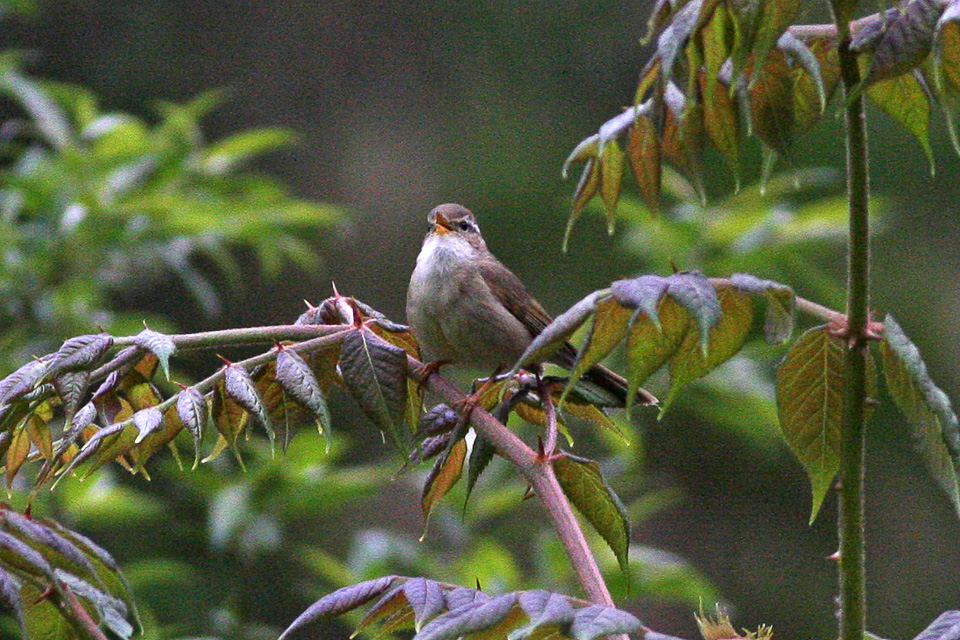
Plain-tailed Warbler
Seicercus soror
Order: Passeriformes / Family: Phylloscopidae

Wikimedia Commons
About the Plain-tailed Warbler
The Plain-tailed Warbler, scientifically known as Seicercus soror, is a small bird of the family Phylloscopidae, celebrated for its subtle yet captivating coloration and lively behavior. It inhabits dense montane forests, particularly favoring the understory layers. This warbler thrives in the subtropical and tropical moist montane forests of Southeast Asia, where its presence is a key indicator of the health of these ecosystems. Its range includes countries like Vietnam, Laos, and southern China, where it often inhabits elevations between 1,000 and 2,500 meters. The ecological role of the Plain-tailed Warbler is significant, as it aids in controlling insect populations within its habitat. As an insectivore, it plays a crucial part in the food web, contributing to the balance of the ecosystem. During the breeding season, which usually occurs in the wet months, the Plain-tailed Warbler becomes more visible and vocal. Males engage in elaborate song displays to attract females, showcasing their prowess and territory boundaries. Their songs, though not as melodious as some other songbirds, are distinctive and serve as an essential communication tool. The bird's ability to adapt to various elevations and forest types highlights its ecological versatility. Despite this adaptability, the Plain-tailed Warbler faces challenges from habitat destruction due to logging and agricultural expansion. Conservation efforts aimed at preserving the montane forests are vital for the survival of this species. Additionally, climate change poses a threat by potentially altering its habitat range and the availability of food resources. Overall, the Plain-tailed Warbler serves as a vital component of its ecosystem, and its presence reflects the health of the montane forests it inhabits.
The Plain-tailed Warbler belongs to the family Phylloscopidae, within the order Passeriformes. These birds typically live average 3-5 years with a maximum recorded of 6 years..
How to Identify a Plain-tailed Warbler
The Plain-tailed Warbler is a small songbird, typically measuring about 11 centimeters in length. Its plumage is predominantly olive-green, a characteristic that provides excellent camouflage in its forested habitat. The bird's most distinguishing feature is its plain, unmarked tail, from which it derives its name. Adults possess a subtle yellow wash on the underparts, which is more pronounced during the breeding season. Juveniles resemble adults but tend to have a duller appearance, with less distinct coloring. Males and females are similar in appearance, making visual sex differentiation challenging without closer inspection or behavioral observation. Unlike many warblers, the Plain-tailed Warbler lacks prominent wing bars or eye rings, which can lead to confusion with similar species such as the Yellow-bellied Warbler. However, the absence of these markings and its unique tail pattern help in identification. In flight, the Plain-tailed Warbler exhibits a rapid, fluttering wing beat, typical of many small insectivorous birds. When perched, it often adopts a horizontal posture, with the tail slightly cocked upwards. The bird's movements are quick and agile, allowing it to navigate through dense foliage with ease.
Having trouble telling birds apart? Upload a photo to our bird identification tool for an instant species match.
Plain-tailed Warbler Habitat and Range
Preferred Habitat
The Plain-tailed Warbler primarily inhabits subtropical and tropical moist montane forests. It shows a preference for dense understory layers where it can forage for insects. These forests are typically found at elevations ranging from 1,000 to 2,500 meters, providing a cool and humid environment that supports diverse flora and fauna. In areas like the Annamite Range in Vietnam and Laos, the warbler finds abundant food resources and nesting sites. While the bird is most commonly found in pristine forest habitats, it can tolerate secondary growth forests to some extent. However, it is less likely to be found in heavily disturbed areas or urban environments. Seasonal shifts in habitat use are minimal, as the bird tends to be non-migratory, maintaining territories within its preferred elevation range year-round.
Geographic Range
The Plain-tailed Warbler is native to Southeast Asia, with a range that encompasses parts of Vietnam, Laos, and southern China. Within these regions, the bird is most prevalent in the Annamite Mountains, a biodiversity hotspot that supports a rich variety of avian species. Its breeding range closely mirrors its year-round range, as it typically does not undertake long migrations. Instead, the warbler remains within its montane forest habitat, where it establishes territories and raises its young. Population density tends to be higher in areas where suitable montane forest habitat is abundant and intact. While some populations may exhibit minor altitudinal movements in response to seasonal changes in food availability, these movements are generally limited.
Want to know which birds visit your area? Browse our backyard birds by location guides for region-specific species lists.
What Does the Plain-tailed Warbler Eat?
The diet of the Plain-tailed Warbler consists primarily of insects and other small invertebrates. It employs a variety of foraging techniques, including gleaning from leaves and bark, to capture its prey. The bird exhibits a high degree of agility, allowing it to maneuver through the dense understory where it finds most of its food. During the breeding season, its diet may shift slightly to include a greater variety of insects, providing essential nutrients for chick development. The warbler forages throughout the day, showing peak activity during the cooler morning and late afternoon hours. While it primarily targets small insects, it occasionally consumes spiders and other arthropods, contributing to its role as a pest control agent in its habitat. The size of prey items typically ranges from 2 to 10 millimeters, depending on the availability and type of insects present.
Plain-tailed Warbler Behavior and Social Structure
The Plain-tailed Warbler exhibits a variety of interesting behaviors, particularly during the breeding season. It is generally a solitary or loosely social bird, more often seen alone or in pairs than in large flocks. Territorial behavior is pronounced, with males actively defending their breeding territories through song and displays. Courtship involves a combination of vocalizations and physical displays, with males showcasing their agility and plumage to attract females. In response to predators, the warbler employs a combination of alarm calls and evasive flight patterns. Its daily activity pattern is largely diurnal, with the bird spending the majority of daylight hours foraging and engaging in territorial defense. During non-breeding seasons, the bird may join mixed-species foraging flocks, gaining the advantage of increased vigilance and access to a variety of food resources. However, it maintains a degree of territoriality even outside the breeding season.
Plain-tailed Warbler Nesting and Reproduction
The Plain-tailed Warbler constructs its nest in the dense understory of montane forests, often choosing sites that offer concealment from predators. Nests are cup-shaped and constructed from a variety of plant materials such as moss, leaves, and twigs, providing both insulation and camouflage. The typical clutch size ranges from two to four eggs, which are incubated primarily by the female. The incubation period lasts approximately 12 to 14 days, after which the altricial chicks hatch. Both parents participate in feeding the young, providing a diet rich in insects. Fledging occurs about 14 to 16 days after hatching, with chicks remaining dependent on their parents for a short period thereafter. The warbler typically raises one brood per year, although in areas with extended favorable conditions, a second brood may occur.
Plain-tailed Warbler Sounds and Vocalizations
The Plain-tailed Warbler's primary song is a series of high-pitched, rapid trills that can be described as thin and metallic. These trills vary in rhythm and pitch, often serving as a territorial advertisement by males. In addition to singing, the warbler emits short, sharp call notes, used for communication between mates and as an alarm signal. Alarm calls are usually harsher and lower in pitch compared to regular calls. During the dawn chorus, the Plain-tailed Warbler's song stands out due to its speed and clarity, providing a sonic contrast to the more melodious songs of sympatric species.
Interesting Facts About the Plain-tailed Warbler
- 1The Plain-tailed Warbler can adapt to elevations up to 2,500 meters, thriving in cool montane environments.
- 2Despite its plain appearance, the warbler's subtle coloration provides excellent camouflage in forest habitats.
- 3The species is non-migratory, maintaining territories within its montane forest range throughout the year.
- 4Its song, although not as melodic as some warblers, plays a crucial role in territorial defense and mate attraction.
- 5The warbler's diet consists almost exclusively of small insects, making it an important insect control agent.
- 6Nesting occurs predominantly in dense understory, where the warbler constructs camouflaged cup-shaped nests.
- 7Both male and female Plain-tailed Warblers participate in rearing their young, sharing feeding duties.
Plain-tailed Warbler Conservation Status
The IUCN currently lists the Plain-tailed Warbler as a species of Least Concern, although its populations are thought to be slowly declining. The primary threat facing this bird is habitat destruction, driven by logging, agriculture, and urbanization. Conservation efforts focus on preserving and restoring montane forest habitats, crucial for the survival of this and many other forest-dependent species. Historical population changes are not well-documented, but ongoing habitat loss suggests that current populations may be lower than historical levels. Despite these challenges, the species' adaptability provides some resilience against environmental changes.