
Pompadour Cotinga
Xipholena punicea
Order: Passeriformes / Family: Cotingidae

Wikimedia Commons
About the Pompadour Cotinga
The Pompadour Cotinga, scientifically known as Xipholena punicea, stands out as one of the most visually striking birds in the Amazonian canopy. Belonging to the family Cotingidae, this species exhibits a vivid crimson coloration that sets it apart from other avian inhabitants of its lush, tropical environment. Native to the lowland forests of South America, the Pompadour Cotinga is primarily found in countries like Brazil, Venezuela, and the Guianas, thriving in the humid, dense forest canopies where it plays a crucial role as a seed disperser. Its striking appearance is not just for show; it has ecological significance, reflecting its role in pollination and indicating healthy forest ecosystems. This cotinga is an integral part of the avian biodiversity in the Amazon basin, contributing to the complex web of life that sustains these biodiverse regions. The bird's presence indicates a thriving ecosystem, and its behaviors and interactions with the flora showcase the intricate relationships that sustain tropical forests. During the breeding season, the Pompadour Cotinga's activities become more pronounced. Males engage in elaborate displays to attract potential mates, showcasing their plumage with intricate flight patterns and vocalizations. These behaviors are essential for maintaining genetic diversity within populations and ensuring the continuation of the species. Outside of the breeding season, this cotinga remains relatively solitary, which is typical of many forest-dwelling birds that rely on specific resources. The Pompadour Cotinga also plays a vital role in seed dispersal, contributing significantly to forest regeneration. By consuming various fruits, it aids in spreading seeds across the forest floor, helping promote plant diversity and ecosystem resilience. This ecological role underscores the importance of conserving the habitats where these birds thrive. As deforestation and habitat degradation threaten the Amazon, preserving this species' natural environment is crucial for maintaining the ecological balance. Understanding the Pompadour Cotinga's ecological role highlights the broader significance of preserving tropical forest environments. By ensuring that these birds continue to thrive, we support the countless other species that depend on the same habitats, illustrating the interconnectedness of life in the rainforest.
The Pompadour Cotinga belongs to the family Cotingidae, within the order Passeriformes. These birds typically live average 7-9 years with a maximum recorded of 14 years..
How to Identify a Pompadour Cotinga
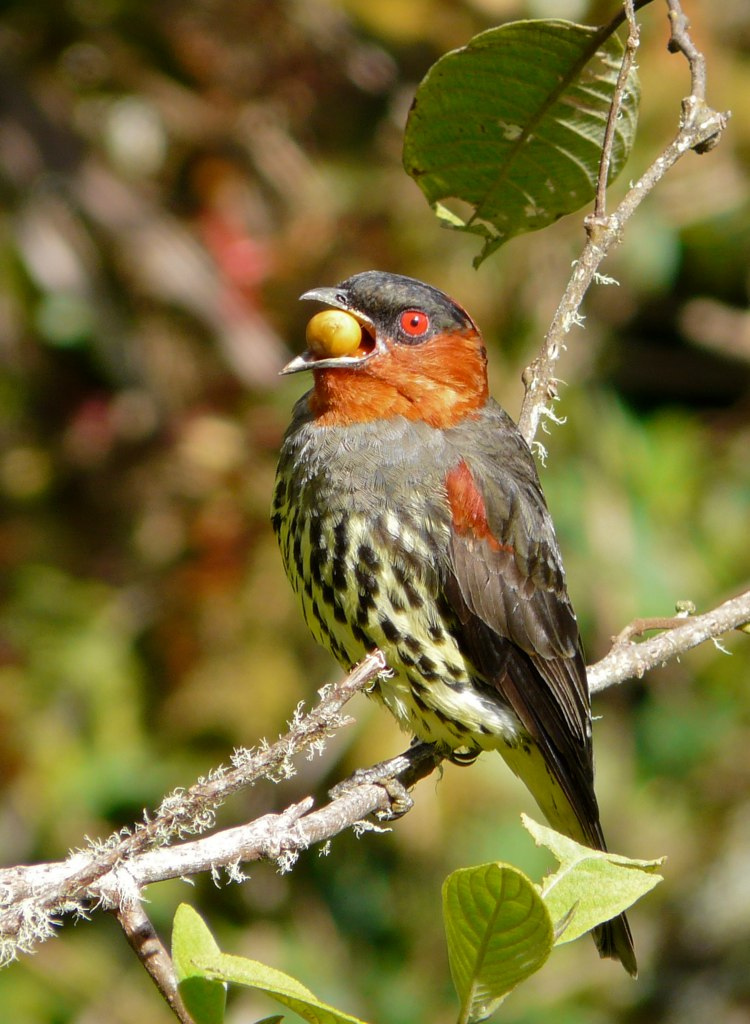
The Pompadour Cotinga is easily identifiable by its deep crimson plumage, which covers most of its body. Adult males exhibit this vibrant coloration, while females and juveniles are more subdued, displaying a brownish hue with subtle crimson highlights. This sexual dimorphism helps in distinguishing between genders, especially during the breeding season when color displays are crucial for mating rituals. The bird's medium size, about 19-21 centimeters in length, with a characteristic short tail and rounded wings, makes it distinct among the canopy dwellers. In flight, the Pompadour Cotinga showcases a slightly undulating flight pattern, with its short tail and rounded wings contributing to its agile maneuvering through dense foliage. When perched, it maintains an upright posture, often found on exposed branches where it can display its vibrant plumage to potential mates. Its crimson color can sometimes cause confusion with similar species like the Scarlet Tanager. However, the cotinga's habitat preferences and geographic range typically help birdwatchers correctly identify it. Unlike the Scarlet Tanager, which migrates to North America, the Pompadour Cotinga remains a steadfast resident of the Amazon basin, aiding identification through geographic context.
Having trouble telling birds apart? Upload a photo to our bird identification tool for an instant species match.
Pompadour Cotinga Habitat and Range
Preferred Habitat
The Pompadour Cotinga thrives in the dense, humid canopies of lowland tropical rainforests, particularly within the Amazon basin. It is predominantly found in Brazil, Venezuela, and the Guianas, where the lush environment provides ample food and nesting opportunities. This species favors primary forests, where tall trees offer vantage points for foraging and displaying its plumage. Unlike some forest birds, it does not migrate vertically to different elevations, remaining in the lowland areas, typically below 1,000 meters in elevation. Seasonal changes do not significantly affect its habitat choice, as the bird relies on the consistent food supply and shelter provided by the evergreen forest canopy. While the Pompadour Cotinga is not typically found in urban or suburban areas, its presence in contiguous forest patches is vital for maintaining healthy populations. Habitat connectivity is crucial for this species, as fragmented forests can hinder its movements and breeding success. Conservation of these habitats is essential for the survival of the Pompadour Cotinga, as well as the myriad other species that share its ecosystem.
Geographic Range
The Pompadour Cotinga inhabits a relatively restricted range within the neotropics, primarily in the Amazon basin. Its distribution spans across northern Brazil, the Guianas (including Guyana, Suriname, and French Guiana), and parts of southern Venezuela. Unlike many other bird species, the Pompadour Cotinga does not migrate seasonally but remains a year-round resident of these lush, tropical forests. This resident status indicates a reliance on the stable climatic conditions and continuous availability of resources in these regions. Although the bird's range does not extend far beyond the Amazon, within its habitat, it is not evenly distributed. The species tends to concentrate in areas where the forest canopy is dense and undisturbed, indicating a preference for pristine environments. Population densities are highest in regions where human disturbance is minimal, and the forest structure remains intact. This pattern underscores the importance of conservation efforts in protecting large swaths of continuous forest to ensure the Pompadour Cotinga's continued presence. While the bird does not typically occupy areas outside its established range, isolated sightings occasionally occur in adjacent forested regions, suggesting some level of dispersal ability within suitable habitats. However, these occurrences are not indicative of regular range expansion.
Want to know which birds visit your area? Browse our backyard birds by location guides for region-specific species lists.
What Does the Pompadour Cotinga Eat?
The diet of the Pompadour Cotinga consists primarily of fruits, making it a frugivore. This dietary preference aligns with its role as a vital seed disperser within its habitat. The bird favors a variety of fruits found in the rainforest canopy, often selecting those that are small to medium-sized. Its foraging technique involves perching on branches and making short flights to pluck fruits from trees, demonstrating a level of agility suited to its environment. Seasonal changes in fruit availability do affect its diet, though the Amazon basin's biodiversity ensures a continuous supply throughout the year. In addition to fruits, the Pompadour Cotinga occasionally supplements its diet with insects. This opportunistic feeding behavior provides additional nutrients, especially during periods when fruit is less abundant. By consuming insects, the cotinga also helps control pest populations, indirectly benefiting the forest ecosystem. The bird typically feeds during the early morning and late afternoon, taking advantage of cooler temperatures and less competition from other frugivores. Its feeding schedule aligns with the diurnal rhythms of the rainforest, allowing it to maximize energy intake while minimizing exposure to predators.
Pompadour Cotinga Behavior and Social Structure
The Pompadour Cotinga exhibits a range of behaviors that reflect its ecological role and adaptation to its environment. Socially, the bird is relatively solitary, often seen alone or in pairs rather than in large flocks. This behavior is typical among frugivores, where competition for food resources can be intense. During the breeding season, males become more territorial, engaging in elaborate courtship displays to attract females. These displays involve a combination of vocalizations and dynamic flight maneuvers designed to showcase their vibrant plumage. Territorial behavior ensures that males secure the best foraging and nesting sites, critical for reproductive success. Outside the breeding season, the Pompadour Cotinga's activities are less conspicuous, as the bird focuses on foraging and maintaining its territory. Its response to predators involves a combination of concealment and escape; the bird relies on its plumage to blend into the forest canopy and its agility to evade threats. During daily activities, the bird follows a predictable pattern, foraging during the early morning and late afternoon while resting during the hottest parts of the day. This schedule minimizes energy expenditure and reduces exposure to predators. The cotinga's solitary nature and territoriality underscore its adaptation to the competitive environment of the Amazon basin, where resource availability dictates social structure and behavior.
Pompadour Cotinga Nesting and Reproduction
Nesting for the Pompadour Cotinga involves selecting sites high in the forest canopy, where the birds construct shallow cup nests using twigs, leaves, and other plant materials. These nests are strategically positioned on sturdy branches, providing safety from ground predators and a good vantage point for monitoring the surrounding area. Clutch size typically ranges from one to two eggs, which the female incubates for about 16 to 18 days. During the incubation period, the male plays a supportive role, providing food for the female and maintaining territory defense. Once the eggs hatch, both parents participate in feeding the chicks, regurgitating a diet rich in fruits. The fledging period lasts approximately 25 to 30 days, after which the young birds leave the nest but remain dependent on their parents for several weeks. The Pompadour Cotinga usually raises one brood per year, although in optimal conditions, a second brood may occur. The nesting success of this species depends heavily on the availability of suitable nesting sites and abundant food sources, highlighting the importance of preserving old-growth forests.
Pompadour Cotinga Sounds and Vocalizations
The primary song of the Pompadour Cotinga is a series of melodious whistles, characterized by a rhythmic pattern that varies in pitch and tone. These vocalizations serve multiple purposes, from attracting mates to marking territory. The male's song is most prominent during the breeding season, often delivered from high perches to maximize its reach. Call notes are softer and used for communication between mates or signaling alarm. In response to threats, the bird emits a sharp, staccato call, alerting others to potential danger. During the dawn chorus, the Pompadour Cotinga's song contributes to the symphony of sounds that fill the rainforest, providing a natural backdrop unique to these biodiverse regions. The quality of its vocalizations can be compared to flutelike notes, resonant and clear, capable of carrying through the dense foliage. This ability to communicate effectively through sound is vital for maintaining social bonds and ensuring reproductive success.
Interesting Facts About the Pompadour Cotinga
- 1The Pompadour Cotinga's vibrant crimson color comes from carotenoid pigments found in its fruit-based diet.
- 2Unlike many birds, the Pompadour Cotinga does not migrate, remaining in the Amazon basin year-round.
- 3The bird's name 'Pompadour' refers to its flamboyant plumage, reminiscent of the hairstyle popularized in the 18th century.
- 4Pompadour Cotingas can be spotted up to 30 meters high in the canopy, showcasing their preference for elevated perches.
- 5Their role in seed dispersal helps maintain the plant diversity of the Amazon rainforest, crucial for ecosystem health.
- 6The species was first described by the renowned ornithologist Louis Jean Pierre Vieillot in 1817.
- 7Despite their striking appearance, Pompadour Cotingas can remain well-camouflaged among the vibrant hues of the rainforest.
Pompadour Cotinga Conservation Status
The Pompadour Cotinga is currently classified as Least Concern by the IUCN, indicating a stable population. However, the primary threat to its survival is habitat destruction due to deforestation in the Amazon basin. This loss of habitat poses significant risks, as the bird depends on large tracts of continuous forest for food, shelter, and breeding sites. Conservation efforts focus on preserving these critical habitats, with initiatives like protected areas and reforestation projects playing essential roles. Historically, the population of Pompadour Cotingas has fluctuated with changes in forest cover, underscoring the importance of sustainable land management practices. Encouragingly, awareness of the Amazon's ecological value is growing, and efforts to curb deforestation are being implemented. These conservation measures are vital for ensuring the long-term survival of the Pompadour Cotinga and the myriad other species that share its habitat.
Other Cotingidae Species



Birds Similar to the Pompadour Cotinga
These species are often confused with the Pompadour Cotinga due to similar appearance or overlapping range.

