
White-tailed Cotinga
Xipholena lamellipennis
Order: Passeriformes / Family: Cotingidae

Wikimedia Commons
About the White-tailed Cotinga
The White-tailed Cotinga, known scientifically as Xipholena lamellipennis, inhabits the lush rainforests of South America, primarily in the Amazon Basin. This species belongs to the family Cotingidae, a group known for their vibrant colors and intricate vocalizations. The bird's ecological role in these tropical ecosystems is significant, as it contributes to seed dispersal through its frugivorous diet. Found predominantly in Brazil, this cotinga thrives in undisturbed primary forests but can also adapt to secondary growth areas, provided they meet its habitat and dietary needs. Seasonal behaviors of the White-tailed Cotinga include subtle shifts in altitudinal distribution, which are often influenced by food availability. During the breeding season, which peaks in the rainy months, males perform elaborate courtship displays to attract females, showcasing their dazzling white tails. Cotingas play a crucial role in maintaining the health of their forest environments. By consuming various fruits, they help propagate plant species, thus ensuring biodiversity. The White-tailed Cotinga is particularly dependent on intact forest canopies, where it finds its primary food sources and nesting sites. As deforestation and habitat loss threaten these areas, the significance of the White-tailed Cotinga as an indicator species becomes increasingly apparent. Conservation efforts in regions like the Amazon are crucial, as they help preserve not only the cotinga but the myriad of species that share its habitat. Understanding the White-tailed Cotinga's ecological role and habitat requirements aids in developing effective conservation strategies, highlighting the interconnectedness of species within these diverse ecosystems.
The White-tailed Cotinga belongs to the family Cotingidae, within the order Passeriformes. These birds typically live average 7-9 years with a maximum recorded of 13 years..
How to Identify a White-tailed Cotinga
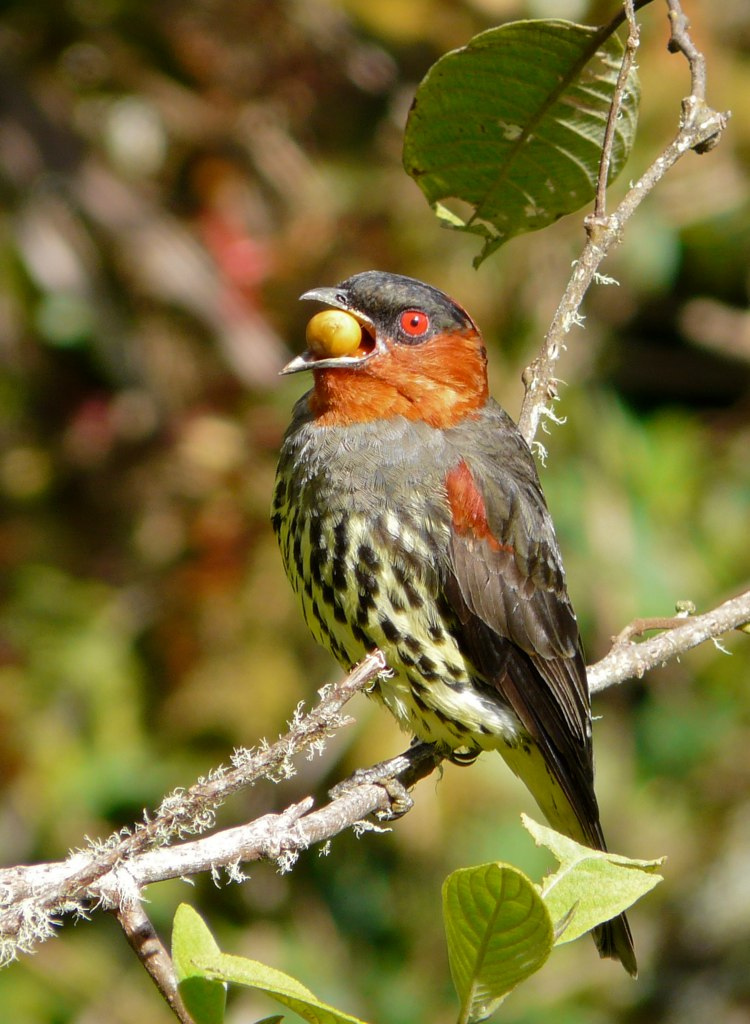
The adult White-tailed Cotinga is unmistakable with its dark plumage and strikingly white tail. Males display a deep purplish-black body with a bright white tail, which is especially visible during flight and courtship displays. Females are slightly less vibrant, with a muted grayish tone, yet they retain the signature white tail. Juvenile birds resemble females but with more subdued colors and a lack of the glossy sheen seen in mature males. This sexual dimorphism is typical among cotingas, aiding in mate selection. In terms of size, the White-tailed Cotinga is medium-sized, measuring about 20 to 25 centimeters in length. In flight, its wings appear broad and slightly rounded, contributing to a unique silhouette. While perched, the bird maintains an upright posture, often making it easier to spot against the dark green foliage of its habitat. Although similar species exist within the cotinga family, the combination of white tail and dark body helps distinguish it from others, such as the Pompadour Cotinga, which lacks the stark tail contrast.
Having trouble telling birds apart? Upload a photo to our bird identification tool for an instant species match.
White-tailed Cotinga Habitat and Range
Preferred Habitat
The White-tailed Cotinga primarily inhabits the dense, humid rainforests of the Amazon Basin. It prefers undisturbed primary forests but may also be found in well-preserved secondary forests. The bird thrives at elevations ranging from sea level up to about 1,000 meters, mainly within the lowland tropical forest zone. Seasonal habitat shifts are minimal since the species is not migratory, yet it might adjust its elevation slightly in response to food availability. While it is primarily a forest dweller, the White-tailed Cotinga rarely ventures into urban areas, as it relies heavily on the complex structure of mature forests for both feeding and breeding.
Geographic Range
The range of the White-tailed Cotinga is confined to the Amazon Basin in South America. Its presence is noted extensively within Brazil, with populations also found in eastern Peru and northern Bolivia. As a non-migratory species, it remains within this range year-round. Population densities are highest in regions where the forest canopy remains largely intact, such as the central Amazon and parts of the Brazilian states of Amazonas and Pará. The bird does not typically undertake long-distance migrations, instead opting for localized movements within its established range to exploit seasonal food resources.
Want to know which birds visit your area? Browse our backyard birds by location guides for region-specific species lists.
What Does the White-tailed Cotinga Eat?
The primary diet of the White-tailed Cotinga consists of a variety of fruits, which it forages from the mid to upper canopy layers of the forest. It shows a preference for small to medium-sized fruits, often from species of trees like figs and palms. The bird also occasionally consumes insects, providing a secondary food source that supplements its diet, particularly during breeding season when energy demands increase. Foraging behavior involves short flights from perch to perch, employing a sit-and-wait strategy. The cotinga's feeding schedule aligns with peak fruiting times, making it an integral part of the frugivorous community within its ecosystem.
White-tailed Cotinga Behavior and Social Structure
White-tailed Cotingas exhibit a solitary or loosely gregarious social structure outside of the breeding season. During courtship, males perform elaborate displays, utilizing their unique white tails to attract females. These displays occur prominently in clearings or at the forest edge, where visibility is optimal. Territorial behavior is moderate, with males maintaining small territories primarily for breeding purposes. Flocking patterns are not commonly observed, as the species tends to be more solitary in its habits. In response to predators, the White-tailed Cotinga relies on its cryptic coloration and the dense forest canopy for cover. Daily activity patterns are largely diurnal, with peak activities occurring in the early morning and late afternoon when they are most likely to be vocal and active.
White-tailed Cotinga Nesting and Reproduction
The White-tailed Cotinga constructs small, cup-shaped nests, often situated high in the forest canopy. Nests are typically made from twigs and lined with softer materials like leaves and feathers. Preferred nesting sites are in the forks of branches, providing stability and concealment. The typical clutch size ranges from one to two eggs. Incubation, primarily by the female, lasts approximately 18 to 20 days. Post-hatching, both parents participate in feeding and caring for the young. Fledging occurs about three weeks after hatching, with juveniles remaining dependent on their parents for a short period thereafter. The species generally raises one brood per year, with breeding timed to correspond with peak food availability.
White-tailed Cotinga Sounds and Vocalizations
The primary song of the White-tailed Cotinga is a series of melodious whistles, characterized by a clear, rising pitch and a smooth, flute-like quality. Calls are simpler, often consisting of short, sharp notes used in communication between individuals or as alarm calls. During the dawn chorus, their vocalizations can be heard resonating through the forest, contributing to the rich acoustic tapestry of the Amazon. In comparison to familiar sounds, the song is reminiscent of a distant flute, gentle yet distinct, allowing the bird to communicate effectively within its dense habitat.
Interesting Facts About the White-tailed Cotinga
- 1The White-tailed Cotinga's courtship displays are so elaborate that they can occupy entire mornings during the breeding season.
- 2Despite its striking appearance, the White-tailed Cotinga often remains hidden in the dense canopy, making it a challenge to spot.
- 3This cotinga species plays a significant role in seed dispersal, helping to maintain the biodiversity of the Amazon rainforest.
- 4The name 'cotinga' is derived from the Tupi language, meaning a bird with a loud voice, reflecting their vocal nature.
- 5The White-tailed Cotinga's tail feathers are not only visually striking but also play a role in its balance during agile flights.
White-tailed Cotinga Conservation Status
The White-tailed Cotinga is currently listed as Least Concern by the IUCN, though its population is suspected to be declining due to habitat loss. Deforestation, particularly in the Amazon Basin, poses the greatest threat to its survival. Conservation efforts focus on habitat preservation and the protection of large forested areas to prevent further decline. Historical population changes have been closely tied to the extent of forest cover, highlighting the need for sustainable land management practices. Continued monitoring and research are essential to ensure the long-term viability of this species.
Other Cotingidae Species



Birds Similar to the White-tailed Cotinga
These species are often confused with the White-tailed Cotinga due to similar appearance or overlapping range.

