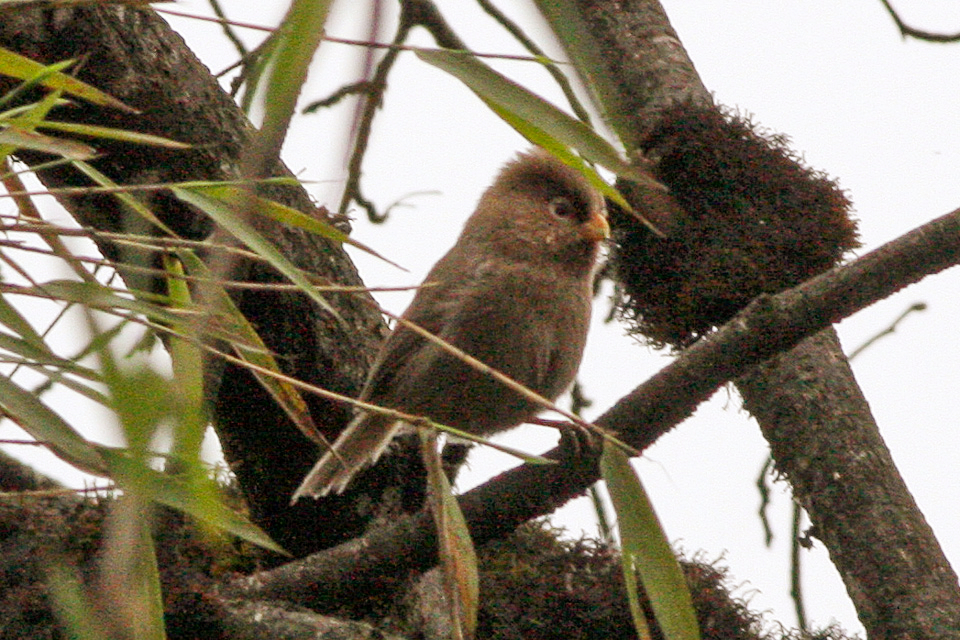
Pseudoalcippe abyssinica
Pseudoalcippe abyssinica
Order: Passeriformes / Family: Sylviidae

Wikimedia Commons
About the Pseudoalcippe abyssinica
The Pseudoalcippe abyssinica, commonly referred to as the Abyssinian illadopsis, is a small bird species belonging to the family Sylviidae. This species is predominantly found in the dense forested regions of East Africa, particularly thriving in the undergrowth of montane and lowland forests. The Abyssinian illadopsis plays a crucial role in its ecosystem by participating in insect control and seed dispersal, facilitating forest health. Its presence is significant across regions such as Ethiopia, Eritrea, and parts of Kenya and Uganda, where it contributes to the rich avian biodiversity.
The bird's ecological role extends beyond its feeding habits. By preying on insects and small invertebrates, the Abyssinian illadopsis helps manage pest populations, thus maintaining a balanced ecosystem. It also aids in seed dispersal, contributing to the regeneration of forested areas. During the breeding season, typically between March and June, the bird becomes more active, displaying territorial behavior and engaging in courtship activities to attract mates.
The Abyssinian illadopsis is adapted to a range of habitats but shows a preference for forested areas with thick undergrowth. It is particularly common in areas where human disturbance is minimal, allowing it to maintain its ecological niche. The bird is often observed foraging in the leaf litter, where it searches for food while remaining well-camouflaged. As a resident species, it does not undertake long migrations, although it may move locally in response to environmental conditions such as food availability and habitat quality.
Seasonal behaviors of the Pseudoalcippe abyssinica are largely influenced by climatic conditions. During the dry season, the bird might be found in slightly more open areas, taking advantage of the available resources. In the wet season, it retreats deeper into the forest, where the abundance of food supports its breeding activities. The Abyssinian illadopsis is an integral part of the forest ecosystem, and its presence indicates a healthy, functioning environment.
The Pseudoalcippe abyssinica belongs to the family Sylviidae, within the order Passeriformes. These birds typically live estimated 6-8 years, though exact data is scarce..
How to Identify a Pseudoalcippe abyssinica
The Abyssinian illadopsis, Pseudoalcippe abyssinica, is characterized by its olive-brown plumage, which offers excellent camouflage in its forest habitat. The bird typically measures around 14-15 cm in length, making it a small yet conspicuous presence for those familiar with its features. Its plumage varies slightly between adults and juveniles, with juveniles sporting a duller appearance.
A key identification feature of the Abyssinian illadopsis is its pale eye-ring, which contrasts subtly with the darker hues of its head and back. The bird's underparts tend to be lighter, often displaying a grayish tone. Both males and females exhibit similar plumage, although slight variations in size may occur, with males being marginally larger.
In flight, the Abyssinian illadopsis maintains a low, darting trajectory, which is typical of many forest-dwelling birds. Its perching posture is often upright, and it frequently engages in short, hopping movements while foraging. Potential confusion with similar species, such as the Brown Illadopsis, can be resolved by paying attention to specific field marks like the distinct vocalizations and habitat preferences unique to Pseudoalcippe abyssinica.
Having trouble telling birds apart? Upload a photo to our bird identification tool for an instant species match.
Pseudoalcippe abyssinica Habitat and Range
Preferred Habitat
The Pseudoalcippe abyssinica thrives in dense forest habitats, primarily within the undergrowth where it forages and breeds. It is commonly found in montane and lowland forests across East Africa, including regions in Ethiopia, Eritrea, Kenya, and Uganda. This bird prefers areas with thick vegetation that provides ample cover and food resources.
The Abyssinian illadopsis inhabits elevations ranging from lowland forests at sea level up to montane forests at around 3,000 meters. Although primarily a forest species, it may occasionally venture into scrubby areas or forest edges, especially during the dry season when food becomes scarce.
Seasonal habitat shifts are minimal, as the Abyssinian illadopsis is a resident species. However, local movements within its range may occur in response to changes in food availability and climatic conditions. It is less frequently observed in urban areas, preferring the tranquility and resources offered by rural and forested environments.
Geographic Range
The breeding range of the Pseudoalcippe abyssinica is predominantly located in East Africa. Countries such as Ethiopia and Eritrea host significant populations, with the bird also found in parts of Kenya and Uganda. Its presence is most concentrated in forested regions where suitable habitat conditions prevail.
Unlike many migratory species, the Abyssinian illadopsis is a year-round resident within its range. It does not undertake long-distance migrations but may engage in minor local movements as it adjusts to seasonal changes in food availability and habitat quality.
Population density hotspots for the Abyssinian illadopsis are often associated with well-preserved forest areas where human disturbance is minimal. The bird is relatively common in suitable habitats, although it may be difficult to spot due to its secretive nature and effective camouflage within the dense undergrowth.
Want to know which birds visit your area? Browse our backyard birds by location guides for region-specific species lists.
What Does the Pseudoalcippe abyssinica Eat?
The diet of the Abyssinian illadopsis primarily consists of insects and small invertebrates, which it forages from the leaf litter and low vegetation. This diet plays a vital role in controlling pest populations within its forest habitat. The bird employs a methodical foraging technique, often seen hopping on the forest floor as it searches for prey.
During the breeding season, the bird's diet may expand to include small fruits and seeds, supplementing its nutritional intake. Seasonal changes can influence its feeding habits, with the dry season prompting a shift to available alternative food sources.
The Abyssinian illadopsis typically feeds during daylight hours, with peak activity occurring in the early morning and late afternoon. This schedule allows it to take advantage of insect activity patterns while avoiding the heat of midday. The bird's foraging strategy involves using its bill to probe and flip through leaf litter, ensuring a diverse intake of prey items.
Pseudoalcippe abyssinica Behavior and Social Structure
The Pseudoalcippe abyssinica exhibits a range of behaviors that reflect its adaptation to forest life. It is generally a solitary or pair-living bird, though small family groups can form, especially during the breeding season. The bird is territorial, often engaging in vocalizations to defend its space from intruders.
During courtship, the Abyssinian illadopsis may perform displays that include wing and tail movements combined with vocal exchanges. These displays serve to strengthen pair bonds and ensure successful mating. Once paired, the birds work cooperatively to build nests and rear offspring.
In response to predators, the bird relies on its camouflage and the dense forest cover to remain undetected. It may emit alarm calls to alert others of potential threats. Daily activity patterns include periods of intense foraging interspersed with rest and preening, maintaining its plumage in excellent condition for both insulation and flight.
Pseudoalcippe abyssinica Nesting and Reproduction
Nesting for the Abyssinian illadopsis involves constructing a cup-shaped nest made from materials such as twigs, leaves, and grass. The nest is typically located low in the undergrowth, providing concealment from predators and environmental elements.
A typical clutch consists of 2-3 eggs, with the incubation period lasting approximately 12-14 days. Both parents participate in incubation, taking turns tending to the eggs while the other forages for food. After hatching, the chicks remain in the nest for about two weeks, during which both parents are actively involved in feeding and caring for them.
The Abyssinian illadopsis may produce one or two broods per year, depending on environmental conditions and food availability. Parental roles are shared, though females may take a more prominent role in incubation, while males contribute significantly to feeding the young.
Pseudoalcippe abyssinica Sounds and Vocalizations
The primary song of the Abyssinian illadopsis is a melodious series of notes, characterized by a rhythmic pattern with a clear, whistling quality. These songs serve to establish territory and attract mates during the breeding season.
Call notes are typically short and sharp, serving as communication between mates or family members. In the presence of threats, the bird may emit alarm calls, which are harsher in tone to alert others of potential danger.
During the dawn chorus, the Abyssinian illadopsis actively participates, its song contributing to the rich tapestry of forest sounds. The bird's vocalizations are reminiscent of other members of the Sylviidae family, yet distinct enough to be identified by experienced birdwatchers.
Interesting Facts About the Pseudoalcippe abyssinica
- 1The Abyssinian illadopsis was previously classified in the genus Illadopsis but has since been reclassified to reflect its distinct traits.
- 2Despite its small size, the Abyssinian illadopsis plays a significant ecological role, particularly in insect population control.
- 3The bird's olive-brown plumage provides excellent camouflage, making it difficult to spot in its dense forest habitat.
- 4Its song, though melodious, is often overshadowed by the calls of more boisterous forest birds, requiring keen listening to discern.
- 5The Abyssinian illadopsis is a master of stealth, often remaining undetected by staying close to the forest floor and using its plumage to blend in.
- 6During the breeding season, the bird's vocal activity increases, serving as a key indicator for birdwatchers seeking to observe its behavior.
- 7While largely a forest bird, it can occasionally be spotted at forest edges, adapting to slight habitat variations when necessary.
Pseudoalcippe abyssinica Conservation Status
The Abyssinian illadopsis is currently listed as a species of Least Concern by the IUCN, with stable population trends across its range. However, habitat loss due to deforestation and human encroachment poses a potential threat to its long-term survival. Conservation efforts focus on preserving forest habitats and promoting sustainable land use practices. Protected areas within its range, such as national parks and reserves, play a crucial role in safeguarding the bird's habitat. Historically, the population of the Abyssinian illadopsis has remained relatively stable, but ongoing monitoring is essential to ensure early detection of any negative trends. Community engagement and education are also vital components of conservation strategies, fostering awareness and support for habitat conservation.