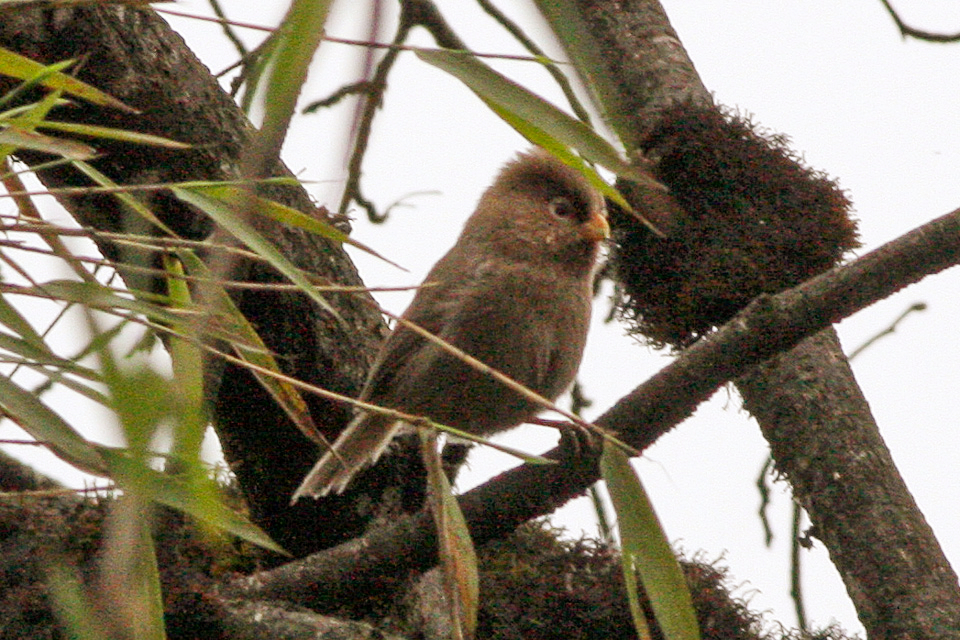
Black-headed Pseudoalcippe
Pseudoalcippe atriceps
Order: Passeriformes / Family: Sylviidae

Wikimedia Commons
About the Black-headed Pseudoalcippe
The Black-headed Pseudoalcippe (Pseudoalcippe atriceps) is a small passerine bird belonging to the Sylviidae family. This bird is notable for its striking black head, which contrasts sharply with its olive-brown body and pale underparts. Found predominantly in Southeast Asia, it inhabits countries such as Thailand, Laos, Vietnam, and parts of southern China. Its preferred ecosystem is the dense, subtropical forests where it finds ample cover and food resources. This bird's presence signifies a healthy forest ecosystem, as it contributes to insect population control and seed dispersal.
The Black-headed Pseudoalcippe plays a crucial role in maintaining the ecological balance within its habitat. It feeds on a variety of insects, which helps control potential pest populations. During the breeding season, it becomes an essential part of the forest's food web. The bird's nesting behavior, involving the use of local materials, also supports the recycling of natural resources. Furthermore, the Black-headed Pseudoalcippe is a bioindicator species; its presence or absence can indicate changes in the environmental health of its habitat.
In terms of behavior, this species is known for its adaptability to seasonal changes. During the wet season, when food is plentiful, the Black-headed Pseudoalcippe tends to be more active and vocal, participating in social flocks that forage together. In contrast, the dry season sees a reduction in vocal activity and a slight shift in dietary habits as it adapts to the changing availability of food. This species' ability to adjust its behavior and diet according to seasonal variations underscores its resilience and importance to the ecosystems it inhabits.
The Black-headed Pseudoalcippe belongs to the family Sylviidae, within the order Passeriformes. These birds typically live 5-7 years with a maximum recorded of 9 years.
How to Identify a Black-headed Pseudoalcippe
The Black-headed Pseudoalcippe is distinguished by its black cap, which extends from the forehead to the nape, giving it a unique and unmistakable appearance. The rest of its plumage is primarily olive-brown, offering excellent camouflage among the dense foliage of its forest habitat. Adult birds have a subtle wash of pale cream on their underparts, providing a gentle contrast to the darker upperparts. Juveniles lack the sharp black cap, instead displaying a more muted brown head, which gradually darkens as they mature.
Differences between males and females are minimal, making it challenging to distinguish between the sexes in the field. However, males may exhibit slightly brighter plumage during the breeding season, likely an adaptation to attract mates. When comparing the Black-headed Pseudoalcippe to similar species, such as other Pseudoalcippe members or closely related genera, its distinctive black head and the absence of wing bars help avoid confusion.
In flight, the Black-headed Pseudoalcippe presents a swift, undulating silhouette, typical of small passerines. Its wings are short and rounded, facilitating agile maneuvering through forested environments. When perching, this bird often adopts a horizontal posture, allowing it to blend seamlessly into its surroundings. This posture, combined with its coloration, makes the Black-headed Pseudoalcippe a challenge to spot when stationary.
Having trouble telling birds apart? Upload a photo to our bird identification tool for an instant species match.
Black-headed Pseudoalcippe Habitat and Range
Preferred Habitat
The Black-headed Pseudoalcippe thrives in subtropical and tropical moist lowland forests, as well as montane forests. It is most commonly found at elevations ranging from 500 to 2,000 meters, where the dense canopy provides ideal conditions for foraging and nesting. These birds favor forests with a rich understory, which offers both food and protection from predators.
In terms of habitat preference, the Black-headed Pseudoalcippe does not typically inhabit urban areas, maintaining a strong preference for undisturbed forest environments. However, it may occasionally venture into secondary growth forests or degraded habitats if primary forests are unavailable. During certain seasons, such as the rainy season, these birds may move to higher elevations in search of abundant food resources.
Despite their strong association with forest habitats, Black-headed Pseudoalcippes demonstrate some adaptability; they can survive in fragmented landscapes provided there is sufficient tree cover and food supply. Their presence in these areas highlights the importance of forest conservation and the need to maintain connectivity between forest patches for species survival.
Geographic Range
The Black-headed Pseudoalcippe's range is primarily confined to the subtropical forests of Southeast Asia. It is found in countries including Thailand, Vietnam, Laos, and parts of southern China, particularly in regions such as Yunnan and Guangxi. Within these areas, the bird is considered relatively common, with certain local populations exhibiting higher densities due to optimal habitat conditions.
During the breeding season, the birds may concentrate in areas with abundant food and nesting sites, often at mid-elevations where forest density is greatest. In contrast, the non-breeding season may see some local movements within its range, although the species is generally non-migratory, maintaining year-round territories.
While the Black-headed Pseudoalcippe does not undertake long-distance migrations, it may exhibit altitudinal movements, particularly in response to seasonal changes in weather and food availability. These movements are typically short-range, within the bird's established home range, and do not extend beyond its typical geographic distribution. Conservation efforts focusing on habitat protection in these key regions are crucial for sustaining the bird's populations.
Want to know which birds visit your area? Browse our backyard birds by location guides for region-specific species lists.
What Does the Black-headed Pseudoalcippe Eat?
The diet of the Black-headed Pseudoalcippe primarily consists of insects and other small invertebrates, making it an important predator in its ecosystem. It targets a variety of prey, including beetles, caterpillars, spiders, and ants, which it gleans from leaves and branches. During the breeding season, the bird's diet becomes even more insect-centric, providing the necessary protein for growing chicks.
In addition to its insectivorous habits, the Black-headed Pseudoalcippe occasionally consumes seeds and small fruits, particularly during the dry season when insect abundance may decline. This dietary flexibility allows the bird to adapt to seasonal variations in food availability, ensuring its survival throughout the year.
Foraging typically occurs in the mid to upper levels of the forest canopy, where the bird exhibits acrobatic skills to capture prey. It often forages in small mixed-species flocks, taking advantage of the increased efficiency and reduced risk of predation that such groups provide. Feeding activity peaks during the early morning and late afternoon, coinciding with periods of higher insect activity.
Black-headed Pseudoalcippe Behavior and Social Structure
The Black-headed Pseudoalcippe displays a range of intriguing behaviors that reflect its adaptability and social nature. Typically, these birds are seen foraging in small family groups or mixed-species flocks, particularly outside the breeding season. This social structure provides enhanced foraging success and protection against predators.
During the breeding season, which generally occurs in the warmer months, the Black-headed Pseudoalcippe becomes more territorial. Males establish territories through song and display, often engaging in aerial chases to ward off intruders. Courtship involves both visual displays and vocalizations, with males performing a series of hops and wing flutters to attract females.
The bird's response to predators includes a variety of alarm calls and evasive maneuvers. When sensing danger, the Black-headed Pseudoalcippe will emit sharp, rapid calls to alert other members of its group. It may also employ sudden, rapid flights into dense foliage to evade capture. Daily activity patterns are diurnal, with peak activity occurring during cooler parts of the day when insects are most active.
Black-headed Pseudoalcippe Nesting and Reproduction
The Black-headed Pseudoalcippe constructs a cup-shaped nest using twigs, leaves, and grass, often lining the interior with softer materials such as moss or feathers. These nests are typically situated in the fork of a small tree or shrub, ranging from 1 to 5 meters above ground, providing a balance between security and accessibility.
Clutch size generally consists of 2 to 4 eggs, which are pale with subtle speckling. Both parents share in the incubation duties, which last approximately 12 to 14 days. After hatching, the chicks are altricial, requiring extensive care and feeding by both parents.
Fledging occurs about 14 to 16 days post-hatching, although young birds remain dependent on their parents for several weeks after leaving the nest. The Black-headed Pseudoalcippe usually raises one brood per year, although favorable conditions may occasionally allow for a second. Parental roles are shared, with both male and female contributing to feeding and protection of the young.
Black-headed Pseudoalcippe Sounds and Vocalizations
The Black-headed Pseudoalcippe's primary song is a series of melodious whistles and trills, with a rhythm that alternates between slow, drawn-out notes and rapid sequences. This song, which serves both territorial and mating purposes, is heard most frequently during the breeding season.
Call notes are typically short and sharp, functioning as contact calls between group members or as alarms. When a predator is detected, the bird emits a rapid, high-pitched series of notes, alerting nearby conspecifics of the danger.
During the dawn chorus, the Black-headed Pseudoalcippe becomes particularly vocal, joining other forest residents in a symphony of sound that serves to reinforce territory boundaries and social bonds. The bird's song and calls, while distinctive, can be confused with other sylviid species, requiring careful listening to differentiate.
Interesting Facts About the Black-headed Pseudoalcippe
- 1The Black-headed Pseudoalcippe's distinctive black cap helps differentiate it from similar species in its habitat.
- 2This bird is often seen in mixed-species flocks, which can include up to 10 different bird species.
- 3The Black-headed Pseudoalcippe's diet shifts seasonally, showcasing its adaptability to environmental changes.
- 4Despite its non-migratory nature, the Black-headed Pseudoalcippe exhibits altitudinal movements during seasonal changes.
- 5Its melodious song plays a crucial role in territory establishment and mate attraction during the breeding season.
- 6The species is a bioindicator, providing insight into forest ecosystem health and integrity.
- 7Nesting in dense undergrowth, the Black-headed Pseudoalcippe effectively conceals its nest from predators.
Black-headed Pseudoalcippe Conservation Status
According to the IUCN Red List, the Black-headed Pseudoalcippe is currently classified as Least Concern, with stable population trends throughout its range. However, habitat loss due to deforestation and land conversion poses a significant threat to its long-term survival. Conservation efforts focus on preserving the bird's natural habitats through the establishment of protected areas and sustainable forest management practices. Historical records indicate stable populations, but ongoing monitoring is necessary to detect any potential declines. Primary threats include logging, agricultural expansion, and infrastructure development, which fragment habitats and reduce available resources. Supporting local conservation initiatives and raising awareness about the importance of forest ecosystems are vital steps in ensuring the continued survival of the Black-headed Pseudoalcippe.