
Radde's Warbler
Phylloscopus schwarzi
Order: Passeriformes / Family: Phylloscopidae

Wikimedia Commons
About the Radde's Warbler
Radde's Warbler, known scientifically as Phylloscopus schwarzi, is a small passerine bird that belongs to the family Phylloscopidae. This species is particularly intriguing to ornithologists and birders alike due to its subtle yet distinct identification marks and its extensive migratory patterns. Native to regions of northeastern Asia, Radde's Warbler is primarily found in dense, scrubby habitats that provide ample cover and foraging opportunities. During the breeding season, which occurs from May to July, these birds primarily inhabit areas of the southern Siberian taiga, stretching from the Ural Mountains to the Russian Far East. In these regions, Radde's Warbler plays a pivotal role in controlling insect populations, consuming a variety of invertebrates and thus maintaining ecological balance. As autumn approaches, Radde's Warbler embarks on an impressive migratory journey, covering thousands of kilometers to reach its wintering grounds in Southeast Asia. Countries such as Thailand, Laos, and Vietnam become temporary homes for these warblers during the colder months. This migration is a critical period for the species, as it requires precise timing and energy reserves to successfully navigate long distances and variable weather conditions. The seasonal behavior of Radde's Warbler is not merely a survival mechanism but also an integral part of its lifecycle, influencing breeding success and population dynamics. The species' reliance on specific habitats during different times of the year underscores the importance of habitat conservation in both breeding and wintering areas. As a migratory species, Radde's Warbler also serves as an indicator of environmental changes across vast geographic ranges. Shifts in its migratory patterns or population numbers could reflect broader ecological shifts, making it a species of interest for conservationists and ecologists. The presence of Radde's Warbler in various ecosystems highlights its adaptability and the interconnectedness of global habitats, emphasizing the need for international cooperation in preserving migratory bird species.
The Radde's Warbler belongs to the family Phylloscopidae, within the order Passeriformes. These birds typically live typically around 5 years, with some living up to 8 years in the wild..
How to Identify a Radde's Warbler
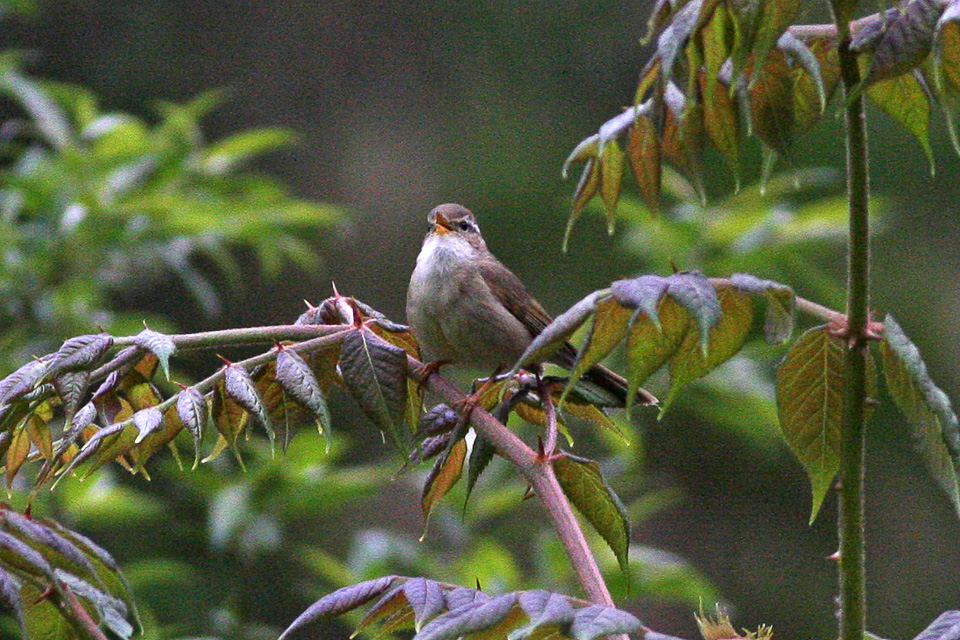
Radde's Warbler is a small songbird, measuring approximately 13 centimeters in length with a wingspan ranging from 18 to 21 centimeters. One of its most distinctive features is the yellowish-buff underparts that contrast with its olive-brown upperparts. The bird's face is marked by a prominent pale supercilium, or eyebrow stripe, which stands out against its darker crown. Its teardrop-shaped eye-ring further aids in identification, especially when viewed up close. Juvenile Radde's Warblers resemble adults but may have a slightly duller plumage, lacking the sharpness of the adult's markings. Male and female Radde's Warblers are similar in appearance, making it difficult to distinguish between the sexes in the field. When perched, the bird holds its body horizontally, often flicking its wings and tail in a characteristic manner. In flight, Radde's Warbler presents a compact silhouette with rapid wingbeats. Its flight is typically short and low, as it moves between shrubs and low branches. Confusion with similar species such as the Dusky Warbler can occur, but Radde's Warbler's larger size and distinctive coloration serve as key differentiators.
Having trouble telling birds apart? Upload a photo to our bird identification tool for an instant species match.
Radde's Warbler Habitat and Range
Preferred Habitat
Radde's Warbler inhabits dense, scrubby areas and is often associated with the undergrowth of deciduous and mixed forests. During the breeding season, it favors the southern Siberian taiga, where it finds ample cover and insect prey. These habitats typically occur at elevations ranging from lowland areas up to 1,500 meters. In winter, Radde's Warbler migrates to Southeast Asia, where it occupies similar shrubby habitats in countries like Thailand and Vietnam. Here, it can be found in both rural and semi-urban settings, provided there is sufficient vegetation. Seasonal shifts in habitat preference are primarily driven by food availability and climate, with the bird seeking out warmer regions during the non-breeding season.
Geographic Range
Radde's Warbler breeds across a wide range in northeastern Asia, from the Ural Mountains eastward to the Russian Far East. During the non-breeding season, it migrates to Southeast Asia, with wintering populations observed in countries such as Thailand, Laos, and Vietnam. The species follows well-established migratory corridors, utilizing stopover sites in China and Korea to rest and refuel. Population densities are generally higher in the core breeding areas of southern Siberia, where suitable habitat is abundant. In wintering areas, Radde's Warbler is more dispersed, but can still be regularly observed in suitable scrubby habitats.
Want to know which birds visit your area? Browse our backyard birds by location guides for region-specific species lists.
What Does the Radde's Warbler Eat?
The diet of Radde's Warbler consists primarily of insects and other small invertebrates. During the breeding season, it feeds extensively on caterpillars, beetles, and spiders, which are abundant in its taiga habitat. Its foraging technique involves gleaning prey from leaves and branches, often using a combination of visual and auditory cues to locate food. In winter, the bird's diet shifts slightly to include a higher proportion of ants and larvae, reflecting the available prey in its Southeast Asian habitats. Radde's Warbler typically forages alone, moving methodically through vegetation to capture prey items. The bird is most active in early morning and late afternoon, taking advantage of cooler temperatures and peak insect activity.
Radde's Warbler Behavior and Social Structure
Radde's Warbler exhibits a range of behaviors that are typical of small passerines. It is generally solitary outside of the breeding season, though it may form loose associations with other warblers during migration and winter. Territorial during the breeding season, males establish and defend territories through song and displays. Courtship involves a combination of vocalizations and physical displays, with males often chasing females through dense vegetation. In response to predators, Radde's Warbler employs a variety of alarm calls and may engage in distraction displays to draw attention away from nests. Daily activity patterns include periods of intense foraging interspersed with rest and preening. The species is predominantly active during daylight hours, with peak activity occurring in the early morning and late afternoon.
Radde's Warbler Nesting and Reproduction
Radde's Warbler constructs its nest close to the ground, often within dense undergrowth or low shrubs. The nest is a compact cup made from grass, leaves, and moss, lined with finer materials such as feathers and hair. Clutch size typically ranges from 4 to 6 eggs, which are incubated by the female for around 12 to 14 days. Both parents share in feeding and caring for the young, which fledge approximately 10 to 12 days after hatching. Radde's Warbler usually raises one brood per year, though in some cases, a second brood may be attempted if conditions are favorable.
Radde's Warbler Sounds and Vocalizations
Radde's Warbler is known for its distinctive song, which consists of a series of rapid, buzzy notes interspersed with clearer whistles. The rhythm is steady and methodical, often described as a 'chick-chick-chick-weet' sequence. Call notes are sharp and metallic, used primarily for communication between individuals. Alarm calls are harsher and more insistent, serving to warn of potential threats. During the breeding season, the male's song is a prominent feature of the dawn chorus, with individuals often singing from concealed perches within dense vegetation.
Interesting Facts About the Radde's Warbler
- 1Radde's Warbler was named after the German naturalist Gustav Radde, who contributed significantly to Siberian ornithology.
- 2Despite being a small bird, Radde's Warbler undertakes a remarkable migration covering over 5,000 kilometers annually.
- 3The bird's song, though not complex, is a crucial tool for territory establishment and mate attraction during the breeding season.
- 4Radde's Warbler's eye-ring and supercilium make it stand out among similar Phylloscopus species, aiding in field identification.
- 5Studies suggest that Radde's Warbler can adjust its migratory timing in response to climate changes, demonstrating adaptability.
- 6In its wintering grounds, Radde's Warbler often shares habitats with other migratory warblers, forming mixed-species flocks.
- 7The bird's preference for dense undergrowth makes it a challenge to observe, often detected more by sound than sight.
Radde's Warbler Conservation Status
Radde's Warbler is currently classified as Least Concern by the IUCN, with stable population trends. However, habitat loss due to deforestation and land conversion poses a potential threat, particularly in its breeding and wintering areas. Conservation efforts focus on preserving key habitats and monitoring population trends to ensure long-term viability. Historically, the species has maintained stable numbers, but ongoing environmental changes could impact its future distribution and abundance.
Other Phylloscopidae Species



Birds Similar to the Radde's Warbler
These species are often confused with the Radde's Warbler due to similar appearance or overlapping range.

