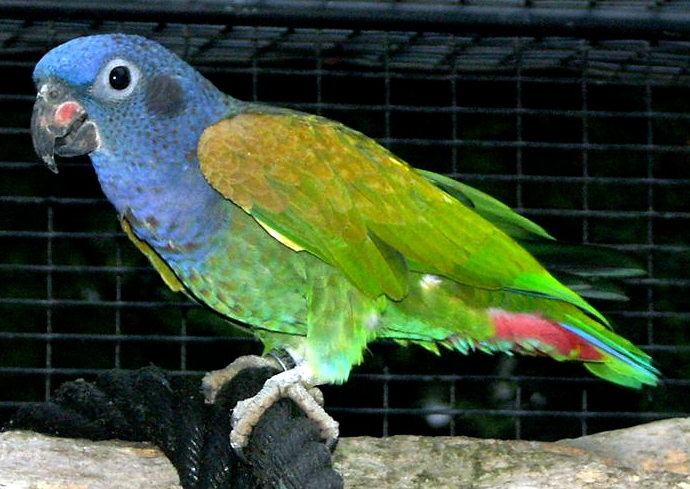
Red-billed Parrot
Pionus sordidus
Order: Psittaciformes / Family: Psittacidae

Wikimedia Commons
About the Red-billed Parrot
The Red-billed Parrot, scientifically known as Pionus sordidus, is a striking member of the Psittacidae family, well recognized by its vibrant red bill. This species is native to the tropical and subtropical regions of South America, with a range that includes countries such as Colombia, Venezuela, Ecuador, Peru, and Bolivia. The Red-billed Parrot plays a vital role in its ecosystem, acting as both a seed disperser and a pollinator. Found primarily in humid montane forests, these parrots are adept at exploiting a variety of forest types, from lowland rainforests to cloud forests at elevations reaching 3,000 meters.
The ecological significance of the Red-billed Parrot is substantial, as it contributes to the health and regeneration of forests through its foraging activities. By consuming a wide array of fruits and seeds, the parrot aids in seed dispersal, promoting plant diversity and forest resilience. This role is particularly crucial in areas where deforestation threatens biodiversity. Furthermore, the parrot’s interactions with flowering plants facilitate pollination, supporting the reproductive success of various flora.
Beyond its ecological contributions, the Red-billed Parrot holds cultural and economic importance in several regions. Its vibrant plumage and charismatic behavior make it a popular subject in ecotourism, drawing birdwatchers and nature enthusiasts to its habitats. However, this popularity also poses challenges, as the demand for the pet trade has historically impacted wild populations. Conservation efforts and habitat protection are essential to ensure the longevity of this species, which also serves as an environmental indicator, reflecting the health of its forest ecosystems.
Seasonal behaviors of the Red-billed Parrot include altitudinal migrations in response to fruit availability. During breeding periods, pairs become more territorial, often occupying the same breeding sites year after year. In contrast, non-breeding times see the formation of larger flocks, which roam the canopy in search of food resources. These seasonal movements highlight the species' adaptability to varying environmental conditions, although habitat fragmentation and climate change pose ongoing threats.
The Red-billed Parrot belongs to the family Psittacidae, within the order Psittaciformes. These birds typically live 15-25 years.
How to Identify a Red-billed Parrot
The Red-billed Parrot exhibits a predominantly green plumage, which serves as effective camouflage against the verdant forest backdrop. Its most distinguishing feature is the bright red bill, which contrasts sharply with its feathers. Adults possess a subtle blue tinge on the chest and underparts, a characteristic that becomes more prominent in good lighting. Juvenile Red-billed Parrots are similar in appearance but can be identified by their duller coloration and the absence of the full red bill, which develops with maturity.
Male and female Red-billed Parrots appear similar, with no significant sexual dimorphism in plumage. However, slight size differences may be noticeable upon closer observation, with males typically being marginally larger. In flight, the parrot's broad wings and short tail create a distinctive silhouette, while its flight is characterized by strong, rapid wingbeats interspersed with short glides.
Confusion with similar species, such as other Pionus parrots, can occur. However, the red bill is a key field mark that sets Pionus sordidus apart from its congeners, which generally lack this feature. When perched, the parrot often adopts an upright posture, allowing observers to note its robust build and rounded head, further aiding in identification.
Having trouble telling birds apart? Upload a photo to our bird identification tool for an instant species match.
Red-billed Parrot Habitat and Range
Preferred Habitat
The Red-billed Parrot inhabits a variety of forested environments, with a preference for humid montane forests. It is commonly found in cloud forests, where mist and moisture create ideal conditions for its diverse diet. These parrots also occupy lowland rainforests, particularly in areas that provide a rich abundance of food resources.
The species demonstrates adaptability in its elevation range, thriving from sea level up to altitudes of 3,000 meters. In montane regions, the parrot may migrate vertically in response to seasonal shifts in fruiting patterns. While it primarily resides in forest interiors, the Red-billed Parrot occasionally ventures into forest edges and clearings, where flowering and fruiting trees attract them.
Urban presence of the Red-billed Parrot is limited, as it generally avoids highly developed areas. However, the species can sometimes be observed near rural agricultural lands, where remnants of natural vegetation provide refuge and feeding opportunities. The conservation of forested habitats remains critical for its survival, as deforestation and habitat degradation pose significant threats.
Geographic Range
The Red-billed Parrot's range spans much of northern and western South America. It is a resident species in Colombia, where it inhabits both the eastern and western slopes of the Andes. In Venezuela, it is found predominantly in the northern mountain ranges, while Ecuador hosts populations in both the Andean and Amazonian regions.
In Peru, the Red-billed Parrot resides in the eastern Andean slopes, extending into the lowland forests of the Amazon Basin. To the south, its range reaches northern Bolivia, where suitable montane habitats support its populations. Unlike many migratory birds, the Red-billed Parrot does not undertake long-distance migrations. Instead, it exhibits altitudinal movements within its home range, shifting elevations in response to food availability.
Population densities vary, with hotspots typically occurring in areas of intact forest where food sources are plentiful. Fragmented landscapes can result in lower densities and isolated populations, increasing vulnerability to environmental changes. Conservation priorities focus on safeguarding these high-density areas and ensuring connectivity between fragmented habitats.
Want to know which birds visit your area? Browse our backyard birds by location guides for region-specific species lists.
What Does the Red-billed Parrot Eat?
The diet of the Red-billed Parrot primarily consists of fruits, seeds, and nuts, reflecting its role as a seed disperser within its ecosystem. It exhibits a preference for fruiting trees and bushes, consuming a wide variety of plant species to meet its nutritional needs. During the wet season, when fruit abundance peaks, the parrot's diet is dominated by fresh fruits, which provide essential hydration and energy.
In the dry season, when fruits become scarce, the Red-billed Parrot shifts its foraging strategy to include more seeds and nuts. It is adept at cracking hard shells with its powerful beak, accessing the nutritious kernels inside. This dietary flexibility allows the parrot to exploit available resources year-round, ensuring its survival in fluctuating environments.
Foraging occurs primarily in the early morning and late afternoon, with midday periods often spent resting in shaded areas. The parrot's feeding behavior involves meticulous examination of tree canopies and understory vegetation, where it skillfully extracts food items with its dexterous feet and bill. This systematic approach to foraging minimizes competition and maximizes dietary intake.
Red-billed Parrot Behavior and Social Structure
The Red-billed Parrot is a social species known for its gregarious nature. It often forms small flocks outside the breeding season, with group sizes ranging from a few individuals to over a dozen. These flocks facilitate social interaction and enhance foraging efficiency, as collective vigilance reduces the risk of predation.
Territorial behavior becomes more pronounced during breeding periods, when pairs defend nesting sites within their chosen territories. Courtship displays involve mutual preening and synchronized head movements, strengthening pair bonds. These rituals play a crucial role in the species' reproductive success, ensuring coordinated parenting efforts.
The Red-billed Parrot exhibits a diurnal activity pattern, with peak activity occurring in the early morning and late afternoon. During these times, the parrots engage in foraging, preening, and social interaction. Midday hours are often spent in shaded areas, conserving energy and avoiding the hottest part of the day. In response to predators, the parrots rely on their agility and strong flight capabilities, retreating to the safety of dense foliage or higher canopy levels.
Red-billed Parrot Nesting and Reproduction
Nesting for the Red-billed Parrot typically occurs in tree cavities, where the birds excavate or modify existing hollows to suit their needs. They prefer mature forest trees, where natural cavities are more abundant. The nesting site is often chosen for its proximity to reliable food sources, maximizing the efficiency of feeding trips.
The nesting process begins with courtship and site selection, followed by the female laying a clutch of 2 to 4 eggs. Both parents share incubation duties, which last approximately 26 to 28 days. During this period, the non-incubating partner forages for food, ensuring a steady supply of nutrients for the incubating bird.
After hatching, the chicks remain in the nest for several weeks, receiving care and feeding from both parents. Fledging occurs around 8 to 10 weeks after hatching, with the young parrots gradually gaining independence while still receiving guidance from the adults. The Red-billed Parrot typically raises one brood per year, though optimal conditions may occasionally lead to a second nesting attempt.
Red-billed Parrot Sounds and Vocalizations
The Red-billed Parrot's vocalizations are characterized by a series of short, sharp notes and screeches, often delivered in rapid succession. Its primary call consists of high-pitched, raspy sounds that can carry over long distances, facilitating communication within flocks.
These parrots also produce softer, melodic calls used in close-range interactions between mates or family groups. Alarm calls are more urgent and harsh, serving as a warning system to alert conspecifics to potential threats. During the dawn chorus, the Red-billed Parrot's calls contribute to the vibrant soundscape of tropical forests, mingling with the songs of other avian residents.
The vocal repertoire of the Red-billed Parrot is diverse, with variations in pitch and rhythm reflecting different social contexts. This complexity aids in maintaining social cohesion and coordinating group activities, essential for survival in forest environments.
Interesting Facts About the Red-billed Parrot
- 1The Red-billed Parrot can live for over 30 years in the wild, showcasing its adaptability to changing environments.
- 2Pionus sordidus is one of the few parrot species that perform altitudinal migrations, adapting to seasonal food availability.
- 3The vibrant red bill of the Red-billed Parrot is not just for show, it's a powerful tool for cracking open hard seeds and nuts.
- 4During courtship, Red-billed Parrots engage in mutual preening, a behavior that strengthens pair bonds and ensures reproductive success.
- 5Despite its name, the Red-billed Parrot is not restricted to humid forests; it can also be found in drier forest types as long as food is available.
- 6In the wild, Red-billed Parrots are rarely seen alone, reflecting their highly social nature and preference for flocking together.
- 7The Red-billed Parrot contributes to forest regeneration by dispersing seeds over large areas, supporting plant diversity and ecosystem health.
Red-billed Parrot Conservation Status
The Red-billed Parrot is classified as Least Concern by the IUCN, with stable population trends reported across much of its range. However, habitat destruction due to logging and agricultural expansion poses significant threats, particularly in regions experiencing rapid deforestation. Conservation efforts focus on preserving critical habitats and promoting sustainable land-use practices. Protected areas and national parks play a key role in safeguarding essential breeding and foraging habitats for the Red-billed Parrot. Historically, the species has faced pressures from the pet trade, though regulations and awareness campaigns have helped mitigate this threat. Continued monitoring and research are necessary to understand population dynamics and adapt conservation strategies to emerging challenges. The Red-billed Parrot's presence serves as an indicator of forest health, emphasizing the importance of preserving these ecosystems for future generations.
Other Psittacidae Species


Birds Similar to the Red-billed Parrot
These species are often confused with the Red-billed Parrot due to similar appearance or overlapping range.