
Red-headed Manakin
Pipra rubrocapilla
Order: Passeriformes / Family: Pipridae

Wikimedia Commons
About the Red-headed Manakin
The Red-headed Manakin (Pipra rubrocapilla) is a small passerine bird renowned for its vibrant red crown, contrasting sharply with its otherwise dark plumage. It belongs to the Pipridae family, known for their spectacular courtship dances and vivid colors. This species inhabits the tropical rainforests of South America, favoring dense understory environments where it remains partly concealed among the foliage. Its range typically includes the lowland forests of the Amazon Basin, stretching across countries such as Brazil, Peru, and Colombia.
This bird plays a significant ecological role as a seed disperser, contributing to forest regeneration. As a frugivore, it consumes a variety of fruits, aiding in the distribution of seeds through its droppings. This behavior supports the growth of diverse plant species, maintaining the rich biodiversity of its habitat. Additionally, the Red-headed Manakin's presence indicates a healthy, intact forest ecosystem, as it relies on abundant fruiting trees and undisturbed habitats.
The Red-headed Manakin exhibits seasonal behaviors linked to the fruiting cycles of its favored trees. During the peak fruiting season, these birds become more conspicuous as they actively forage and engage in courtship displays. Outside of the breeding season, their behavior becomes more elusive, with individuals dispersing over wider areas in search of food. This seasonal variation in behavior underscores the importance of understanding and preserving their natural habitats to ensure their survival.
The Red-headed Manakin belongs to the family Pipridae, within the order Passeriformes. These birds typically live average 7 years with a maximum recorded of 12 years..
How to Identify a Red-headed Manakin
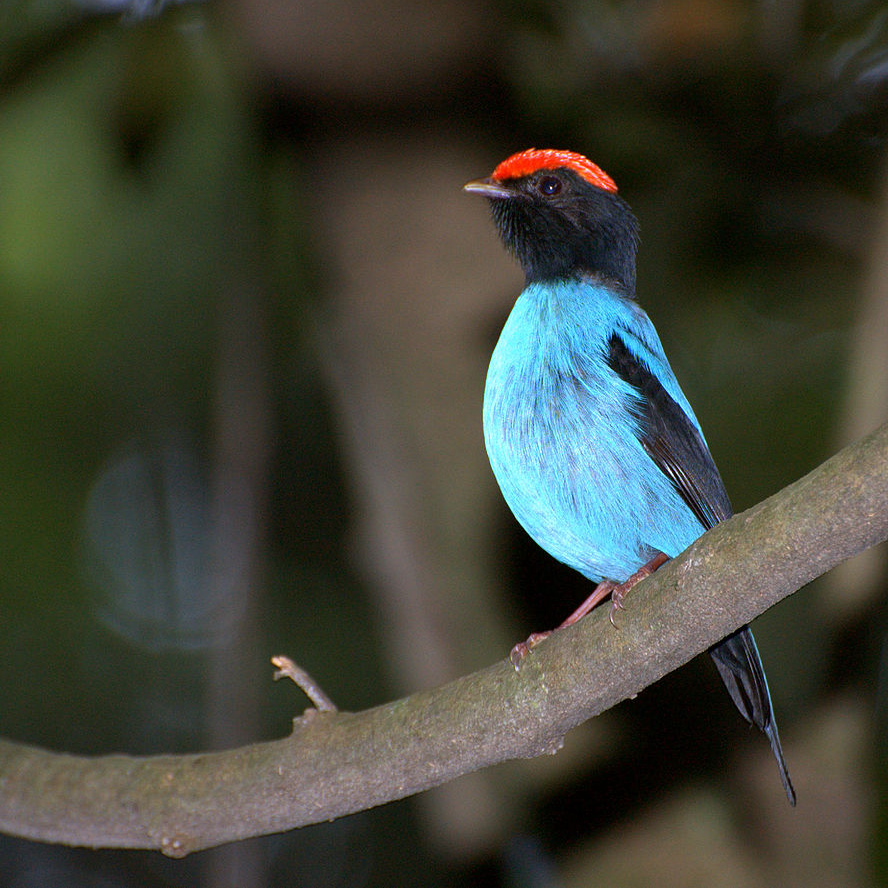
The Red-headed Manakin is easily identified by its bright red head, which stands out against its predominantly black body. Adult males exhibit this striking coloration, while females and juveniles display a more subdued olive-green plumage that provides excellent camouflage in the forest understory. This sexual dimorphism is typical of manakins, where males are more vibrantly colored to attract mates and females are more cryptic for nesting purposes.
In terms of size, the Red-headed Manakin is relatively small, measuring about 10-11 cm in length. Its compact body and short tail aid in maneuvering through dense foliage. The male's red crown, combined with its glossy black body, makes it unmistakable when observed in good light. Females, on the other hand, might be confused with other greenish manakin species; however, their more robust shape and slight differences in shade can aid in identification.
In flight, the Red-headed Manakin exhibits quick, direct movements, often flying short distances between fruiting trees. Its perching posture is rather upright, a characteristic trait of many manakins. Observers often see them perched quietly before they burst into short flights, chasing one another during their dynamic courtship displays.
Having trouble telling birds apart? Upload a photo to our bird identification tool for an instant species match.
Red-headed Manakin Habitat and Range
Preferred Habitat
The Red-headed Manakin primarily inhabits tropical rainforest environments, particularly favoring the dense understory where fruiting shrubs and small trees abound. These forests provide the necessary resources and cover for feeding, breeding, and protection from predators. The species is typically found at elevations ranging from sea level to 1200 meters, often showing a preference for lowland regions rich in biodiversity.
While mainly associated with primary rainforests, the Red-headed Manakin can also occur in secondary forests and edges provided that these areas offer adequate food sources. Unlike some other birds, it rarely ventures into urban areas as it requires the dense vegetation and specific fruiting plants found in more pristine environments. Seasonal shifts in habitat are generally dictated by the availability of fruit, leading to slight movements within their range but not extensive migrations.
Geographic Range
The range of the Red-headed Manakin covers a significant portion of northern South America, with its presence confirmed in countries like Brazil, Peru, Colombia, and Bolivia. Its distribution is centered around the Amazon Basin, where the vast tracts of rainforest provide an ideal habitat. This species is a non-migratory resident, meaning it does not undertake large-scale migrations but may exhibit local movements in response to resource availability.
Within its range, population density tends to be higher in areas with abundant fruiting trees, often resulting in more frequent sightings in these hotspots. Despite its relatively limited geographic range compared to some other tropical birds, the Red-headed Manakin is well-adapted to its specific environmental niche. The species' range does not extend into regions outside the tropical rainforest belt, underscoring the importance of this habitat for its continued survival.
Want to know which birds visit your area? Browse our backyard birds by location guides for region-specific species lists.
What Does the Red-headed Manakin Eat?
The diet of the Red-headed Manakin primarily consists of fruits, making it an essential frugivore in its ecosystem. It feeds on a variety of small fruits and berries, often plucking them directly from branches in the forest understory. The bird's short, stout bill is well-suited for consuming these food items efficiently.
In addition to fruits, the Red-headed Manakin may occasionally consume small insects and other arthropods, especially during the breeding season when the demand for protein increases. This opportunistic feeding behavior helps meet the nutritional needs of both adults and growing chicks.
Foraging typically occurs during the early morning and late afternoon, coinciding with peak fruit availability and activity. The bird uses a combination of sight and memory to locate fruiting trees, often returning to the same reliable sources over time. By dispersing seeds through its droppings, the Red-headed Manakin plays a crucial role in maintaining the health and diversity of its habitat.
Red-headed Manakin Behavior and Social Structure
The Red-headed Manakin exhibits fascinating behavioral patterns, particularly during the breeding season. Males are known for their elaborate courtship displays, which involve intricate dances and acrobatic maneuvers designed to attract females. These displays often take place in leks, where multiple males gather to perform simultaneously, creating a spectacle of color and movement.
Socially, the Red-headed Manakin is generally solitary outside the breeding season, although it may form small groups when foraging. Territorial behavior is most evident during courtship, with males defending their display sites vigorously. Despite their small size, these birds exhibit boldness and persistence in maintaining their territories.
Daily activity patterns of the Red-headed Manakin align with the availability of light, with most activity occurring during daylight hours. The bird typically rests during the hottest parts of the day, resuming foraging and social interactions as temperatures cool. In response to predators, the bird relies on its agility and camouflage, often remaining motionless to avoid detection.
Red-headed Manakin Nesting and Reproduction
The nesting habits of the Red-headed Manakin involve the construction of a small, cup-shaped nest, typically situated in the fork of a tree branch. The nest is constructed using fine plant materials, such as rootlets, leaves, and fibers, bound together with spider silk for added strength and flexibility.
Females are solely responsible for nest building and incubation, reflecting the bird's pronounced sexual dimorphism. The typical clutch size consists of two eggs, which are incubated for about 18-20 days. This period requires the female to remain vigilant and attentive, leaving the nest only briefly to forage.
After hatching, the chicks are altricial, meaning they are born helpless and require significant parental care. The female tends to the young, feeding them regurgitated fruit and insects until they fledge approximately 18-20 days post-hatching. The Red-headed Manakin generally raises one brood per year, although favorable conditions may allow for a second.
Red-headed Manakin Sounds and Vocalizations
The Red-headed Manakin's vocalizations are characterized by a series of short, sharp notes that resemble a high-pitched 'peeet-peeet.' These calls serve multiple functions, including maintaining contact with mates and signaling alarm in the presence of predators.
During the dawn chorus, males become particularly vocal, using their calls to establish and defend territories while simultaneously attracting females. The rhythm of the song is rapid and lively, matching the bird's energetic courtship displays.
Alarm calls are sharper and more urgent, serving as a warning to other birds in the vicinity. These vocalizations, though not melodious, are distinct and serve as an important communication tool within the dense forest habitat.
Interesting Facts About the Red-headed Manakin
- 1The Red-headed Manakin's courtship dance involves a moonwalk-like movement, captivating observers with its unique flair.
- 2Despite its striking appearance, the Red-headed Manakin weighs only about 12-15 grams, making it a lightweight among birds.
- 3The species' name 'rubrocapilla' comes from Latin roots meaning 'red cap,' aptly describing its vivid crown.
- 4Males can spend several hours a day practicing their elaborate dances to perfect their technique.
- 5The Red-headed Manakin's lekking behavior is a key social structure, with males displaying collectively to maximize mating success.
- 6Females judge potential mates based on dance performance, showcasing the importance of skill in reproductive success.
- 7This species' reliance on fruit makes it a critical participant in seed dispersal, aiding forest regeneration.
Red-headed Manakin Conservation Status
The Red-headed Manakin currently holds a status of Least Concern according to the IUCN Red List. Its population appears stable, thanks in part to its wide distribution and adaptability to various forest environments. However, ongoing habitat destruction, particularly due to deforestation in the Amazon Basin, poses a significant threat to its long-term survival. Conservation efforts focus on preserving large tracts of intact rainforest, which are crucial for the survival of the Red-headed Manakin and countless other species. Protected areas and sustainable land-use practices are vital in mitigating habitat loss. Historically, the population has shown resilience, but continued monitoring and conservation actions remain essential to safeguard the species against future threats.
Other Pipridae Species


Birds Similar to the Red-headed Manakin
These species are often confused with the Red-headed Manakin due to similar appearance or overlapping range.
