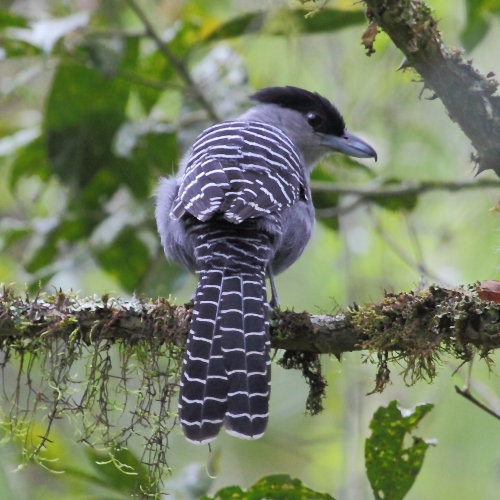
Rio de Janeiro Antbird
Cercomacra brasiliana
Order: Passeriformes / Family: Thamnophilidae

Wikimedia Commons
About the Rio de Janeiro Antbird
The Rio de Janeiro Antbird, scientifically known as Cercomacra brasiliana, inhabits the lush Atlantic Forest ecoregion of southeastern Brazil. This species plays a crucial role in the biodiversity of the region, acting as both predator and prey within its ecosystem. Found predominantly in the states of Rio de Janeiro, São Paulo, and Espírito Santo, this bird thrives in the dense understory of lowland tropical and subtropical forests. Its presence is indicative of healthy forest ecosystems, as it requires intact habitats for foraging and nesting. The Rio de Janeiro Antbird exhibits a territorial nature, often defending its range vigorously. During the breeding season, which typically occurs in the warmer months, the bird becomes even more vocal and conspicuous. Its song and calls echo through the forest, serving both to attract mates and to delineate territory boundaries. The ecological role of the Rio de Janeiro Antbird extends to seed dispersal, as it occasionally consumes fruits and inadvertently aids in the propagation of various plant species. Its diet, however, is primarily insectivorous, with a preference for ants and other small arthropods. This dietary behavior helps control insect populations, maintaining a balanced ecosystem. Throughout the year, the Rio de Janeiro Antbird remains largely sedentary, showing little evidence of long-distance migration. However, it may exhibit some local movements, particularly in response to food availability or environmental conditions. Despite its relatively restricted range, the Rio de Janeiro Antbird is an integral component of the Atlantic Forest's avian community, contributing to the intricate web of life in one of the world's most biodiverse regions.
The Rio de Janeiro Antbird belongs to the family Thamnophilidae, within the order Passeriformes. These birds typically live average 4 years with a maximum recorded of 7 years.
How to Identify a Rio de Janeiro Antbird
The Rio de Janeiro Antbird is a small songbird, measuring about 14 cm in length with a wingspan of around 20 cm. Adult males display striking black plumage with subtle white wing bars, while females exhibit a more muted brown coloration, providing effective camouflage against the forest floor. Juveniles resemble females but often have more rufous tones, especially on their underparts. This sexual dimorphism is typical of the Thamnophilidae family. In terms of behavior, this antbird often perches low to the ground, moving quickly through dense vegetation in search of prey. Its flight is characterized by short, rapid bursts followed by pauses, a style well-suited to its cluttered habitat. When foraging, it frequently flicks its tail and wings, a behavior thought to flush out insects. The Rio de Janeiro Antbird can be confused with the similar Dusky-tailed Antbird (Drymophila malura), but key distinctions include the Rio de Janeiro Antbird's lack of a rufous tail and its more pronounced wing barring. Observers can also rely on vocalizations for identification, as the Rio de Janeiro Antbird has a distinctive song pattern not shared by its relatives.
Having trouble telling birds apart? Upload a photo to our bird identification tool for an instant species match.
Rio de Janeiro Antbird Habitat and Range
Preferred Habitat
The Rio de Janeiro Antbird predominantly inhabits the Atlantic Forest, favoring dense, humid forests with a rich understory. It thrives in both primary and secondary growth forests, often found at elevations ranging from sea level to about 1,200 meters. In these environments, the bird prefers areas with substantial leaf litter and fallen logs, which provide ample foraging opportunities. While it is primarily a forest dweller, the Rio de Janeiro Antbird occasionally ventures into wooded urban parks or garden areas near forest edges, particularly where human encroachment has fragmented its natural habitat. However, such sightings are rare, as the bird generally avoids open areas. Seasonal habitat shifts are minimal, as the species remains in its forested territories year-round, relying on the stable microclimates and consistent food supplies found there.
Geographic Range
The Rio de Janeiro Antbird's range is largely confined to the southeastern Atlantic Forest of Brazil. Its breeding range encompasses the coastal states of Rio de Janeiro, São Paulo, and Espírito Santo, where it resides year-round. Within these regions, the bird occupies a patchy but stable distribution, often found in areas with high forest integrity. Population density hotspots include the Serra do Mar, a mountain range that runs parallel to the Atlantic Coast, and the expansive forests of the Vale do Ribeira. The antbird's range does not extend beyond Brazil, and it does not undertake significant migratory movements. This limited range and lack of migration make conservation efforts within its habitat especially critical.
Want to know which birds visit your area? Browse our backyard birds by location guides for region-specific species lists.
What Does the Rio de Janeiro Antbird Eat?
The diet of the Rio de Janeiro Antbird primarily consists of insects, with a particular focus on ants and other small arthropods. This bird employs a methodical foraging technique, scanning the forest floor and low shrubs for prey. It often participates in mixed-species foraging flocks, which can increase foraging efficiency and reduce predation risk. While ants form the bulk of its diet, the Rio de Janeiro Antbird also consumes spiders, beetles, and occasionally small fruits or seeds. During the wet season, when insect abundance peaks, the bird intensifies its foraging activity. Prey size varies but generally includes small to medium-sized insects, which it captures with swift, precise movements. Feeding typically occurs during daylight hours, with peak activity in the early morning and late afternoon.
Rio de Janeiro Antbird Behavior and Social Structure
The Rio de Janeiro Antbird exhibits a solitary or paired social structure, with individuals or pairs maintaining and defending their territories throughout the year. Territorial disputes are common, particularly during the breeding season, when both males and females become more vocal and aggressive. Courtship displays involve a combination of song and visual cues, with males often performing short flights and wing-flicking displays to attract females. The bird's response to predators includes a series of alarm calls and rapid, evasive flights into dense cover. Daily activity patterns are diurnal, with most foraging and social interactions occurring during daylight hours. The Rio de Janeiro Antbird participates in mixed-species flocks, a behavior that provides greater protection from predators and increases foraging success.
Rio de Janeiro Antbird Nesting and Reproduction
The Rio de Janeiro Antbird constructs its nest in dense undergrowth, typically placing it low to the ground in a sheltered location. The nest itself is a cup-shaped structure made from twigs, leaves, and plant fibers, often lined with softer materials for insulation. Clutch size generally consists of two to three eggs, which are oval and speckled in appearance. Both parents participate in incubating the eggs, a period that lasts approximately 14 days. Once hatched, the chicks remain in the nest for about two weeks, during which both parents share feeding and brooding duties. The species is known for having one to two broods per year, depending on environmental conditions and food availability.
Rio de Janeiro Antbird Sounds and Vocalizations
The Rio de Janeiro Antbird's primary song is a melodious series of whistles, each note rising and then falling in pitch. This song, often described as haunting and flute-like, serves to establish territory and attract mates. In addition to its primary song, the bird produces a variety of call notes, including sharp 'chit' sounds used in communication between mates and alarm calls that alert others to potential predators. During the dawn chorus, the Rio de Janeiro Antbird is particularly vocal, contributing to the cacophony of the waking forest. Its vocalizations are a key identifying feature, easily distinguishable from the calls of other antbird species.
Interesting Facts About the Rio de Janeiro Antbird
- 1The Rio de Janeiro Antbird belongs to the antbird family Thamnophilidae, known for their specialized hunting of ants.
- 2Despite its name, the Rio de Janeiro Antbird is not limited to the state of Rio de Janeiro; it also inhabits São Paulo and Espírito Santo.
- 3The Rio de Janeiro Antbird's diet includes ants, spiders, and occasionally small fruits, making it a versatile feeder.
- 4Rio de Janeiro Antbirds often participate in mixed-species flocks, which can include up to 20 different bird species.
- 5The bird's distinctive song is used by researchers to monitor population densities and track habitat changes.
- 6The Rio de Janeiro Antbird's habitat, the Atlantic Forest, is one of the most biodiverse regions on the planet, yet also one of the most threatened.
- 7Male Rio de Janeiro Antbirds are easily recognizable by their striking black plumage with subtle white wing bars.
Rio de Janeiro Antbird Conservation Status
The Rio de Janeiro Antbird is currently listed as Near Threatened by the IUCN, with its population trend considered decreasing. The primary threat to this species is habitat loss due to deforestation and urbanization in the Atlantic Forest region. Fragmentation of its habitat reduces available territory and resources, making conservation efforts critical. Initiatives aimed at preserving and restoring forest habitats, such as protected areas and reforestation projects, are vital for the survival of this species. Historical population changes indicate a decline correlated with increased deforestation rates, highlighting the need for continued monitoring and conservation action.