
Giant Antshrike
Batara cinerea
Order: Passeriformes / Family: Thamnophilidae
Wikimedia Commons
About the Giant Antshrike
The Giant Antshrike (Batara cinerea) is the largest member of the Thamnophilidae family, a group known for its diverse and adaptive antbirds. This imposing bird holds a significant presence in the subtropical and tropical forests of South America, particularly thriving in regions such as the Atlantic Forest of Brazil and the eastern slopes of the Andes. Measuring up to 34 cm in length, it commands attention not only with its size but also with its distinctive vocalizations that echo through its forested habitat.
The ecological role of the Giant Antshrike is pivotal, as it acts as both a predator and a participant in the complex web of biodiversity within its environment. In the dense understory of its forest home, it preys primarily on insects and arthropods, contributing to the natural regulation of these populations. Its presence is an indicator of a healthy forest ecosystem, often found in areas with rich biodiversity and complex habitat structures.
Seasonally, the Giant Antshrike exhibits some variability in behavior and habitat use. Though predominantly sedentary, it may undertake short local movements in response to food availability and environmental conditions. During the breeding season, which typically coincides with the local wet season, its activities become more pronounced, with males engaging in elaborate territorial displays and vocal duets with their mates. This species is a crucial part of the avian community, and its conservation is tied to the preservation of the forest habitats it inhabits.
The Giant Antshrike belongs to the family Thamnophilidae, within the order Passeriformes. These birds typically live average 8-12 years, with a maximum recorded of 15 years..
How to Identify a Giant Antshrike
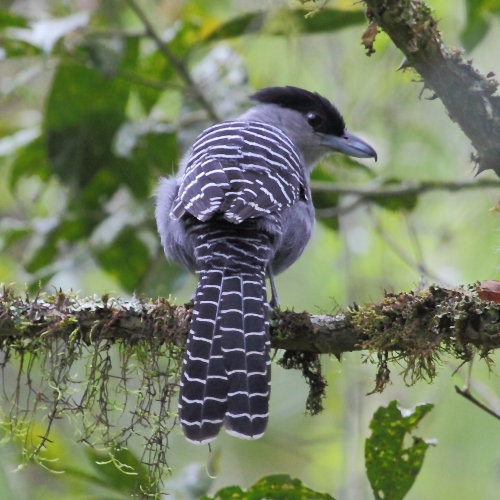
The Giant Antshrike is easily recognizable by its bold black and white coloration. Adult males display a striking black crown and back, contrasted with a white supercilium and underparts. The wings and tail are black, adorned with white barring that adds to its distinctive appearance. In contrast, females exhibit a rich rufous-brown coloration on their upperparts, with the same pattern of barring on the wings and tail. This sexual dimorphism in plumage is a key feature for identifying males and females in the field.
Juveniles resemble females but with a more muted coloration and less pronounced barring. When observing these birds, pay close attention to their size and posture. The Giant Antshrike has a robust body and a strong, curved bill ideal for its diet of insects and small vertebrates. Its flight silhouette is characterized by slow, deliberate wingbeats, often accompanied by a tail flick as it navigates the dense understory.
Similar species, such as the Barred Antshrike (Thamnophilus doliatus), may cause confusion due to overlapping ranges and similar habits, yet they are notably smaller and lack the distinctive size and plumage contrast of the Giant Antshrike. Observers should note the Giant Antshrike's preference for dense, tangled vegetation where it perches upright, often remaining in shadowed areas.
Having trouble telling birds apart? Upload a photo to our bird identification tool for an instant species match.
Giant Antshrike Habitat and Range
Preferred Habitat
The Giant Antshrike inhabits subtropical and tropical moist lowland and montane forests. It thrives in areas with dense understory vegetation, often found at elevations ranging from sea level up to 2,000 meters. Preferred habitats include the Atlantic Forest and other lush forest regions in countries like Brazil, Paraguay, and Argentina. The bird exhibits a preference for mature forests but can also adapt to secondary growth, provided there is sufficient underbrush.
Seasonal habitat shifts are minimal, as it typically remains in its chosen habitat year-round. However, local movements may occur in response to food availability or environmental changes such as drought. While primarily a forest dweller, the Giant Antshrike occasionally ventures into forest edges and partially cleared areas, indicating some degree of adaptability to changing landscapes. Urban presence is rare, as the species relies heavily on dense, natural vegetation for both foraging and breeding.
Geographic Range
The range of the Giant Antshrike extends across a wide swath of South America. It is primarily found in the Atlantic Forest of eastern Brazil, but its range also includes parts of southeastern Paraguay and northeastern Argentina. Within this range, it occupies both lowland and montane forests.
The species does not exhibit long-distance migration, maintaining a sedentary lifestyle throughout its range. However, it may undertake short movements within these areas in search of optimal feeding grounds or suitable breeding sites. Population density tends to be higher in well-preserved forest regions where habitat conditions are ideal.
While its range is relatively localized compared to some other antbird species, the Giant Antshrike's presence is a key indicator of healthy forest ecosystems in these areas. Conservation efforts focus on maintaining and protecting these habitats to ensure the continued survival of this striking bird.
Want to know which birds visit your area? Browse our backyard birds by location guides for region-specific species lists.
What Does the Giant Antshrike Eat?
The diet of the Giant Antshrike primarily consists of insects and arthropods, including beetles, ants, and spiders, which it skillfully extracts from leaf litter and tangled vegetation. This opportunistic feeder employs a methodical foraging technique, using its strong bill to probe and glean prey from crevices and foliage. It shows a preference for larger prey items, often capturing sizable insects that provide substantial nutritional benefits.
Seasonal changes in diet are linked to the availability of food resources in its forest habitat. During the breeding season, when energy demands are higher, the Giant Antshrike may expand its diet to include small vertebrates, such as lizards or frogs, providing an additional protein source for feeding young.
Foraging activity peaks during the early morning and late afternoon, coinciding with the cooler parts of the day when prey is more active. This bird's methodical and deliberate foraging style ensures that it exploits its habitat effectively, maintaining its position as a top predator within the avian community.
Giant Antshrike Behavior and Social Structure
The Giant Antshrike exhibits a complex social structure, primarily forming monogamous pairs that maintain territories throughout the year. Territorial behavior is marked by vocal displays and, occasionally, physical confrontations with intruding conspecifics. Males engage in elaborate courtship displays during the breeding season, which include song duets with their mates and conspicuous perching.
This species shows a distinct daily activity pattern, with peak vocal activity occurring during the early morning hours, often forming part of the dawn chorus. The Giant Antshrike is largely solitary or found in pairs, rarely forming larger groups. When threatened by predators, it relies on dense vegetation for cover and may emit alarm calls to alert its mate.
Flocking behavior is minimal, as the Giant Antshrike tends to avoid the mixed-species foraging flocks that are common among other antbird species. Its preference for solitude underscores its role as a territorial and solitary hunter, adept at navigating the thick vegetation of its forest habitat.
Giant Antshrike Nesting and Reproduction
The nesting habits of the Giant Antshrike are as fascinating as they are strategic. This species constructs a cup-shaped nest, intricately woven from twigs, leaves, and other plant materials, which it positions in dense underbrush or low branches. The nest's strategic placement provides camouflage from predators and shelter from the elements.
Clutch size typically consists of two eggs, which the female incubates over a period of approximately 16 to 18 days. Both parents share responsibilities in feeding and caring for the chicks, which fledge about two weeks after hatching. This cooperative breeding strategy ensures higher survival rates for the young, as both parents diligently protect and provision their offspring.
The Giant Antshrike usually raises one brood per year, although in areas with abundant resources, a second brood may occur. The choice of nesting site is crucial, as it must offer protection from predators and proximity to reliable food sources, ensuring the successful rearing of young in its dense forest habitat.
Giant Antshrike Sounds and Vocalizations
The vocalizations of the Giant Antshrike are distinctive and serve as a key identification feature. Its primary song consists of a series of deep, resonant notes delivered in a slow, rhythmic sequence that reverberates through the forest. This song serves both as a territorial call and a means of communication between mates, particularly during the breeding season.
In addition to its song, the Giant Antshrike emits a variety of call notes, including sharp, short alarms used to signal potential danger. These calls are often heard during interactions with predators or when defending territory from rival individuals. The bird's vocal repertoire is an integral part of its behavioral ecology, aiding in mate selection, territorial defense, and predator avoidance.
During the dawn chorus, the Giant Antshrike's voice stands out for its depth and rhythm, adding to the rich auditory tapestry of the forest. Its vocalizations, while complex, are easily distinguishable by those familiar with the sounds of South American forests.
Interesting Facts About the Giant Antshrike
- 1The Giant Antshrike is the largest species in the Thamnophilidae family, measuring up to 34 cm.
- 2Despite its size, the Giant Antshrike remains elusive, often heard before it is seen in dense vegetation.
- 3Males and females exhibit striking sexual dimorphism, with males displaying bold black and white plumage.
- 4The Giant Antshrike's diet includes not only insects but also small vertebrates like lizards.
- 5Its robust bill is perfectly adapted for a diet consisting of arthropods and larger insect prey.
- 6The Giant Antshrike's song is a key component of the dawn chorus in South American forests.
- 7Conservation of its habitat is vital, as deforestation poses a significant threat to its population.
Giant Antshrike Conservation Status
The Giant Antshrike is currently listed as Least Concern by the IUCN, reflecting a relatively stable population trend across its range. However, habitat loss due to deforestation poses a significant threat to its long-term survival, particularly in regions where forest clearance and land conversion for agriculture are prevalent. Conservation efforts focus on protecting and restoring forest habitats, as well as establishing protected areas to safeguard critical ecosystems. Awareness campaigns aimed at reducing deforestation and promoting sustainable land use practices are crucial in mitigating threats to this species. Historically, population changes have closely mirrored the extent of forest cover, with declines in regions experiencing significant habitat degradation. Continued monitoring and habitat conservation are essential to ensure the Giant Antshrike remains a vibrant part of South America's avian diversity.
Other Thamnophilidae Species


Birds Similar to the Giant Antshrike
These species are often confused with the Giant Antshrike due to similar appearance or overlapping range.

