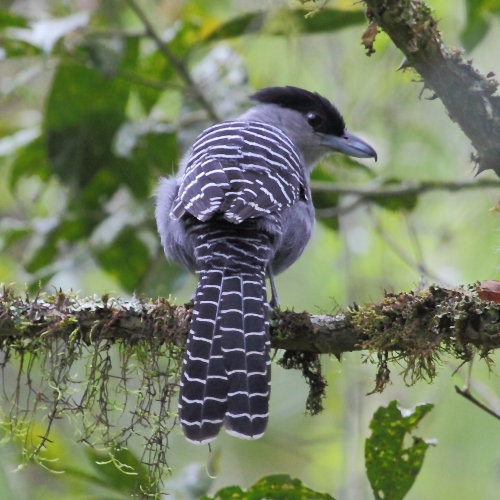
White-bearded Antshrike
Biatas nigropectus
Order: Passeriformes / Family: Thamnophilidae

Wikimedia Commons
About the White-bearded Antshrike
The White-bearded Antshrike (Biatas nigropectus) is a fascinating bird species belonging to the family Thamnophilidae. It inhabits the subtropical and tropical moist lowland forests of South America, with a stronghold in the Atlantic Forest of southeastern Brazil, extending into eastern Paraguay and northeastern Argentina. This bird plays a significant ecological role as an insectivore, aiding in the control of insect populations within its habitat. The White-bearded Antshrike thrives in the dense understory of forests, where it moves with agility and precision. Its presence indicates a healthy, biodiverse ecosystem, as it relies on the rich insect life supported by such environments. Seasonally, the White-bearded Antshrike demonstrates a degree of opportunistic movement within its range, although it is generally considered non-migratory. During the breeding season, from September to January, it becomes more vocal and active in its territory. As an indicator species, it provides insights into the health of the forest habitats it occupies. Conservationists keenly observe its populations to understand broader ecological changes in the region. The bird's reliance on intact forest understories makes it particularly vulnerable to habitat destruction, highlighting the need for preserving these critical ecosystems. Its ecological significance extends beyond its role as a predator, as it also serves as prey for larger bird species and mammals, thus contributing to the forest food web. Efforts to protect the White-bearded Antshrike and its habitat are essential for maintaining the biodiversity and ecological balance of the areas it inhabits.
The White-bearded Antshrike belongs to the family Thamnophilidae, within the order Passeriformes. These birds typically live average 5 years with a maximum recorded of 8 years.
How to Identify a White-bearded Antshrike
Adult White-bearded Antshrikes are medium-sized with distinctive plumage. Males are identifiable by their black upperparts and striking white facial feathers, which form the 'beard' that gives the species its name. Females, contrastingly, exhibit brownish tones on their upperparts, with a less pronounced facial pattern. Juveniles are similar to females but have even more subdued coloring, aiding in their camouflage within the forest understory. This sexual dimorphism is crucial for identification in the field. Their silhouette in flight is not particularly distinctive, as they are more often observed skulking through dense vegetation rather than in open flight. When perching, these antshrikes adopt a typical upright posture, often flicking their tails, which can assist in their identification. Similar species confusion may occur with other antshrikes in overlapping ranges, such as the Spot-backed Antshrike, but the White-bearded Antshrike's unique facial markings and overall coloration serve as reliable distinguishing features.
Having trouble telling birds apart? Upload a photo to our bird identification tool for an instant species match.
White-bearded Antshrike Habitat and Range
Preferred Habitat
The White-bearded Antshrike primarily inhabits the Atlantic Forest biome, favoring lowland and foothill areas with dense understory vegetation. This species thrives in regions with ample leaf litter and tangled shrubbery, which provide cover and abundant foraging opportunities. It is most commonly found at elevations ranging from sea level up to 1,000 meters, although it occasionally ventures into higher altitudes. While it primarily occupies undisturbed forest tracts, the bird can also persist in secondary growth and regenerating forest areas, as long as sufficient understory cover exists. It is notably absent from open, urban, or heavily altered landscapes, highlighting its reliance on forested environments. During the breeding season, it may exhibit slight shifts in habitat preference, seeking areas with optimal conditions for nesting and raising young.
Geographic Range
The White-bearded Antshrike's range is largely confined to the Atlantic Forest of southeastern Brazil, extending into eastern Paraguay and the Misiones province of northeastern Argentina. Within Brazil, its distribution includes the states of Rio de Janeiro, São Paulo, Paraná, Santa Catarina, and Rio Grande do Sul. The bird is considered a resident species, with no significant migratory movements observed, although it may undertake local movements in response to food availability or habitat disturbances. Populations are most concentrated in regions where forest cover remains relatively intact, particularly within protected areas and reserves. Despite its limited range, the White-bearded Antshrike's presence in multiple countries underscores the importance of transnational conservation efforts. Population densities are highest in regions with extensive, contiguous forest habitats, where the ecological conditions support robust insect populations.
Want to know which birds visit your area? Browse our backyard birds by location guides for region-specific species lists.
What Does the White-bearded Antshrike Eat?
The White-bearded Antshrike primarily consumes insects and other arthropods, making it a vital participant in controlling insect populations within its habitat. Its diet predominantly consists of ants, beetles, spiders, and caterpillars, which it forages from leaf litter and low vegetation. The bird employs a methodical foraging technique, moving deliberately through the understory while flicking its wings to flush out hidden prey. During the breeding season, its dietary needs increase, prompting it to forage for additional protein-rich prey to sustain its young. Seasonal variations in prey availability may cause subtle shifts in its diet, though it remains largely insectivorous year-round. The White-bearded Antshrike's feeding schedule is diurnal, with peak activity during the early morning and late afternoon, when insect activity is highest.
White-bearded Antshrike Behavior and Social Structure
White-bearded Antshrikes exhibit a largely solitary or pair-based social structure, with pairs maintaining territories throughout the year. Territorial behavior is pronounced during the breeding season, with males engaging in vocal displays to assert dominance and deter intruders. Courtship involves subtle displays and mutual foraging excursions, strengthening pair bonds. Unlike some antbird species, the White-bearded Antshrike does not typically form large flocks, although it may join mixed-species foraging parties in search of food. Its response to predators is cautious, often retreating into dense cover at the first sign of danger. Daily activity patterns are governed by foraging needs, with peak activity aligning with periods of heightened insect activity. Although not strictly crepuscular, the bird shows a preference for dawn and dusk foraging.
White-bearded Antshrike Nesting and Reproduction
The White-bearded Antshrike constructs a cup-shaped nest using a variety of materials, including leaves, twigs, and fibers, which it places in low shrubs or small trees. Nesting sites are carefully chosen to offer concealment and protection from predators. The typical clutch size ranges from two to three eggs, which are incubated by both parents for approximately 16 to 18 days. Upon hatching, the chicks are altricial and require extensive parental care. Both parents participate in feeding the nestlings, which fledge after about 12 to 14 days. The species typically raises one brood per year, although favorable conditions may allow for a second brood. Parental roles are shared, with both male and female contributing to nest building, incubation, and chick rearing.
White-bearded Antshrike Sounds and Vocalizations
The primary song of the White-bearded Antshrike is a series of sharp, rapid notes that ascend in pitch, often described as a 'tchip-tchip-tchip' sequence. This song is used primarily for territory establishment and mate attraction. Call notes include various soft, metallic 'tik' sounds, which facilitate communication between pairs, especially during foraging. Alarm calls are more strident and are employed to alert conspecifics of potential threats. During the dawn chorus, the White-bearded Antshrike's vocalizations contribute to the rich tapestry of forest sounds, often overlapping with those of other bird species. These vocalizations serve as a reliable cue for birdwatchers and researchers attempting to locate this elusive species.
Interesting Facts About the White-bearded Antshrike
- 1The White-bearded Antshrike's striking white facial feathers resemble a beard, a feature unique among its close relatives.
- 2Despite its name, the White-bearded Antshrike's vocalizations are more akin to high-pitched ticks and chirps than shrikes.
- 3This antshrike is monogamous, with pairs maintaining lifelong bonds and joint territories.
- 4The bird's reliance on dense understory makes it a key indicator of forest health and biodiversity.
- 5White-bearded Antshrikes often participate in mixed-species flocks, benefiting from collective foraging strategies.
- 6Their nests are well-camouflaged, often resembling the surrounding foliage to evade predators.
- 7The Atlantic Forest, home to the White-bearded Antshrike, boasts over 20,000 plant species, many of which support the bird's insect prey.
White-bearded Antshrike Conservation Status
The White-bearded Antshrike is currently classified as Near Threatened by the IUCN, with populations experiencing a declining trend due to habitat loss and fragmentation. The primary threat to this species is the extensive deforestation of the Atlantic Forest, one of the most endangered biomes in the world. Conservation efforts focus on protecting remaining forest tracts, promoting reforestation, and establishing protected areas to safeguard critical habitats. Historical population changes reflect a significant decline over the past decades, driven by agricultural expansion and urban development. Conservation initiatives, including habitat restoration and legal protection measures, are crucial for reversing population declines and ensuring the long-term survival of the White-bearded Antshrike.