
Barred Antshrike
Thamnophilus doliatus
Order: Passeriformes / Family: Thamnophilidae

Wikimedia Commons
About the Barred Antshrike
The Barred Antshrike (Thamnophilus doliatus) is a captivating bird species belonging to the Thamnophilidae family, prevalent throughout lowland tropical areas. This small passerine bird exhibits a strong presence in regions extending from southern Mexico through Central America to much of South America, including the Amazon Basin, eastern Brazil, and the Caribbean islands. Its significance in these ecosystems stems from its role as both predator and prey, contributing to the intricate food web of tropical forests. The Barred Antshrike primarily inhabits dense shrubs and woodland edges, where it can effectively forage for insects and small arthropods. Its adaptability allows it to thrive in a variety of environments such as secondary growth, plantations, and even suburban areas. Unlike many birds that undertake extensive migrations, the Barred Antshrike is predominantly sedentary, maintaining its territory year-round. However, it may perform minor seasonal movements in response to food availability. This species displays fascinating ecological relationships by participating in mixed-species feeding flocks during the non-breeding season, enhancing foraging efficiency and protection against predators. The Barred Antshrike's ecological role extends to seed dispersal, as its insectivorous diet occasionally includes fruit consumption, aiding in the propagation of various plant species.
The Barred Antshrike belongs to the family Thamnophilidae, within the order Passeriformes. These birds typically live average 5-7 years with a maximum recorded of 10 years..
How to Identify a Barred Antshrike
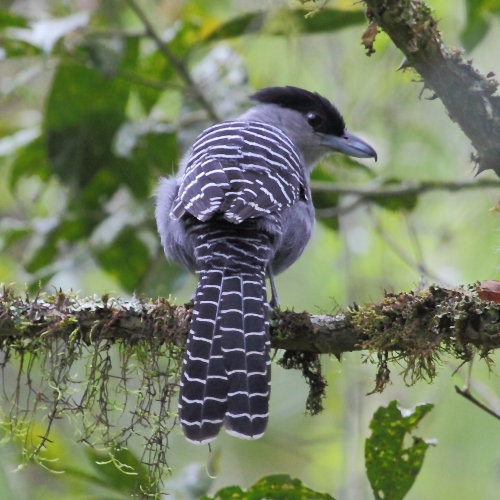
The Barred Antshrike is easily recognizable by its bold zebra-striped plumage, a standout feature among its peers. Adult males exhibit striking black and white barring across their body, with a prominent black crest that they often raise when alarmed or displaying. Females, on the other hand, have a more subdued appearance with rufous-brown and white barring, lacking the black crest but featuring a distinctive rufous crown. Juvenile birds resemble females but with less distinct barring, making them sometimes challenging to identify. In terms of size, the Barred Antshrike is a medium-sized antbird, measuring approximately 16-18 cm in length with a robust body and a relatively long tail. Its perching posture is characterized by an upright stance, often flicking its tail. In flight, it presents a short, rounded wing profile, which is not typically visible as the bird prefers to move through dense vegetation rather than taking long flights. When identifying the Barred Antshrike, birders should note its preference for staying within low to mid-level shrubbery and its characteristic calls, which are often the first indication of its presence.
Having trouble telling birds apart? Upload a photo to our bird identification tool for an instant species match.
Barred Antshrike Habitat and Range
Preferred Habitat
The Barred Antshrike thrives in a variety of habitats within the tropical and subtropical regions. Preferring dense understory vegetation, it is commonly found in lowland forests, secondary growth, and scrubby areas. This species adapts well to human-altered environments, frequently inhabiting plantations, gardens, and even urban parks. It occurs from sea level up to approximately 1,200 meters in elevation, although it is most abundant in lowland areas. The Barred Antshrike does not exhibit significant seasonal habitat shifts, maintaining a consistent presence in its preferred environments. While primarily a forest-edge species, it will venture into interior forest areas during foraging, demonstrating versatility in habitat selection. In urban settings, it often occupies gardens and edges of city parks where dense shrubbery provides adequate cover and food resources. Its ability to adapt to both rural and urban landscapes highlights its resilience in the face of habitat modification.
Geographic Range
The Barred Antshrike's range extends over a vast geographic area, covering much of Central and South America. In Central America, it is found from southern Mexico through Belize, Guatemala, and into Panama. In South America, its distribution includes the northern and eastern parts of Colombia, Venezuela, the Guianas, and much of Brazil, extending south to northern Argentina and east to the Caribbean islands such as Trinidad and Tobago. It is a non-migratory species, remaining within its established range throughout the year. Its population density varies, with higher concentrations in areas with suitable dense vegetation and lower human disturbance. The Barred Antshrike is particularly common in the Amazon Basin and the Atlantic Forest of Brazil, where it benefits from the dense understory vegetation. Despite its broad range, it remains localized in areas where its specific habitat requirements are met, making it less frequently encountered in open or heavily urbanized environments.
Want to know which birds visit your area? Browse our backyard birds by location guides for region-specific species lists.
What Does the Barred Antshrike Eat?
The diet of the Barred Antshrike primarily consists of insects and small arthropods, reflecting its role as an insectivore in the tropical forest ecosystem. It forages by hopping through dense shrubbery and low trees, using its strong bill to probe leaves and bark for hidden prey. Common dietary items include ants, beetles, caterpillars, spiders, and occasionally small lizards. During the breeding season, its dietary needs may expand to include a higher proportion of protein-rich insects, supporting the nutritional demands of raising young. The Barred Antshrike employs a methodical foraging technique, often observed pausing and listening intently between movements to detect the slightest rustling from potential prey. In addition to insects, it may consume small fruits and berries, particularly during periods of scarce insect availability. This occasional frugivory aids in seed dispersal, contributing further to its ecological role. The species exhibits consistent foraging activity throughout the day, with peak feeding times occurring in the early morning and late afternoon when insects are most active.
Barred Antshrike Behavior and Social Structure
The Barred Antshrike exhibits a fascinating array of behaviors, underscoring its adaptability and social nature. It typically maintains a monogamous pair bond, with pairs defending their territory aggressively against intruders. Territorial displays often involve raising their crest and engaging in vocal duets to reinforce bonds and assert dominance. During the breeding season, males perform elaborate courtship displays, which include singing, feather fluffing, and wing quivering to attract females. The Barred Antshrike is generally non-flocking, although it may join mixed-species foraging flocks. These associations provide increased foraging efficiency and protection from predators. The species displays a characteristic response to predators, such as snakes or larger birds, by emitting loud alarm calls and engaging in mobbing behavior. Its daily activity patterns are marked by bursts of foraging interspersed with periods of rest, often in dense cover where it remains vigilant. The bird's inquisitive nature and adaptability ensure its successful habitation of diverse environments.
Barred Antshrike Nesting and Reproduction
The Barred Antshrike constructs its nest as a small, cup-shaped structure, skillfully woven from fine twigs, leaves, and plant fibers. Typically, the nest is positioned within dense shrubbery or low tree branches, usually at a height of 1 to 3 meters above the ground. This strategic placement minimizes exposure to predators while providing easy access to foraging areas. The female primarily undertakes nest construction, with the male occasionally assisting. A typical clutch consists of two to three eggs, which are creamy white and speckled with reddish-brown spots. The incubation period lasts approximately 14 days, with both parents sharing incubation duties. After hatching, the chicks remain in the nest for about 12 to 15 days before fledging. During this period, both parents participate in feeding and caring for the young, showcasing a cooperative breeding strategy. The Barred Antshrike may produce two broods per year, depending on environmental conditions and food availability, contributing to its stable population numbers.
Barred Antshrike Sounds and Vocalizations
The Barred Antshrike's vocalizations are a defining characteristic, with its primary song being a rapid series of melodious whistles descending in pitch, often described as a 'chee-chee-chee-chee-chee-chee.' This song serves as both a territorial declaration and a mating call. In addition to its song, the species produces a variety of call notes, including sharp 'chack' sounds used as contact calls between pairs. Alarm calls are harsh and metallic, designed to alert mates and other birds to potential threats. The dawn chorus behavior of the Barred Antshrike is particularly notable, as it joins other forest species in a collective symphony each morning. This bird's vocal repertoire is complex and serves as a vital tool for communication within its dense habitat.
Interesting Facts About the Barred Antshrike
- 1The Barred Antshrike is known for its duet singing, with males and females often performing synchronized vocalizations.
- 2Despite its name, the Barred Antshrike does not specialize in eating ants, instead consuming a wide variety of insects.
- 3The species' distinctive barring pattern provides excellent camouflage in the dappled light of its forest habitat.
- 4Barred Antshrikes are known to participate in mixed-species flocks, enhancing their foraging success.
- 5Males have a unique courtship display involving crest raising and wing quivering to attract a mate.
- 6They are one of the few antbirds that have adapted well to suburban and urban environments.
- 7Juvenile Barred Antshrikes take on adult plumage by their first year, allowing them to blend seamlessly into their habitat.
Barred Antshrike Conservation Status
Currently, the Barred Antshrike holds a status of Least Concern on the IUCN Red List, reflecting its widespread distribution and stable population trend. Despite this status, ongoing habitat destruction poses a significant threat to local populations, particularly in regions undergoing extensive deforestation for agriculture and urban development. Conservation efforts focus on habitat preservation and sustainable land-use practices to ensure the viability of its natural habitats. The Barred Antshrike has demonstrated resilience, adapting to altered environments, yet continued vigilance is necessary to maintain healthy population levels. Historical population data indicate fluctuations aligned with habitat availability, underscoring the importance of preserving forested areas for this species' long-term survival.
Other Thamnophilidae Species



Birds Similar to the Barred Antshrike
These species are often confused with the Barred Antshrike due to similar appearance or overlapping range.
