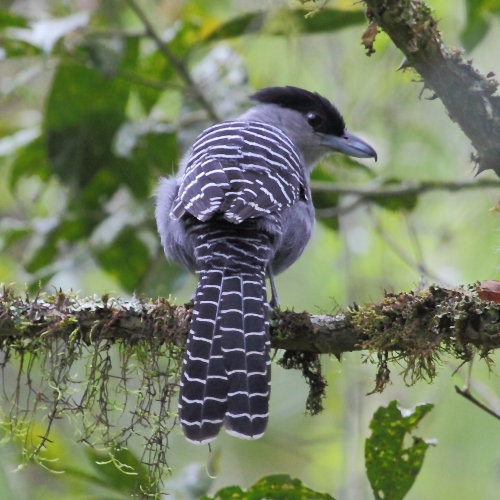
Plain Antvireo
Dysithamnus mentalis
Order: Passeriformes / Family: Thamnophilidae

Wikimedia Commons
About the Plain Antvireo
The Plain Antvireo (Dysithamnus mentalis) is a small passerine bird belonging to the family Thamnophilidae, native to the Neotropical region. With its understated gray plumage and elusive nature, it thrives in the dense understory of humid forests. This bird is predominantly found in Central and South America, ranging from southern Mexico through much of Brazil and into northeastern Argentina. The significance of the Plain Antvireo lies in its role as an insectivore, contributing to controlling insect populations, which helps maintain ecological balance.
This species is particularly associated with diverse forest types, including lowland rainforests, montane forests, and even secondary growth areas. The Plain Antvireo's adaptability to different forest environments makes it a crucial component of its ecosystem, particularly in regions where deforestation and habitat alteration are prevalent. During the breeding season, which typically aligns with the rainy season in its range, the Plain Antvireo becomes more vocal, using its calls to establish territories and attract mates.
Ecologically, the Plain Antvireo serves as a valuable indicator species for forest health due to its reliance on intact understory habitats. As it forages, it often joins mixed-species flocks, contributing to the dynamic interactions among forest bird communities. The presence of the Plain Antvireo in a forest can signify a biodiverse and healthy environment, underscoring its ecological importance. Understanding the seasonal behaviors of this bird, such as its breeding patterns and habitat preferences, can aid in conservation efforts, particularly in regions where habitat loss is a significant threat.
The Plain Antvireo belongs to the family Thamnophilidae, within the order Passeriformes. These birds typically live average 4-6 years, with a max recorded of 7 years..
How to Identify a Plain Antvireo
The adult Plain Antvireo is a small bird, measuring about 12-14 cm in length. Its plumage is primarily gray with subtle differences between males and females. Males typically have a darker gray coloration, while females may exhibit a slightly brownish tinge. A distinguishing feature is the bird's light supercilium, which contrasts with its otherwise plain appearance. Juveniles resemble adults but may have a more pronounced brownish wash.
In the field, the Plain Antvireo can be confused with similar understory species, such as the Dusky Antbird. However, the Plain Antvireo's lack of bold wing bars and its more monotone gray appearance help in distinguishing it. When perched, it often adopts an upright posture, scanning the surrounding foliage for prey. In flight, the bird's movements are typically short and direct, reflecting its preference for dense vegetation.
The Plain Antvireo's subtle field marks require keen observation, particularly in dimly lit forest understories. Birders often rely on its vocalizations to locate this species since its plumage provides excellent camouflage against the forest backdrop. Its perching behavior, often in the mid to lower understory, is another key identification trait that aids in differentiating it from canopy-dwelling antbirds.
Having trouble telling birds apart? Upload a photo to our bird identification tool for an instant species match.
Plain Antvireo Habitat and Range
Preferred Habitat
The Plain Antvireo thrives in various types of tropical forests, primarily favoring dense understory habitats. It is commonly found in lowland rainforests, montane forests, and humid foothills. Elevationally, it can inhabit areas from sea level up to around 2,000 meters, adapting to different forest strata. This bird also inhabits secondary growth forests, which provide suitable coverage and food resources.
Seasonally, the Plain Antvireo does not exhibit significant habitat shifts, as it remains within forested areas year-round. However, deforestation and habitat fragmentation pose threats to its preferred environments, particularly in lowland rainforests. Although primarily associated with forest interiors, this bird exhibits some degree of adaptability, occasionally venturing into forest edges and overgrown plantations.
In urban or heavily altered rural settings, the Plain Antvireo is less commonly encountered, as it relies heavily on the structural complexity of natural forests. Its presence in a given area often reflects the health and continuity of local forest ecosystems, making it a useful indicator species for conservationists assessing habitat quality.
Geographic Range
The Plain Antvireo has a broad range across the Neotropics, inhabiting regions from southern Mexico through Central America and into South America. It is found in countries such as Guatemala, Costa Rica, Panama, Colombia, Venezuela, Ecuador, Peru, Bolivia, and Brazil. Additionally, its range extends into northeastern Argentina and Paraguay.
Throughout its range, the Plain Antvireo is a resident species, meaning it does not undertake long-distance migrations. Instead, it remains within its established territories year-round, although some local movements within forested areas may occur in response to food availability.
Population densities can vary significantly across its range, with higher concentrations often found in undisturbed primary forests. In contrast, areas experiencing significant deforestation may see reduced numbers of this species. Despite habitat pressures, the Plain Antvireo remains relatively widespread, though its dependence on intact forest ecosystems makes it vulnerable to ongoing habitat destruction.
Want to know which birds visit your area? Browse our backyard birds by location guides for region-specific species lists.
What Does the Plain Antvireo Eat?
The diet of the Plain Antvireo is primarily insectivorous, consisting of various arthropods found in the forest understory. Ants, beetles, caterpillars, and spiders make up the bulk of its diet. The bird employs a gleaning technique, carefully picking insects from leaves and branches as it moves through the vegetation.
Seasonal changes can influence the availability of specific prey items, prompting the Plain Antvireo to adjust its foraging strategies. During the wet season, when insect populations typically peak, the bird's diet becomes more varied. In contrast, during dry periods, it may rely more heavily on available ants and other resilient insects.
The Plain Antvireo forages actively throughout the day, often joining mixed-species flocks to exploit the collective foraging advantage. This behavior not only enhances its feeding efficiency but also reduces the risk of predation. Observations of its foraging habits reveal its preference for dense foliage, where it can efficiently locate and capture prey while remaining concealed from potential predators.
Plain Antvireo Behavior and Social Structure
Plain Antvireos exhibit a solitary or paired social structure outside the breeding season, but they frequently participate in mixed-species flocks. This behavior facilitates foraging efficiency and predator avoidance. Within these flocks, they maintain a low profile while foraging in the dense understory.
Territorial behavior becomes prominent during the breeding season, with males using vocalizations to assert dominance and secure breeding territories. These vocal displays are a critical component of courtship, attracting mates and deterring rivals. The Plain Antvireo's calls are often heard before the bird is seen due to its secretive nature.
Daily activity patterns show that the Plain Antvireo is primarily diurnal, with peak activity during early morning and late afternoon. This timing corresponds with optimal foraging conditions in the dimly lit forest understory. In response to predators, the bird relies on its cryptic coloration and the safety of dense foliage, often freezing in place or retreating deeper into the understory to avoid detection.
Plain Antvireo Nesting and Reproduction
The nesting habits of the Plain Antvireo are adapted to its forest environment. It constructs a small, cup-shaped nest using materials such as fine twigs, leaves, and rootlets. These nests are typically placed in forked branches or dense vegetation, often 1-3 meters above the ground.
The clutch size generally consists of 2 eggs, which the female incubates predominantly, although the male may assist. The incubation period lasts around 14-17 days. Once hatched, both parents participate in feeding and caring for the chicks.
Fledging occurs approximately 10-12 days after hatching, but the young remain dependent on the parents for several weeks. The Plain Antvireo often produces one to two broods per year, depending on environmental conditions and food availability. This reproductive strategy helps sustain its population in the face of habitat challenges.
Plain Antvireo Sounds and Vocalizations
The Plain Antvireo's primary song is a rapidly delivered series of high-pitched notes, often described as a trill. This song serves both territorial and mating functions, resonating through the forest understory. The bird's call notes are softer, often likened to a series of 'chup-chup' sounds used during flocking or when communicating with a mate.
Alarm calls are sharp and abrupt, signaling potential threats to conspecifics. The dawn chorus prominently features the Plain Antvireo's song, marking its presence in the early morning hours. Compared to other antbirds, its vocalizations are less melodious but efficient in dense habitats.
The Plain Antvireo's vocal repertoire is critical for maintaining social bonds and territory boundaries in the visually complex forest environment. Birders often rely on these sounds to locate and identify the bird, as its subtle plumage blends seamlessly with the forest backdrop.
Interesting Facts About the Plain Antvireo
- 1The Plain Antvireo often forages in mixed-species flocks, benefiting from the safety and increased foraging success.
- 2Despite its name, the Plain Antvireo has a complex song used for territory defense and mate attraction.
- 3This bird's cryptic plumage provides excellent camouflage in the dense understory of tropical forests.
- 4The Plain Antvireo can remain motionless for extended periods, making it difficult to spot in its habitat.
- 5With a range covering multiple countries, the Plain Antvireo exhibits adaptability to various tropical forest types.
- 6Its presence in a forest often indicates a healthy, diverse ecosystem due to its reliance on intact habitats.
- 7The Plain Antvireo's cup-shaped nest is cleverly concealed among foliage, protecting it from predators.
Plain Antvireo Conservation Status
The IUCN currently lists the Plain Antvireo as a species of Least Concern, reflecting its wide distribution and relatively stable population. However, habitat destruction due to deforestation poses a significant threat, particularly in lowland rainforests. Conservation efforts focus on preserving forest habitats and mitigating deforestation impacts. Protected areas and reserves in its range play a crucial role in sustaining populations. Historical data suggest that while some regional declines have occurred due to habitat loss, the species' adaptability to secondary growth areas offers some resilience. Despite its current status, continued habitat monitoring and conservation initiatives remain essential to ensure the long-term survival of the Plain Antvireo. Local and international efforts, including sustainable land-use practices and reforestation projects, contribute to preserving the ecological integrity of its habitats.