
Great Antshrike
Taraba major
Order: Passeriformes / Family: Thamnophilidae

Wikimedia Commons
About the Great Antshrike
The Great Antshrike (Taraba major) is a striking member of the Thamnophilidae family, known for its conspicuous presence in the lowland forests of Central and South America. This robust songbird is a regular inhabitant of thick shrubbery and tangled vegetation, showcasing its adaptability to various environments. The Great Antshrike plays a crucial ecological role as both predator and prey within its ecosystem. By preying on insects and small vertebrates, it helps control the populations of these species, maintaining a balance within its habitat. Its presence also supports the food web by providing prey for larger predators.
This bird's range extends from southern Mexico through Central America and into much of South America, including countries such as Brazil, Colombia, and Peru. The Great Antshrike is especially prevalent in the Amazon Basin, where it finds ample food and suitable nesting sites. Seasonal behaviors include subtle shifts in foraging patterns as food availability changes with the rain cycles. During the breeding season, which varies by region, the male's vocalizations become more pronounced, drawing attention to its territory and mate.
The Great Antshrike's adaptability to different forest types, from dry tropical forests to humid rainforests, underscores its ecological significance. It thrives in areas with dense undergrowth, often near water sources where insect populations are abundant. Despite its adaptability, the species faces challenges from habitat destruction and fragmentation, particularly in regions where deforestation is rampant. Conservation efforts focus on preserving its natural habitats and mitigating the impacts of human encroachment.
The Great Antshrike belongs to the family Thamnophilidae, within the order Passeriformes. These birds typically live average 5 years, with a maximum recorded of 8 years..
How to Identify a Great Antshrike
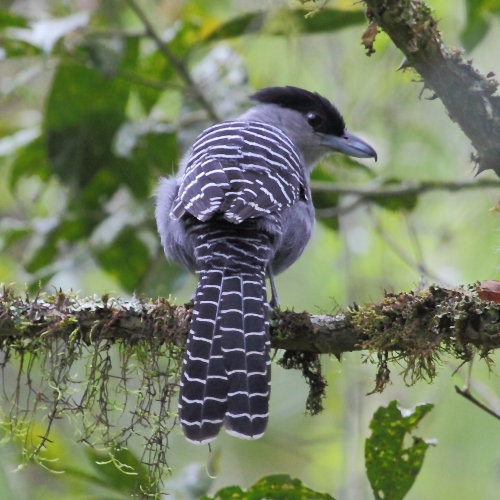
The Great Antshrike exhibits a striking appearance with pronounced sexual dimorphism, making it relatively easy to identify in the field. Adult males boast a bold black and white plumage, with a vivid black cap and back contrasting sharply with their white underparts. Their wings are black with distinctive white wing bars. Females, on the other hand, present a more subdued coloration, with a rich chestnut-brown upper body and a similar white underside, though their wing bars are less prominent than those of males.
Juvenile Great Antshrikes resemble females but may display duller and less defined coloration. Observing these differences can assist in determining the age and sex of the bird. The Great Antshrike's robust body, strong legs, and short, stout bill are typical of the Thamnophilidae family, adapted for a diet primarily consisting of insects and small animals.
When compared to similar species, such as the Barred Antshrike, the Great Antshrike's larger size and distinct plumage patterns stand out. In flight, the bird maintains a low, direct trajectory, with its rounded wings and short tail evident. Its perching posture is upright, often on a low branch or within dense vegetation, where it remains still and quiet, blending into its surroundings despite its vivid plumage.
Having trouble telling birds apart? Upload a photo to our bird identification tool for an instant species match.
Great Antshrike Habitat and Range
Preferred Habitat
The Great Antshrike favors dense, tangled undergrowth in a variety of forested environments. It is commonly found in tropical and subtropical forests, including both humid rainforests and drier deciduous forests. This bird prefers areas with thick shrubbery and low trees, often near streams or wetlands where insect prey is plentiful.
While predominantly a lowland species, the Great Antshrike can be found at elevations up to 1,500 meters, particularly in regions with suitable forest cover. In its preferred habitats, the bird utilizes the dense vegetation both for foraging and nesting, relying on the cover to avoid predators.
Although primarily a resident of rural and wilderness areas, the Great Antshrike can sometimes be found in the outskirts of urban areas, particularly where natural vegetation remains intact. Its ability to adapt to different forest types allows it to occupy a range of habitats, though it remains largely absent from heavily urbanized or deforested regions.
Geographic Range
The Great Antshrike's range is extensive, covering a majority of Central and South America. It breeds from southern Mexico through Central America, including Belize, Honduras, and Costa Rica. In South America, its presence is prominent in countries like Brazil, Colombia, Peru, and Argentina, reaching eastward to the Guianas and westward into the Andes foothills.
Notably, it does not undergo long-distance migrations, a trait uncommon among many songbirds. Instead, the Great Antshrike is a resident species, maintaining territories year-round. However, slight altitudinal migrations may occur in response to seasonal changes in food availability or weather conditions.
Population densities vary across its range, with higher concentrations in the Amazon Basin and parts of southeastern Brazil. These areas provide an abundance of suitable habitat and food resources. In contrast, the bird is less common in areas with significant deforestation or habitat degradation, where its preferred environments have been altered.
Want to know which birds visit your area? Browse our backyard birds by location guides for region-specific species lists.
What Does the Great Antshrike Eat?
The Great Antshrike primarily feeds on insects and small vertebrates, showcasing its role as an agile hunter within the understory of forests. Its diet includes a wide variety of arthropods, such as beetles, ants, and spiders, as well as small lizards and frogs. This varied diet reflects the bird's adaptability and opportunistic feeding strategies.
During the rainy season, when insect activity peaks, the Great Antshrike intensifies its foraging efforts, capitalizing on the abundance of prey. It often employs a sit-and-wait technique, perching quietly in dense foliage before making quick, decisive strikes to capture unsuspecting prey.
The bird's stout bill is well-suited for grasping and dispatching a range of prey sizes, allowing it to exploit different food sources. Feeding typically occurs throughout the day, with peak activity during the cooler morning and late afternoon hours, aligning with periods of increased prey movement.
Great Antshrike Behavior and Social Structure
The Great Antshrike exhibits a solitary and territorial nature, with pairs often maintaining exclusive territories throughout the year. Males are particularly vocal, using a series of sharp calls and songs to establish and defend their territory from rivals. These vocalizations are also crucial during courtship, with males performing displays to attract females and reinforce pair bonds.
Despite their solitary tendencies, Great Antshrikes occasionally join mixed-species foraging flocks, benefiting from the increased efficiency in locating prey. They remain vigilant and alert, with both sexes participating in territorial defense against intruders.
In response to predators, the Great Antshrike relies on its cryptic behavior and dense habitat to remain concealed. It may freeze in place or retreat deeper into cover to avoid detection. The bird is most active during early morning and late afternoon, reducing its exposure during the hottest part of the day when predators are more active.
Great Antshrike Nesting and Reproduction
Great Antshrikes construct cup-shaped nests, typically using twigs, leaves, and vines, which they position in low shrubs or small trees within dense thickets. This location provides both concealment from predators and proximity to food sources.
The female usually lays two to three eggs per clutch, with both parents sharing incubation duties over a period of roughly 14 days. Upon hatching, the altricial young remain in the nest for about 12-14 days before fledging, during which time both parents are actively involved in feeding and caring for them.
The Great Antshrike may produce two broods per year, particularly in regions with extended breeding seasons. This reproductive strategy enhances the bird's ability to maintain stable populations despite environmental pressures.
Great Antshrike Sounds and Vocalizations
The Great Antshrike's song is a distinctive series of sharp, melodious notes, often described as a drawn-out 'chee-chee-chee.' This song serves multiple purposes, including territory defense and mate attraction. The bird's calls are similarly sharp, with a consistent rhythm that punctuates the forest's background noise.
Alarm calls are more abrupt and high-pitched, alerting other birds to the presence of predators. During the dawn chorus, the Great Antshrike's vocalizations stand out among the forest sounds, establishing its presence and reinforcing territorial boundaries.
Interesting Facts About the Great Antshrike
- 1The Great Antshrike's striking black and white plumage makes it one of the most easily recognizable antbirds in its range.
- 2Unlike many songbirds, the Great Antshrike does not migrate, remaining in its territory year-round.
- 3The bird's strong legs and stout bill are adaptations for its insectivorous diet, allowing it to catch and handle a wide variety of prey.
- 4Great Antshrikes are known for their secretive behavior, often remaining hidden in dense underbrush despite their bold appearance.
- 5While primarily insectivorous, the Great Antshrike occasionally preys on small vertebrates like lizards and frogs.
- 6The species displays sexual dimorphism, with males and females exhibiting markedly different plumage colors.
- 7The Great Antshrike's song, a series of sharp, melodious notes, is an essential tool for territory defense and mate attraction.
Great Antshrike Conservation Status
Currently, the Great Antshrike is listed as a species of least concern by the IUCN, with stable population trends across much of its range. However, habitat destruction due to deforestation and land conversion poses significant threats, particularly in the Amazon and other densely forested regions. Conservation efforts focus on habitat preservation and the establishment of protected areas to ensure the species' long-term survival. Monitoring programs aim to track population changes and assess the impact of environmental pressures. Historically, the Great Antshrike has shown resilience in the face of habitat alterations, but continued vigilance is necessary to safeguard its future.
Other Thamnophilidae Species



Birds Similar to the Great Antshrike
These species are often confused with the Great Antshrike due to similar appearance or overlapping range.

