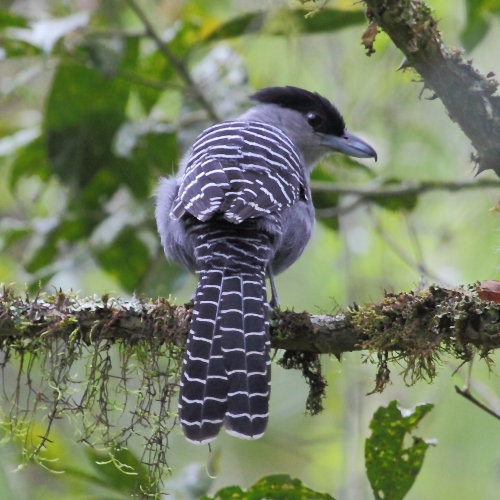
Black-crowned Antshrike
Thamnophilus atrinucha
Order: Passeriformes / Family: Thamnophilidae

Wikimedia Commons
About the Black-crowned Antshrike
The Black-crowned Antshrike (Thamnophilus atrinucha), a member of the Thamnophilidae family, is a prominent bird species inhabiting the dense tropical forests of Central and South America. Its range extends from southern Mexico through Central America to northwestern Colombia, thriving in lowland and foothill forests. This bird is especially significant as an indicator species for healthy forest ecosystems, often found in mature forests, secondary growth, and even plantations. It plays a vital role in controlling insect populations, thus maintaining ecological balance. The Black-crowned Antshrike exhibits fascinating seasonal behaviors; during the breeding season, its activity level increases, and it becomes more vocal, often heard before seen. Its sharp, repetitive calls serve as a quintessential soundtrack to the tropical forest. The species is sedentary, and its territories are defined and defended year-round, a trait shared with many antbirds. It is commonly found in mixed-species flocks outside the breeding season, participating in a cooperative foraging strategy that enhances its survival chances. The Black-crowned Antshrike's ecological role extends beyond predation; its presence supports the broader food web, offering cues to other species about predator presence and habitat quality. Its adaptability to secondary and degraded habitats highlights its potential resilience to certain levels of habitat disturbance, though it remains sensitive to extensive deforestation and habitat fragmentation. The antshrike's preference for understory and mid-level canopies makes it a crucial component of the vertical stratification in tropical forests, interacting with a variety of flora and fauna. Through its interactions within these complex ecosystems, the Black-crowned Antshrike contributes to seed dispersal and the regulation of insect populations, thereby promoting the health and diversity of tropical forests.
The Black-crowned Antshrike belongs to the family Thamnophilidae, within the order Passeriformes. These birds typically live average 5-7 years, with a maximum recorded of 10 years..
How to Identify a Black-crowned Antshrike
The Black-crowned Antshrike is characterized by its distinctive dark crown, which contrasts with its otherwise gray and white plumage. Adult males feature a black crown and a slate-gray body, with a white belly that provides a striking contrast. Females, while similar in size, have a slightly more muted coloration with a brownish tinge to the crown and upper parts, distinguishing them from the males. Juveniles resemble females but are paler overall, lacking the full intensity of adult plumage. This bird's field marks are essential for its identification, as it shares its habitat with numerous similarly sized and colored bird species. The Black-crowned Antshrike's robust, slightly curved bill is adapted for capturing insects, a primary component of its diet. Its short, rounded wings and long tail are typical of antbirds, aiding in agility and maneuverability through dense foliage. Unlike many other small forest birds, the Black-crowned Antshrike often perches with its tail held slightly upwards, a posture that, along with its consistent vocalizations, aids birders in locating it. It is often mistaken for the Barred Antshrike due to similar coloration, but the latter has distinctive barring on its underparts, which the Black-crowned Antshrike lacks.
Having trouble telling birds apart? Upload a photo to our bird identification tool for an instant species match.
Black-crowned Antshrike Habitat and Range
Preferred Habitat
The Black-crowned Antshrike inhabits tropical and subtropical moist lowland forests, with a particular affinity for dense undergrowth and tangled vegetation. It thrives in primary and secondary forests, demonstrating an adaptability to a range of forest conditions. This species can also be found in forest edges and clearings, provided there is sufficient cover for foraging. Typically residing at elevations from sea level to approximately 1,200 meters, the Black-crowned Antshrike is not commonly found in montane or highland regions. While predominantly a forest bird, it occasionally ventures into plantations and gardens, especially those adjacent to larger forested areas. The antshrike's reliance on dense vegetation makes it less common in heavily urbanized areas, though it can persist in rural settings where suitable habitat patches remain. Seasonal habitat shifts are minimal due to its sedentary nature, but local movements may occur in response to food availability or habitat disturbances.
Geographic Range
The Black-crowned Antshrike's range spans from southern Mexico, through Belize, Guatemala, Honduras, Nicaragua, Costa Rica, and Panama, reaching into the northwestern corner of Colombia. It occupies a wide range of tropical forest habitats throughout this region, with population density greatest in areas of extensive, continuous forest. Despite its wide distribution, the species does not migrate, maintaining year-round territories. Its stronghold lies in the expansive rainforests of the Darién Gap in Panama and Colombia, where it is most frequently encountered. The Black-crowned Antshrike is absent from islands and coastal regions far from the mainland, reflecting its preference for contiguous forest habitats. Its presence in Central America is relatively stable, though localized declines have occurred in areas where deforestation is prevalent.
Want to know which birds visit your area? Browse our backyard birds by location guides for region-specific species lists.
What Does the Black-crowned Antshrike Eat?
The Black-crowned Antshrike primarily feeds on insects and other invertebrates, employing a 'sit-and-wait' hunting strategy typical of many antbirds. It forages in the understory and mid-levels of the forest, often gleaning prey from foliage or capturing it mid-air. The antshrike's diet includes beetles, ants, caterpillars, and spiders, with occasional consumption of small vertebrates like lizards. Seasonal diet variations occur, with a higher intake of caterpillars and other larvae during the rainy season when these prey are more abundant. The bird forages alone or in pairs during the breeding season, but it often joins mixed-species flocks outside this period to improve foraging efficiency and reduce predation risk. Its feeding schedule is largely dictated by prey availability, with peak activity occurring in the early morning and late afternoon.
Black-crowned Antshrike Behavior and Social Structure
The Black-crowned Antshrike exhibits a range of intriguing behaviors that reflect its complex ecological role. It is typically observed in pairs, maintaining strong pair bonds through mutual preening and cooperative territory defense. Territorial disputes with other pairs involve vocal duets, where both males and females participate in a synchronized call-and-response pattern to assert dominance. During courtship, males perform a series of display behaviors, including wing flicking and tail fanning, to attract females. The species is generally non-migratory, remaining within its established territory throughout the year. Outside the breeding season, the Black-crowned Antshrike often joins mixed-species flocks, enhancing its foraging success and reducing the risk of predation. Its response to predators includes a range of alarm calls and evasive flight patterns, retreating into dense cover when threatened. Daily activities are concentrated in the cooler parts of the day, with periods of rest during the intense midday heat.
Black-crowned Antshrike Nesting and Reproduction
The Black-crowned Antshrike constructs a cup-shaped nest, typically placed in a shrub or small tree within dense forest undergrowth. The nest is made from twigs, leaves, and other plant materials, woven together to provide stability and camouflage. Clutch size usually consists of two eggs, which are creamy white with brown spots. Both parents share incubation duties, which last approximately 14 days. After hatching, the nestlings remain in the nest for about 12 to 14 days before fledging. Parental care continues for several weeks post-fledging, with both parents involved in feeding and protecting the young. The species typically raises one brood per year, though in areas with extended favorable conditions, a second brood may occur.
Black-crowned Antshrike Sounds and Vocalizations
The Black-crowned Antshrike is notably vocal, with a primary song described as a series of sharp, repetitive whistles or 'peee-peee-peee' notes, increasing in volume and intensity. These calls are often used in territorial disputes and pair bonding. The bird also produces a variety of call notes, including a harsh 'churr' sound when alarmed. During the dawn chorus, the antshrike's calls are among the first to be heard, setting the acoustic scene for the day. Its vocalizations serve as a key identification feature, particularly in dense forest settings where visual sightings are challenging.
Interesting Facts About the Black-crowned Antshrike
- 1The Black-crowned Antshrike is part of a family known for following army ant swarms, although this species does not exhibit this behavior.
- 2Unlike many birds, the Black-crowned Antshrike is sedentary, maintaining year-round territories rather than migrating.
- 3Its vocal duets between pairs serve both as territorial displays and as a means to strengthen pair bonds.
- 4The species is often a part of mixed-species flocks, cooperating with other birds for better foraging success.
- 5Despite its inconspicuous behavior, the Black-crowned Antshrike's sharp calls often reveal its presence before it is seen.
- 6The bird's adaptability to secondary forests demonstrates some resilience against deforestation impacts.
- 7The Black-crowned Antshrike's diet shifts seasonally, increasing its intake of caterpillars during rainier periods.
Black-crowned Antshrike Conservation Status
Classified as Least Concern by the IUCN, the Black-crowned Antshrike's population is currently stable, although it faces ongoing threats from habitat loss due to deforestation and land conversion. Conservation efforts focus on preserving large tracts of continuous forest and promoting sustainable land-use practices. The species' adaptability to secondary growth provides some resilience against habitat change, but continued habitat fragmentation could pose significant challenges. Historical population trends suggest localized declines in heavily deforested areas, underscoring the importance of habitat protection.