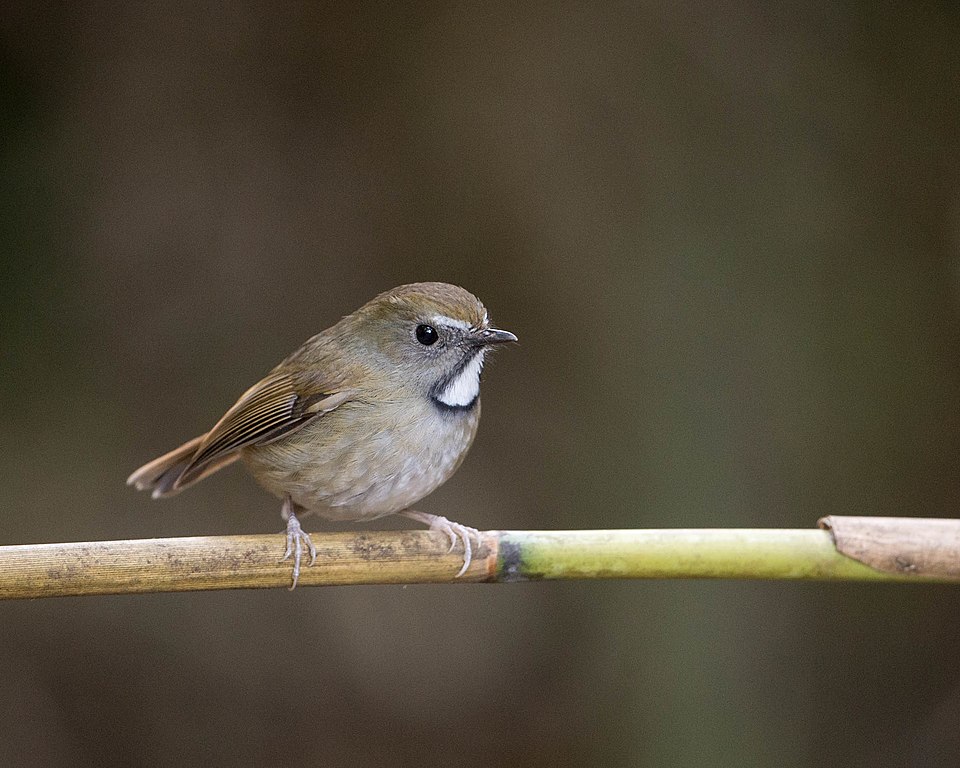
Rufous-browed Flycatcher
Anthipes solitaris
Order: Passeriformes / Family: Muscicapidae

Wikimedia Commons
About the Rufous-browed Flycatcher
The Rufous-browed Flycatcher, scientifically known as Anthipes solitaris, is an intriguing small passerine bird, primarily found in the montane forests of Southeast Asia. Its range extends through countries such as Thailand, Malaysia, Indonesia, and Brunei, where it inhabits the lush undergrowth of tropical and subtropical forests. This flycatcher is particularly adapted to life in dense vegetation, preferring altitudes between 600 to 2000 meters. Its presence is a testament to the rich biodiversity of these regions, serving an important role in the ecological balance by controlling insect populations. The Rufous-browed Flycatcher is not only a symbol of the incredible avian diversity of Southeast Asia but also an indicator of the health of the montane forest ecosystems it calls home. During the breeding season, these birds exhibit fascinating territorial behaviors, often seen flitting through the lower canopy and showcasing their striking plumage. Their role in seed dispersal, albeit indirectly through their insect diet, contributes to the forest's regeneration processes. As insectivores, they help maintain a balance in the ecosystem by preying on a variety of insects. Despite their common presence in suitable habitats, the Rufous-browed Flycatcher's population dynamics can be closely tied to the health of forest habitats, making them susceptible to deforestation and habitat fragmentation. Seasonal behaviors include altitudinal migration, where they move to slightly lower elevations during colder months in search of food. Their adaptability to changes within their habitat underscores their resilience, yet also highlights the need for conservation efforts to ensure these habitats remain intact. The Rufous-browed Flycatcher's role extends beyond its ecological functions, serving as a point of interest for birdwatchers and researchers alike, providing insights into the complex interactions within tropical montane ecosystems.
The Rufous-browed Flycatcher belongs to the family Muscicapidae, within the order Passeriformes. These birds typically live averages around 5 years with a maximum recorded of 8 years..
How to Identify a Rufous-browed Flycatcher
The Rufous-browed Flycatcher is a small bird, measuring about 12 to 14 centimeters in length. Adults showcase a striking combination of rufous and olive-brown plumage. The most distinctive feature is the rufous eyebrow that gives the bird its name, contrasting sharply against its olive-brown head and back. The underparts are generally paler, ranging from buffy to whitish, which aids in identification when observed in the field. Juveniles differ slightly, often having a more mottled appearance with less defined rufous markings, a trait that helps them blend into the forest environment more effectively. There is little sexual dimorphism in this species, with males and females appearing quite similar, although females may have slightly duller plumage. In flight, the Rufous-browed Flycatcher exhibits a fairly rapid, fluttering motion, typical of small insectivorous birds. Its perching posture is upright, often on thin branches or within dense foliage where it can be seen actively darting out to catch insects mid-air. This behavior is a key characteristic, differentiating it from other similar species. While the Rufous-browed Flycatcher shares its habitat with other small flycatchers, its distinct rufous brow and behavior make it stand out.
Having trouble telling birds apart? Upload a photo to our bird identification tool for an instant species match.
Rufous-browed Flycatcher Habitat and Range
Preferred Habitat
The Rufous-browed Flycatcher primarily inhabits montane and submontane forests, thriving in dense undergrowth and bamboo thickets. It is commonly found at elevations ranging from 600 to 2000 meters, favoring moist, shaded areas with abundant insect life. These habitats are typically located in the highlands of Southeast Asia, including the mountain ranges of Thailand, Peninsular Malaysia, and Sumatra. The bird's adaptability to different forest types, including primary and secondary growth, allows it to exploit various niches. Seasonal habitat shifts occur, with some populations moving to lower elevations during the non-breeding season to access food and milder climates. While the Rufous-browed Flycatcher is predominantly a denizen of rural and undisturbed forest areas, it can occasionally be found in semi-urban settings where suitable habitat patches persist.
Geographic Range
The breeding range of the Rufous-browed Flycatcher spans the montane regions of Southeast Asia. It is commonly found in Thailand, Peninsular Malaysia, Sumatra, and Borneo, including Brunei. The bird does not undertake long-distance migrations, but exhibits altitudinal movements within its range. During the breeding season, it occupies higher elevations, retreating to lower altitudes as conditions dictate. This altitudinal migration is a response to seasonal changes in food availability and climatic conditions in its forested habitat. While the species is relatively widespread within its range, population densities can vary significantly, with higher concentrations in areas of optimal habitat. The Rufous-browed Flycatcher is primarily sedentary, with its presence being a reliable indicator of undisturbed montane forest environments.
Want to know which birds visit your area? Browse our backyard birds by location guides for region-specific species lists.
What Does the Rufous-browed Flycatcher Eat?
The Rufous-browed Flycatcher is an insectivore, with its diet primarily composed of small insects and arthropods. It employs a sit-and-wait foraging strategy, perching quietly before darting out to snatch prey from the air or foliage. This bird is particularly fond of flies, beetles, and other small insects that abound in its forest habitat. Seasonal changes influence its diet slightly, with a greater emphasis on available insect prey during different times of the year. The bird's agile flight and keen vision enable it to capture a wide variety of prey, ranging from tiny flying insects to larger ground-dwelling beetles. Feeding occurs throughout the day, although activity peaks during the cooler morning and late afternoon hours when insect activity is highest. This dietary specialization plays a crucial role in controlling insect populations within its habitat.
Rufous-browed Flycatcher Behavior and Social Structure
Rufous-browed Flycatchers are generally solitary or found in pairs, particularly during the breeding season. They exhibit strong territorial behavior, with males often engaging in vocal displays to defend their territory from intruders. During courtship, males perform subtle displays, including wing flicking and soft calls to attract females. These birds are not known to form flocks, preferring to remain within their established territories. Their response to predators involves sudden, rapid flight into dense cover, a tactic that helps avoid detection. Daily activity patterns are diurnal, with peak activity occurring during the early morning and late afternoon. Rufous-browed Flycatchers are adept at navigating through their dense forest habitat, using their agile flight to maintain an active foraging routine. Despite their solitary nature, they maintain a complex social structure through vocal communication and visual displays.
Rufous-browed Flycatcher Nesting and Reproduction
The Rufous-browed Flycatcher constructs its nest on the ground, often hidden among dense vegetation or at the base of trees. Nesting materials include moss, leaves, and fine plant fibers, forming a cup-shaped structure that provides camouflage and protection. The typical clutch size ranges from two to four eggs, which are incubated by the female for approximately 12 to 14 days. Both parents participate in feeding the young, with fledging occurring about 12 to 15 days after hatching. The parental roles involve frequent feeding trips and vigilant nest defense against potential predators. The Rufous-browed Flycatcher generally raises one brood per year, with nesting occurring during the wet season when food is abundant. Their ground-level nests make them vulnerable to predation, but their choice of secluded and well-camouflaged sites helps mitigate this risk.
Rufous-browed Flycatcher Sounds and Vocalizations
The Rufous-browed Flycatcher's song is a soft, melodious series of whistles and trills. The rhythm is relatively slow, with a gentle, flowing quality that blends into the forest ambiance. Call notes consist of short, sharp 'chip' sounds, used primarily for communication between mates or as alarm signals. Alarm calls are more abrupt and intense, serving to alert other birds to approaching threats. During the dawn chorus, the Rufous-browed Flycatcher's song can be heard resonating through the forest, adding to the symphony of avian sounds. Its vocalizations, while not as pronounced as some other species, are distinctive to those familiar with the forest soundscape.
Interesting Facts About the Rufous-browed Flycatcher
- 1The Rufous-browed Flycatcher is named for the distinctive rufous stripe above its eyes, a key identifying feature.
- 2This species is often found at elevations of 600-2000 meters, showcasing its preference for montane habitats.
- 3Despite being solitary, the Rufous-browed Flycatcher communicates with a variety of whistles and calls.
- 4Its diet primarily consists of insects, which it catches with agile flight maneuvers.
- 5The Rufous-browed Flycatcher has adapted to both primary and secondary forest habitats, showing resilience.
- 6Nesting on the ground, its nests are well-camouflaged among vegetation to avoid predators.
- 7The species is considered an indicator of healthy montane ecosystems, reflecting habitat quality.
Rufous-browed Flycatcher Conservation Status
Currently, the Rufous-browed Flycatcher is classified as Least Concern by the IUCN, with populations considered stable. However, habitat loss due to deforestation and land conversion poses a significant threat to its long-term survival. Conservation efforts focus on protecting montane forests and establishing protected areas to preserve critical habitats. The bird's reliance on specific forest types makes it vulnerable to habitat fragmentation, emphasizing the need for sustainable land-use practices. Historical population changes have been minimal, but ongoing monitoring is essential to detect potential declines. Local conservation initiatives and international partnerships aim to safeguard these vital habitats, ensuring the Rufous-browed Flycatcher remains a thriving component of Southeast Asia's avian diversity.