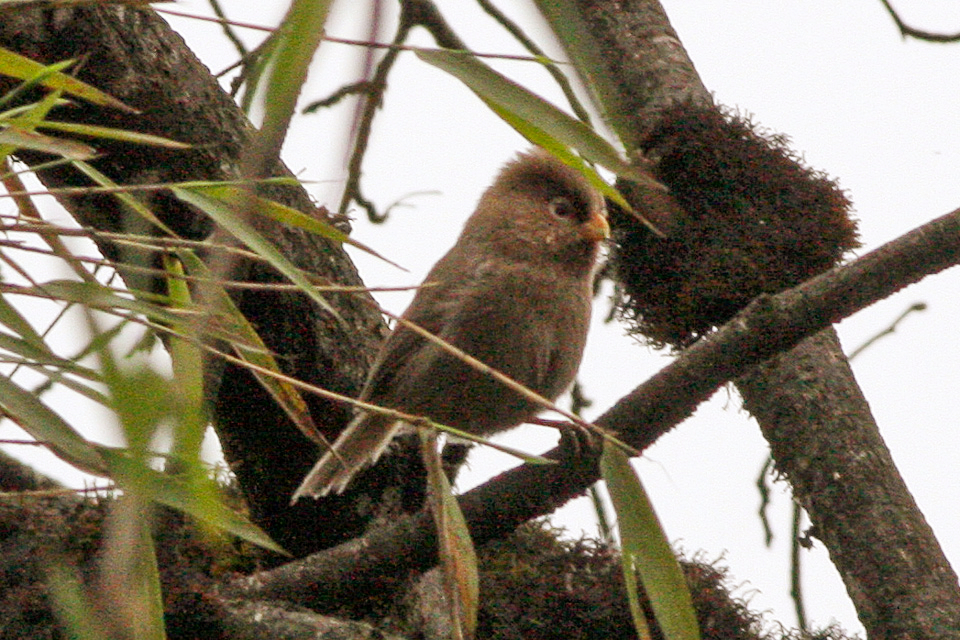
Rufous-headed Parrotbill
Psittiparus bakeri
Order: Passeriformes / Family: Sylviidae

Wikimedia Commons
About the Rufous-headed Parrotbill
The Rufous-headed Parrotbill (Psittiparus bakeri) is a captivating species found predominantly in the subtropical and tropical forests of Southeast Asia. This bird is part of the family Sylviidae, within the order Passeriformes. Characterized by its distinctively colored head, the species stands out with its vibrant rufous crown, which contrasts with its more subdued body plumage. These birds are primarily found in the montane regions of countries like China, Myanmar, and Thailand, where they play a crucial ecological role as both predator and prey.
As a key component of their ecosystem, Rufous-headed Parrotbills contribute to the control of insect populations, which they primarily feed on. They are known to be quite social, often found in small flocks, which aids in their foraging efficiency. Additionally, these birds are important prey for larger avian predators, thus maintaining the balance within their ecological niches. Their adaptability to different altitudinal ranges allows them to exploit various niches within their habitats.
During the breeding season, these parrotbills exhibit specific behaviors that help ensure the survival of their offspring. Their nesting habits, location preferences, and parental roles all play a part in the successful rearing of young. Outside of the breeding season, the Rufous-headed Parrotbill engages in seasonal movements, often descending to lower elevations in search of food. Their adaptability to seasonal changes and their robust population numbers highlight their resilience, although habitat loss remains a concern.
The bird's presence is an indicator of healthy forest ecosystems, and its vitality reflects the broader environmental conditions of its habitat. Conservation efforts aimed at preserving their natural habitats are crucial, as these birds face threats from deforestation and human encroachment. Ensuring the survival of the Rufous-headed Parrotbill not only preserves this unique species but also maintains the ecological integrity of the regions they inhabit.
The Rufous-headed Parrotbill belongs to the family Sylviidae, within the order Passeriformes. These birds typically live 6-8 years with a maximum recorded of 10 years.
How to Identify a Rufous-headed Parrotbill
The Rufous-headed Parrotbill is a medium-sized bird, measuring approximately 16 to 18 centimeters in length. Its most distinctive feature is its rufous crown, which gives the bird its common name. This vibrant head color contrasts sharply with its olive-brown upperparts and paler underparts. The eyes are a striking pale blue, a feature that aids in identification. Juvenile birds resemble adults but tend to have a slightly duller plumage until they mature.
Males and females of the species look similar, making it challenging to distinguish between the sexes based solely on appearance. However, during the breeding season, males might exhibit more vivid plumage as part of their courtship displays. The Rufous-headed Parrotbill's short, rounded wings and relatively long tail are adaptations that aid in their agile movements through dense foliage.
When in flight, the parrotbill's silhouette is characterized by its compact body and slightly rounded wings, allowing for quick maneuvers in its forested habitat. Their perching posture is typically upright, and they often engage in acrobatic movements while foraging among branches. They may be confused with other parrotbills, such as the Gray-headed or Black-headed Parrotbill, but the distinct rufous head of Psittiparus bakeri is a reliable differentiator.
Having trouble telling birds apart? Upload a photo to our bird identification tool for an instant species match.
Rufous-headed Parrotbill Habitat and Range
Preferred Habitat
The Rufous-headed Parrotbill primarily inhabits subtropical and tropical montane forests. These environments provide the dense foliage and abundant insect populations necessary for their survival. Typical elevation ranges from 1,000 to 2,500 meters, where they can find ample food resources and suitable nesting sites.
During the breeding season, they prefer the higher elevations where mature forests offer increased protection and food availability. In non-breeding seasons, these birds may descend to lower elevations, following insect populations and taking advantage of milder weather.
While they predominantly reside in forested areas, Rufous-headed Parrotbills can occasionally be found in secondary growth forests or even near forest edges, adapting to changing environments. Their presence in rural areas is more common than in urban settings, as they require specific habitat conditions that are less available in developed regions.
Geographic Range
The Rufous-headed Parrotbill's range is largely confined to Southeast Asia. It breeds predominantly in the montane regions of southwestern China, including Yunnan Province, as well as in parts of northern Myanmar and northern Thailand. These areas provide the dense forests and elevation that the species prefers for breeding and foraging.
During the winter months, the parrotbill may exhibit some altitudinal migration, moving to lower elevations within its range in search of food and milder conditions. However, it is not known for long-distance migration and tends to remain within its general range throughout the year.
Population density tends to be highest in areas where forest habitats are intact and insect prey is abundant. However, deforestation and habitat fragmentation have affected some populations, leading to localized declines. Despite these challenges, the species remains relatively widespread within its range, thanks to its adaptability to a range of forested habitats.
Want to know which birds visit your area? Browse our backyard birds by location guides for region-specific species lists.
What Does the Rufous-headed Parrotbill Eat?
The Rufous-headed Parrotbill's diet primarily consists of insects, which they capture through skillful foraging techniques adapted to their forest environment. They primarily feed on beetles, caterpillars, and other small arthropods, employing a combination of gleaning and probing techniques to extract prey from foliage and bark.
During the breeding season, their diet is heavily insectivorous, providing the necessary protein and energy required for raising young. Outside of this period, the Rufous-headed Parrotbill may supplement its diet with seeds and berries, particularly during winter when insect availability declines.
Foraging typically occurs in small flocks, which enhances their efficiency and ability to locate food sources. Their feeding schedule is primarily diurnal, with peak activity during the early morning and late afternoon, when insect activity is at its highest. Prey size generally ranges from small to medium-sized insects, aligning with the bird's foraging capabilities and dietary needs.
Rufous-headed Parrotbill Behavior and Social Structure
Rufous-headed Parrotbills are highly social birds, often observed in small flocks that may consist of family groups or mixed-species assemblages. This flocking behavior facilitates efficient foraging and offers protection from predators through increased vigilance.
Territorial behavior is most evident during the breeding season, when pairs establish and defend territories against intruders. Courtship displays include vocalizations and physical displays, with males showcasing their vibrant plumage to attract females. Once paired, both sexes participate in nest building and rearing of young.
Their response to predators involves both vocal alarms and coordinated movements within the flock to confuse and evade potential threats. Daily activity patterns include periods of intense foraging interspersed with bouts of rest and preening, maintaining their plumage in optimal condition for both insulation and display purposes.
Rufous-headed Parrotbill Nesting and Reproduction
The Rufous-headed Parrotbill constructs a cup-shaped nest, often located in dense shrubbery or low trees, providing both concealment and protection. Nests are typically built using a combination of grasses, leaves, and other plant materials bound together with spider silk or other natural adhesives.
Clutch size generally ranges from three to five eggs, which are pale blue or greenish with subtle speckling. The incubation period lasts approximately 14 to 16 days, with both parents sharing incubation duties to ensure consistent warmth and protection.
After hatching, the fledging period is around 12 to 14 days, during which both parents actively feed and care for the chicks. Parental roles are shared, with both adults involved in feeding and defending the nest from potential threats. The Rufous-headed Parrotbill typically raises one to two broods per year, depending on food availability and environmental conditions.
Rufous-headed Parrotbill Sounds and Vocalizations
The primary song of the Rufous-headed Parrotbill is a series of melodious notes, delivered in a rhythmic and somewhat repetitive pattern. It consists of short, high-pitched phrases interspersed with melodious whistles, often used by males during the breeding season to establish territory and attract a mate.
Call notes are generally soft and subdued, serving as contact calls among flock members during foraging. Alarm calls are sharper and more urgent, designed to alert conspecifics to potential danger. During the dawn chorus, these birds add their voices to the cacophony of forest sounds, contributing to the rich auditory tapestry of their habitat.
Interesting Facts About the Rufous-headed Parrotbill
- 1Rufous-headed Parrotbills can be found at elevations as high as 2,500 meters, showcasing their adaptability to mountain habitats.
- 2Despite being primarily insectivorous, Rufous-headed Parrotbills will consume berries and seeds during the winter months.
- 3Rufous-headed Parrotbills are often observed in mixed-species flocks, enhancing their foraging success and predator avoidance.
- 4The nest of a Rufous-headed Parrotbill is often constructed using spider silk, adding strength and flexibility to the structure.
- 5These birds play a crucial role in controlling insect populations, directly impacting forest health and biodiversity.
- 6Rufous-headed Parrotbills have a relatively large range for their size, encompassing parts of China, Myanmar, and Thailand.
- 7Their vocalizations are considered an important communication tool within flocks, maintaining social cohesion and coordination.
Rufous-headed Parrotbill Conservation Status
The IUCN currently lists the Rufous-headed Parrotbill as Least Concern, reflecting its relatively stable population across its range. However, habitat destruction remains a primary threat, with deforestation reducing available habitat and impacting local populations. Conservation efforts focus on preserving forest habitats and mitigating the impacts of human encroachment. Establishing protected areas and promoting sustainable forestry practices are key strategies employed by conservation groups. Historical population trends have shown resilience in the face of habitat changes, though continued vigilance is necessary to ensure long-term survival. Efforts to monitor population dynamics and implement effective conservation measures are ongoing, aiming to balance human development with ecological preservation.