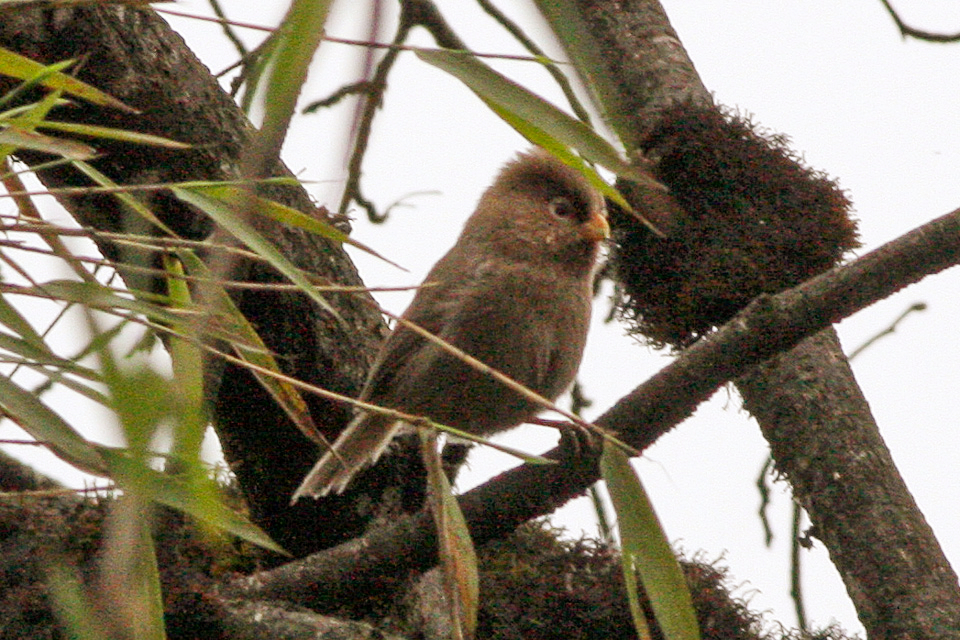
Rusty-throated Parrotbill
Sinosuthora przewalskii
Order: Passeriformes / Family: Sylviidae

Wikimedia Commons
About the Rusty-throated Parrotbill
The Rusty-throated Parrotbill, scientifically known as Sinosuthora przewalskii, is a small passerine bird endemic to the mountainous regions of China. Its presence is predominantly recorded in the scrublands and bamboo thickets of the eastern Tibetan Plateau, particularly in the Sichuan and Qinghai provinces. This bird holds significant importance in its ecosystem due to its role in seed dispersal, particularly for the plants within its specialized habitat. The parrotbill's feeding habits often aid in the propagation of bamboo and other native flora, contributing to the ecological balance of its environment. Throughout the year, this bird exhibits a range of behaviors adapted to its seasonal surroundings. During the breeding season, typically between April and July, the Rusty-throated Parrotbill engages in vibrant displays of courtship and territorial defense. Its melodious song, often heard echoing through the valleys, signals the establishment of breeding territories. As the seasons change, the bird shows adaptability in its movements, occasionally shifting to lower elevations in search of food during harsh winters. The Rusty-throated Parrotbill serves as a fascinating subject for ornithologists and bird enthusiasts alike due to its limited range and specialized habitat requirements. Its presence in the high-altitude environments of China underscores the intricate relationships within these ecosystems, highlighting the importance of conservation efforts to preserve such unique species. The bird's ecological role extends beyond its immediate environment, as it contributes to the broader biodiversity of the region. By maintaining healthy populations of plants and insects, the Rusty-throated Parrotbill supports the food web that sustains many other species. Understanding the significance of this small yet impactful bird aids in appreciating the delicate balance of life in the high-altitude regions it inhabits.
The Rusty-throated Parrotbill belongs to the family Sylviidae, within the order Passeriformes. These birds typically live average 4-6 years with a maximum recorded of 8 years.
How to Identify a Rusty-throated Parrotbill
The Rusty-throated Parrotbill is easily recognized by its vibrant rusty-orange throat, which contrasts sharply with the olive-brown plumage of its body. Adult birds, measuring about 11 cm in length, exhibit a short, stout bill reminiscent of parrots, a notable feature that contributes to its name. The plumage on the back and wings is primarily olive-brown with subtle yellowish tones, while the underparts are lighter, often with a whitish belly. Juveniles resemble adults but may display slightly duller coloring and less pronounced throat rustiness. Sexual dimorphism is minimal in this species; however, males might show slightly brighter plumage during the breeding season. In flight, the parrotbill's short, rounded wings and rapid, flitting flight pattern can be observed. When perched, it often adopts an upright posture, showcasing its distinctive throat and bill. Confusion with similar species, such as the Fulvous Parrotbill, can occur, though the Rusty-throated Parrotbill's unique throat color provides a reliable distinguishing feature.
Having trouble telling birds apart? Upload a photo to our bird identification tool for an instant species match.
Rusty-throated Parrotbill Habitat and Range
Preferred Habitat
The Rusty-throated Parrotbill primarily inhabits the dense bamboo thickets and scrublands of high-altitude regions, thriving at elevations between 2,500 and 4,000 meters. These areas offer both cover and an abundance of food resources. The bird shows a preference for temperate broadleaf and mixed forests where bamboo is a dominant understory component. Seasonal habitat shifts are common, with some populations moving to lower elevations during the winter months to escape harsh conditions and seek more readily available food sources. While typically found in remote, rural areas, the Rusty-throated Parrotbill occasionally ventures into the fringes of human settlements, especially where natural habitats have been altered to create gardens or orchards. Its adaptability in habitat selection reflects its resilience in the face of environmental challenges.
Geographic Range
The Rusty-throated Parrotbill's range is confined primarily to central China, where it breeds in the eastern Tibetan Plateau and parts of Sichuan and Qinghai provinces. Its distribution is highly localized, with population density hotspots centered around specific high-altitude regions that provide suitable habitat conditions. The bird does not undertake long-distance migrations but may exhibit altitudinal movements in response to seasonal changes in temperature and food availability. During the breeding season, the parrotbill remains within its established territories, while in winter, it may descend to slightly lower elevations, though still within its native range. This restricted range highlights the species' reliance on specific ecological conditions and the importance of regional conservation efforts to protect its natural habitat.
Want to know which birds visit your area? Browse our backyard birds by location guides for region-specific species lists.
What Does the Rusty-throated Parrotbill Eat?
The Rusty-throated Parrotbill primarily feeds on a diet composed of small insects and seeds, with a particular preference for bamboo seeds. During the breeding season, insects such as caterpillars and beetles become a major component of its diet, providing the necessary protein for growing chicks. In the winter months, when insect availability declines, the parrotbill shifts its focus to seeds and plant material, foraging in dense thickets where these resources are abundant. The bird employs a foraging technique that involves gleaning insects from foliage and probing into bamboo shoots for seeds. It forages throughout the day, with peak activity occurring in the early morning and late afternoon when temperatures are cooler. The Rusty-throated Parrotbill's diet reflects its adaptability and its crucial role in controlling insect populations and aiding in the dispersal of plant seeds within its habitat.
Rusty-throated Parrotbill Behavior and Social Structure
The Rusty-throated Parrotbill exhibits a range of interesting behaviors that reflect its social and ecological adaptations. It is a highly social bird, often found in small flocks outside of the breeding season. These flocks, typically consisting of 5 to 15 individuals, engage in cooperative foraging and alert each other to potential predators through a series of alarm calls. Territorial behavior becomes prominent during the breeding season, with males vigorously defending their chosen areas through song and displays to deter rivals. Courtship involves a combination of vocalizations and physical displays, where males perform short flights and exhibit their vibrant throat plumage to attract females. This bird's daily activity patterns include periods of intense foraging interspersed with rest and preening. It responds to predators, such as raptors, with a combination of alarm calls and evasive flight maneuvers, often seeking refuge within dense vegetation. The Rusty-throated Parrotbill's behavior underscores its adaptability and the complex social structures that characterize its interactions within the avian community.
Rusty-throated Parrotbill Nesting and Reproduction
The Rusty-throated Parrotbill constructs its nest in dense shrubbery, often within bamboo thickets, which offer protection from predators and harsh weather. The nest itself is a cup-shaped structure made from grasses, bamboo leaves, and other plant fibers, intricately woven to ensure stability. It is usually positioned at a height of 1 to 2 meters above the ground. The typical clutch consists of 3 to 5 eggs, which are pale white with fine reddish speckles. The incubation period lasts about 14 days, with both parents sharing the responsibility of keeping the eggs warm. After hatching, the chicks remain in the nest for approximately two weeks before fledging. During this time, both parents are actively involved in feeding and caring for the young. The Rusty-throated Parrotbill typically raises one brood per year, although in favorable conditions, a second brood may occasionally occur.
Rusty-throated Parrotbill Sounds and Vocalizations
The primary song of the Rusty-throated Parrotbill is a series of melodious whistles, often described as sweet and flute-like. The song consists of repeated phrases, each lasting a few seconds, and is used primarily during the breeding season to attract mates and establish territories. In addition to its song, the parrotbill produces a variety of call notes, including soft chirps and trills used for communication within flocks. Alarm calls are sharp and insistent, serving as warnings to other birds of potential danger. During the dawn chorus, the parrotbill's song can be a prominent feature, adding to the cacophony of sounds in its mountainous habitat. The bird's vocalizations are an integral part of its behavior, facilitating social interactions and territorial defense.
Interesting Facts About the Rusty-throated Parrotbill
- 1The Rusty-throated Parrotbill is one of the smallest parrotbills, measuring only about 11 cm in length.
- 2Despite its name, the Rusty-throated Parrotbill is not a true parrot; its beak shape is an example of convergent evolution.
- 3This bird is endemic to China, meaning it is found nowhere else in the world, highlighting its ecological importance.
- 4The parrotbill's vocalizations can vary slightly between regions, suggesting some level of geographic variation in song.
- 5Its primary habitat, bamboo thickets, is a vital component of its survival, providing both food and shelter.
- 6The Rusty-throated Parrotbill exhibits altitudinal migration, a fascinating adaptation to high-altitude living conditions.
- 7Researchers study this bird to understand the impacts of climate change on high-altitude ecosystems.
Rusty-throated Parrotbill Conservation Status
The Rusty-throated Parrotbill is currently listed as Near Threatened on the IUCN Red List, with its population facing ongoing threats from habitat loss and degradation. Deforestation and the conversion of land for agriculture pose significant risks to its bamboo thicket habitats. Additionally, climate change may alter the delicate ecological balance of its high-altitude environments, further impacting its survival. Conservation efforts focus on protecting and restoring its natural habitat, with emphasis on sustainable land use practices and the establishment of protected areas. Historical population data suggests a decline due to habitat pressures, but targeted conservation initiatives offer hope for stabilizing and potentially increasing populations in the future.