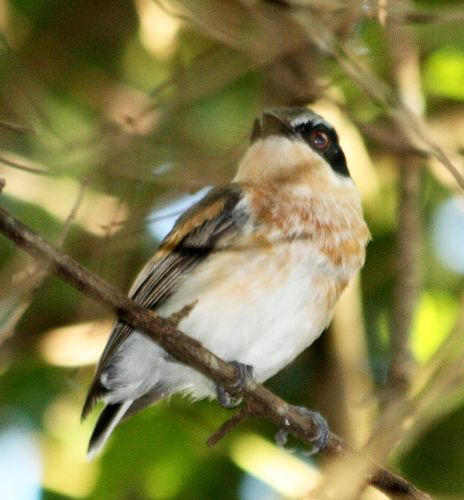
Ruwenzori Batis
Batis diops
Order: Passeriformes / Family: Platysteiridae

Wikimedia Commons
About the Ruwenzori Batis
The Ruwenzori Batis (Batis diops) is an enchanting small passerine that captivates birdwatchers with its vivid plumage and energetic behavior. Found predominantly in the montane forests of central Africa, this bird inhabits regions such as the Ruwenzori Mountains, from which it derives its name. The bird's presence is notable in areas spanning Uganda, Rwanda, and the eastern Democratic Republic of the Congo. As a member of the family Platysteiridae, the Ruwenzori Batis plays a significant role in the ecosystem as both a predator of insects and a prey species for larger avian predators. This bird often frequents the dense undergrowth of montane forest edges and clearings, where its acrobatic foraging can be observed. During the breeding season, which typically coincides with the rainy season, the Ruwenzori Batis becomes highly territorial. Its role in the ecosystem extends to influencing the population dynamics of the insects it preys upon, thus contributing to the ecological balance. The bird's distinctive call, a series of high-pitched whistles, punctuates the forest canopy, serving as both a territorial marker and a means of communication with its mate. The Ruwenzori Batis exhibits seasonal behaviors that are closely tied to the cyclic nature of its montane habitat. During the wetter months, its activity becomes more pronounced, coinciding with an abundance of insect life. Conversely, in drier periods, it may display more subdued behavior, conserving energy and reducing its territorial activities. The Ruwenzori Batis is a compelling subject for study, providing insight into the complex interactions within montane forest ecosystems and the adaptations necessary for survival in such environments.
The Ruwenzori Batis belongs to the family Platysteiridae, within the order Passeriformes. These birds typically live approximately 5-8 years..
How to Identify a Ruwenzori Batis
The Ruwenzori Batis is easily recognized by its striking black and white coloration. Adult males exhibit a bold black mask across the face, which contrasts sharply with their white throat and underparts. The upperparts are a slate gray, while the wings display black and white barring. Females share a similar pattern but with a slightly duller appearance and less intense black markings. Juveniles can be distinguished by their more muted tones and lack of a fully developed mask. The bright yellow eyes of both sexes are particularly striking and serve as an excellent field mark. In terms of size, the Ruwenzori Batis is small, measuring approximately 12 cm in length, which aids in its identification when compared to other birds within its habitat. Its silhouette in flight is characterized by short, rounded wings and a relatively short tail, giving it a somewhat compact appearance. When perched, it maintains a distinctive upright posture, often flicking its tail as it surveys its surroundings. This behavior, along with its vocalizations, helps differentiate it from similar species such as the Chinspot Batis, which lacks the yellow eye coloration and has different vocal patterns.
Having trouble telling birds apart? Upload a photo to our bird identification tool for an instant species match.
Ruwenzori Batis Habitat and Range
Preferred Habitat
The Ruwenzori Batis inhabits montane forests, favoring dense underbrush and forest edges where it can forage for insects. These forests are found at elevations ranging from 1,500 to 3,500 meters, providing a cool and humid environment ideal for its lifestyle. The bird is primarily a resident of primary and secondary forests, though it can occasionally be found in more open areas adjacent to wooded regions. Seasonal habitat shifts are minimal, as the Ruwenzori Batis remains largely within its montane range throughout the year. While not commonly found in urban environments, its presence near rural settlements is possible when suitable forest habitats are nearby. The bird's reliance on montane habitats makes it vulnerable to deforestation and habitat fragmentation, which can impact its population and distribution.
Geographic Range
The Ruwenzori Batis is endemic to central Africa, with its range encompassing the Albertine Rift montane forests. It is primarily found in Uganda, Rwanda, and the eastern Democratic Republic of the Congo. Within this range, it occupies specific montane regions such as the Ruwenzori Mountains and the Virunga Volcanoes. The bird does not undertake significant migratory movements, remaining within its montane habitat throughout the year. While population density can vary, hotspots of abundance are typically found in undisturbed forest areas where insect prey is plentiful. The bird's range is limited to these specific montane regions, making it an important species for conservation efforts focused on preserving these unique ecosystems.
Want to know which birds visit your area? Browse our backyard birds by location guides for region-specific species lists.
What Does the Ruwenzori Batis Eat?
The diet of the Ruwenzori Batis consists primarily of insects and other small arthropods. This bird is an adept forager, often seen flitting through the underbrush in search of prey. Its diet includes beetles, caterpillars, and small spiders, which it catches with precision using a combination of aerial hawking and foliage gleaning techniques. During the rainy season, when insect activity is at its peak, the Ruwenzori Batis exhibits increased foraging activity to take advantage of the abundance of food. In contrast, its diet may shift slightly during drier periods, with a focus on the most readily available prey. The bird's small size necessitates frequent feeding throughout the day to maintain its energy levels, with peak feeding activity occurring during the cooler morning and late afternoon hours.
Ruwenzori Batis Behavior and Social Structure
The Ruwenzori Batis is a socially monogamous species, often seen in pairs or small family groups. Territorial behavior is pronounced, especially during the breeding season when both males and females actively defend their territories from intruders. Courtship displays involve a series of vocalizations and visual displays, including wing flicking and tail fanning. The bird's response to predators includes a combination of alarm calls and evasive maneuvers, utilizing its agile flight to escape threats. Daily activity patterns include periods of intense foraging interspersed with rest and preening. The bird's activity typically peaks during the morning and late afternoon, coinciding with optimal foraging conditions. Although generally solitary outside of the breeding season, the Ruwenzori Batis may occasionally join mixed-species flocks, benefiting from increased vigilance against predators.
Ruwenzori Batis Nesting and Reproduction
Ruwenzori Batis constructs neat, cup-shaped nests using fine twigs, grass, and spider silk, often positioned in the fork of a tree or shrub. The preferred nesting sites are typically located at heights of 2 to 4 meters, providing some protection from ground predators. The female lays a clutch of 2 to 3 eggs, which she incubates for a period of approximately 14 to 16 days. During incubation, the male plays an active role in providing food for the female and guarding the nest. Once hatched, the chicks remain in the nest for about 16 to 18 days, during which both parents participate in feeding and caring for the young. The Ruwenzori Batis typically raises one brood per year, though favorable conditions may occasionally allow for a second. Parental duties are shared, with both adults contributing to feeding and protection throughout the fledging period.
Ruwenzori Batis Sounds and Vocalizations
The primary song of the Ruwenzori Batis is a series of high-pitched whistles, often delivered in quick succession. The rhythm is rapid, and the pitch remains consistent, producing a clear, penetrating sound that can be heard over considerable distances. In addition to its song, the bird produces a variety of call notes, including sharp 'chip' sounds used in communication between mates or to alert others of potential threats. Alarm calls are more abrupt and higher in pitch, serving as a warning to both mates and other nearby birds. During the dawn chorus, the Ruwenzori Batis is an active participant, contributing its distinct whistles to the symphony of sounds that mark the beginning of the day.
Interesting Facts About the Ruwenzori Batis
- 1The Ruwenzori Batis is named after the Ruwenzori Mountains, a range known as the 'Mountains of the Moon.'
- 2This species is one of the few birds with bright yellow eyes, a feature that stands out against its black mask.
- 3Despite its small size, the Ruwenzori Batis is a fierce defender of its territory, especially during the breeding season.
- 4The bird's nest is often constructed with the help of spider silk, adding strength and flexibility to the structure.
- 5Ruwenzori Batis can be a part of mixed-species flocks, gaining added protection against predators through increased numbers.
Ruwenzori Batis Conservation Status
The Ruwenzori Batis currently holds a status of Least Concern according to the IUCN Red List, though it faces threats from habitat loss due to deforestation and land conversion. The population trend appears stable, with no significant declines noted in recent assessments. Conservation efforts focus on preserving the montane forest habitats critical to its survival, with several protected areas established within its range. Historical population changes have been relatively minor, but ongoing monitoring is essential to ensure that habitat degradation does not lead to future declines. Effective conservation strategies must address both the protection of existing habitats and the restoration of degraded areas to support long-term population stability.