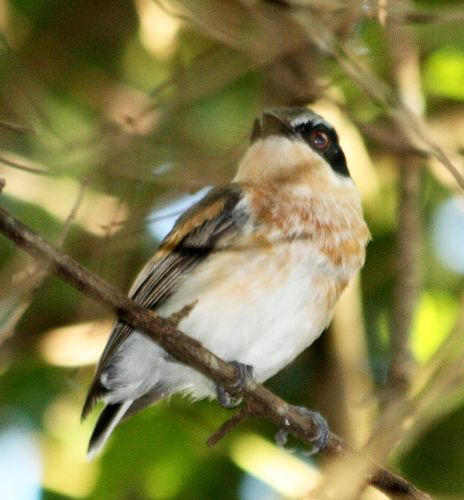
Western Black-headed Batis
Batis erlangeri
Order: Passeriformes / Family: Platysteiridae

Wikimedia Commons
About the Western Black-headed Batis
The Western Black-headed Batis (Batis erlangeri) is a small, socially inclined passerine bird belonging to the family Platysteiridae. This avian species predominantly inhabits the highland regions of Ethiopia and extends into Eritrea, favoring environments that range from montane forests to bushlands. Its ecological role is significant, as it participates in insect population control, feeding on a variety of arthropods. As a resident species, the Western Black-headed Batis is non-migratory, with its presence noted throughout the year in its endemic regions. Its adaptability allows it to thrive in both dense woodlands and open savanna, indicating a versatile foraging strategy and tolerance to habitat variability. During the breeding season, which corresponds with the local wet season, these birds become more vocal and territorial, displaying increased activity levels. The Western Black-headed Batis contributes to the ecological balance by participating in seed dispersal indirectly through its diet and interactions with other species. Its significance in the ecosystem extends to its role as a prey species for several raptors, thus forming a crucial link in the food web. Observations of the Western Black-headed Batis reveal its preference for mixed habitats where it can exploit the resources of both forested and open areas, a testament to its evolutionary adaptability within the African highlands.
The Western Black-headed Batis belongs to the family Platysteiridae, within the order Passeriformes. These birds typically live approximately 5-7 years..
How to Identify a Western Black-headed Batis
The Western Black-headed Batis is readily identifiable by its distinctive black head and contrasting white throat and belly. Adult males exhibit a bold white supercilium above the eye, along with a striking black breast band. The upperparts are primarily gray, providing a subtle backdrop to the pronounced head markings. Females differ slightly, displaying a narrower breast band and often a duller overall coloration. Juveniles are less distinctly marked, lacking the stark contrast seen in adults, and their plumage can appear more muted, with brownish tones replacing the deep black of mature birds. In flight, the Western Black-headed Batis presents a compact silhouette with rounded wings and a short tail, which aids in maneuverability through dense foliage. Its perching posture is upright, often with a slight forward lean, allowing for quick launches into flight when pursuing prey or evading predators. Similar species include the Eastern Black-headed Batis, but the Western species can be distinguished by its geographic range and subtle differences in plumage intensity. Birders focusing on these identification cues will find the Western Black-headed Batis an engaging subject in the field.
Having trouble telling birds apart? Upload a photo to our bird identification tool for an instant species match.
Western Black-headed Batis Habitat and Range
Preferred Habitat
The Western Black-headed Batis inhabits a variety of environments, primarily favoring montane forests, bushlands, and semi-arid savannas. It thrives at elevations ranging from 1,500 to 3,000 meters, often found in regions such as the Ethiopian Highlands. Seasonal shifts may see these birds moving between forested areas and more open landscapes, particularly during the dry season when resources are scarcer. While generally preferring rural settings, the Western Black-headed Batis occasionally ventures into suburban areas where natural habitats intersect with human settlements. Its presence in both forest and savanna environments highlights its adaptability and resourcefulness in exploiting diverse ecological niches.
Geographic Range
The range of the Western Black-headed Batis is predominantly confined to the highland areas of Ethiopia, with some populations extending into Eritrea. This bird is considered a resident species, with no significant migratory movements observed. The breeding range aligns with its year-round habitat, primarily within the Ethiopian Highlands. Although its distribution is relatively restricted geographically, within its range, the Western Black-headed Batis is fairly common, often found in localized population clusters where suitable habitat conditions exist. Conservation efforts focus on preserving these highland ecosystems to ensure the continued stability of its populations.
Want to know which birds visit your area? Browse our backyard birds by location guides for region-specific species lists.
What Does the Western Black-headed Batis Eat?
The diet of the Western Black-headed Batis consists mainly of small insects and arthropods, which it adeptly captures using its agile flight and keen eyesight. It primarily feeds on beetles, caterpillars, and spiders, adjusting its diet seasonally to include a variety of available insects. During the wet season, when insect populations surge, the batis takes advantage of the abundance, while in drier months, it may rely more heavily on spiders and other less mobile prey. Its foraging technique involves short sallies from perches, allowing it to capture prey mid-air or pluck them from foliage. The Western Black-headed Batis typically feeds during daylight hours, with peak activity in the cooler morning and late afternoon periods.
Western Black-headed Batis Behavior and Social Structure
Western Black-headed Batis exhibits intriguing behavioral patterns, often observed in pairs or small family groups. Its social structure includes strong pair bonds, with males and females participating in territorial defense, particularly during the breeding season. Courtship involves vocal displays and aerial chases, with males showcasing their plumage to attract mates. This species is primarily diurnal, engaging in foraging activities early in the morning and late in the afternoon, avoiding the midday heat typical of its habitat. Flocking behavior is rare, as these birds maintain defined territories, but they may join mixed-species flocks during non-breeding periods to enhance foraging success. When faced with predators, the Western Black-headed Batis employs alarm calls and seeks dense cover for protection.
Western Black-headed Batis Nesting and Reproduction
The nesting habits of the Western Black-headed Batis involve constructing small, cup-shaped nests using twigs, grass, and spider silk, often placed in the fork of a tree or shrub. These nests provide a secure environment for the eggs, which typically number between two and three per clutch. Both parents share incubation duties, which last approximately 14 days. Once hatched, the chicks are cared for by both parents, who diligently provide food and protection. The fledging period lasts about 15 to 18 days, after which the young remain under parental supervision for several weeks. The Western Black-headed Batis usually raises one to two broods per year, depending on environmental conditions and resource availability.
Western Black-headed Batis Sounds and Vocalizations
The vocalizations of the Western Black-headed Batis are characterized by a series of melodious whistles and trills. Its primary song consists of a clear, rising sequence of notes, often delivered from a prominent perch. These songs serve both territorial and mate-attraction purposes. The call notes are sharp and distinctive, functioning as contact calls between paired birds. Alarm calls are harsher and more rapid, effectively alerting conspecifics to potential threats. During the dawn chorus, the Western Black-headed Batis contributes to the symphony with its rhythmic and repetitive song, signaling the start of daily activities.
Interesting Facts About the Western Black-headed Batis
- 1The Western Black-headed Batis can often be seen engaging in a behavior known as 'wing-flicking,' a rapid movement used to startle insects.
- 2This species occupies a relatively narrow geographic range, being endemic to the highland regions of Ethiopia and Eritrea.
- 3Despite its small size, the Western Black-headed Batis plays a significant role in controlling insect populations in its native habitats.
- 4The Western Black-headed Batis's distinctive calls can be heard echoing through montane forests during the early morning hours.
- 5Both male and female Western Black-headed Batises participate equally in raising their young, from incubation to fledging.
- 6The Western Black-headed Batis exhibits a unique perching style, often seen leaning slightly forward, ready for quick sallying flights.
- 7This batis species has adapted to a variety of habitats, demonstrating its ecological versatility and resilience.
Western Black-headed Batis Conservation Status
The Western Black-headed Batis currently holds a conservation status of Least Concern according to the IUCN. Its population trend appears stable, thanks in part to its adaptability to various habitats within its restricted range. However, ongoing threats include habitat degradation due to agricultural expansion and deforestation, which could impact its future populations. Conservation efforts focus on habitat preservation and promoting sustainable land use practices in the highland regions of Ethiopia and Eritrea. Historical data suggest that the Western Black-headed Batis has maintained stable numbers, but continuous monitoring is essential to ensure its long-term survival.