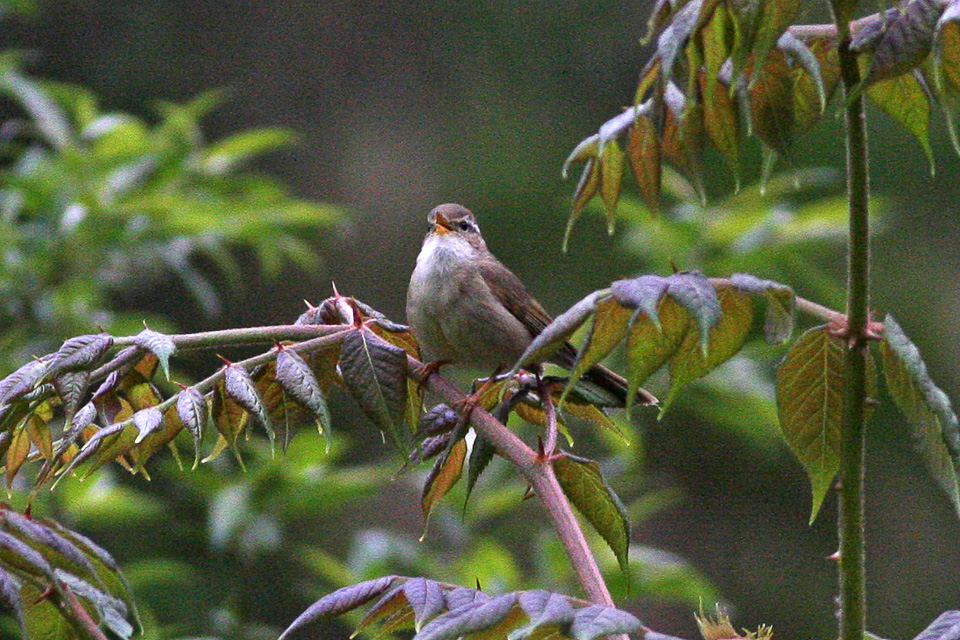
Smoky Warbler
Phylloscopus fuligiventer
Order: Passeriformes / Family: Phylloscopidae

Wikimedia Commons
About the Smoky Warbler
The Smoky Warbler, scientifically known as Phylloscopus fuligiventer, is a small passerine bird belonging to the family Phylloscopidae. This species is particularly noted for its subtle grayish-brown plumage that blends seamlessly with its woodland habitat. Native to the Himalayan regions, the Smoky Warbler inhabits dense, moist forests, often found at elevations ranging from 2,000 to 3,500 meters. Its presence is most pronounced in regions such as Nepal, Bhutan, and northeastern India, where it plays a crucial role in the forest ecosystem by controlling insect populations.
The ecological significance of the Smoky Warbler is underscored by its role as an insectivore. It aids in maintaining local insect populations, thus contributing to the health of the forest understory. During the breeding season, typically from March to July, the Smoky Warbler engages in elaborate courtship displays, which are as much a part of the forest soundscape as the rustle of leaves. The bird's melodic song, a series of high-pitched whistles and trills, resonates through the trees, making it a key player in the region's avian chorus.
Seasonally, the Smoky Warbler exhibits some altitudinal migration, moving to slightly lower elevations during the colder months. This movement ensures its survival in the harsh Himalayan winters, allowing it to exploit different insect populations as its primary food source. The bird's adaptability to different forest types, from subtropical to temperate, highlights its ecological resilience and the importance of diverse habitats in its life cycle.
The Smoky Warbler belongs to the family Phylloscopidae, within the order Passeriformes. These birds typically live average 5 years, with limited data on maximum lifespan..
How to Identify a Smoky Warbler
The Smoky Warbler can be identified by its uniform grayish-brown plumage, which serves as camouflage in its woodland environment. Adults exhibit a subtle differentiation in color with a slightly lighter underbelly. Juveniles closely resemble adults but may appear more muted in their brown tones. Unlike many other warblers, there is minimal sexual dimorphism, with males and females looking remarkably similar. This species is often confused with the Ashy-throated Warbler due to similar coloration. However, the Smoky Warbler lacks the distinct white throat patch of the Ashy-throated.
In terms of silhouette, the Smoky Warbler maintains a typical passerine form with a slightly rounded head and medium-length tail. When perching, it tends to adopt an upright posture, often flicking its tail and wings. In flight, the bird exhibits quick, agile movements, characteristic of insectivorous warblers, allowing it to navigate dense foliage efficiently.
The Smoky Warbler's physical features are complemented by its behavior, which can be a helpful identification cue. It is often seen flitting through the lower to mid-level canopy, rarely descending to the ground. Observers should note its active foraging habits, as it frequently moves between branches in pursuit of insects.
Having trouble telling birds apart? Upload a photo to our bird identification tool for an instant species match.
Smoky Warbler Habitat and Range
Preferred Habitat
The Smoky Warbler predominantly inhabits the montane forests of the Himalayas. These forests are characterized by their dense canopy and rich biodiversity, providing an ideal environment for the warbler's insectivorous diet. This species is commonly found at elevations between 2000 and 3500 meters, thriving in both subtropical and temperate forest zones.
During the breeding season, the Smoky Warbler prefers areas with dense undergrowth, which offer ample foraging opportunities and nesting sites. As the season changes, the warbler may move to slightly lower elevations to avoid the harsh winter conditions, yet it remains within the forested areas. Unlike some other bird species, the Smoky Warbler is not typically found in urban or heavily disturbed areas, relying instead on the continuous cover provided by mature forests. This preference for remote, wooded habitats underscores the bird's dependence on healthy forest ecosystems for its survival.
Geographic Range
The Smoky Warbler's range is largely confined to the Himalayan region, with its breeding grounds spanning across Nepal, Bhutan, and parts of northeastern India. The bird's population is most densely concentrated in these areas, where suitable forest habitats are abundant. During the non-breeding season, the Smoky Warbler may exhibit altitudinal migration, relocating to slightly lower elevations within its range to escape severe winter weather.
While the species does not undertake long-distance migrations typical of other warblers, its movement within the mountainous regions offers an excellent example of altitudinal migration, a strategy that allows the bird to exploit varying environmental conditions and available food resources throughout the year. The Smoky Warbler's range is relatively limited compared to other warblers, yet within its habitat, it remains a common species, frequently encountered by birdwatchers familiar with the Himalayan forests.
Want to know which birds visit your area? Browse our backyard birds by location guides for region-specific species lists.
What Does the Smoky Warbler Eat?
The Smoky Warbler's diet primarily consists of insects, which it skillfully hunts among the foliage of its forest habitat. It prefers small to medium-sized insects, including caterpillars, beetles, and various larvae, which it captures through a combination of gleaning and aerial sallying techniques. The warbler's feeding activity peaks during the early morning and late afternoon when insect activity is highest.
During the breeding season, the Smoky Warbler's dietary intake increases to support its energy demands, and it often supplements its diet with small spiders and other arthropods. Seasonal changes in insect availability influence its foraging behavior, prompting the bird to exploit different strata of the forest canopy as needed. This adaptability in feeding habits not only supports its survival in diverse conditions but also highlights its role in regulating insect populations within the forest ecosystem.
Smoky Warbler Behavior and Social Structure
The Smoky Warbler exhibits a range of behaviors that reflect its adaptability and ecological niche. It is generally solitary or found in small family groups, particularly during the breeding season, when it becomes highly territorial. Males establish territories through song and display behaviors, engaging in vocal duels with rivals to defend their chosen area.
Courtship involves elaborate displays, with males using a combination of song and physical displays, such as wing-flicking and tail-spreading, to attract females. Once paired, the Smoky Warbler remains monogamous throughout the breeding season, with both parents contributing to nest building and chick-rearing.
Despite its small size, the Smoky Warbler is vigilant against predators, employing alarm calls to warn conspecifics of potential threats. During the day, the bird is most active in the early morning and late afternoon, resting during the heat of midday. Outside the breeding season, it may join mixed-species flocks, benefiting from the safety and increased foraging success these groups provide.
Smoky Warbler Nesting and Reproduction
The Smoky Warbler constructs a cup-shaped nest, typically situated in the fork of a branch or within dense foliage to provide concealment from predators. The nest is primarily made of grass, moss, and fine twigs, intricately woven to create a secure structure.
Clutch sizes range from three to five eggs, with incubation lasting approximately 12 to 14 days. Both parents participate in incubation, although the female primarily undertakes this task while the male provides food. After hatching, the nestlings remain in the nest for about 10 to 12 days before fledging. During this period, both parents are actively involved in feeding and caring for the young.
The Smoky Warbler typically raises one to two broods per year, depending on environmental conditions and food availability. This reproductive strategy allows the species to maximize its breeding success in the relatively short breeding season of its montane habitat.
Smoky Warbler Sounds and Vocalizations
The Smoky Warbler's song is a distinctive series of high-pitched whistles and trills, delivered with a rapid rhythm and a clear, melodic quality. This song serves as both a territorial and an advertising call, establishing the singer's presence in its territory.
In addition to its primary song, the Smoky Warbler produces various call notes, including a soft 'tsee-tsee' used for communication with mates and offspring. Its alarm call is a sharp, short 'chip' sound, deployed in response to potential threats.
During the dawn chorus, the Smoky Warbler's song contributes to the symphony of avian voices that greet the day in the Himalayan forests. This vocal performance is a testament to its role in the complex social and ecological interactions of its habitat.
Interesting Facts About the Smoky Warbler
- 1The Smoky Warbler's song is so high-pitched that it can be difficult for some older humans to hear.
- 2Despite being predominantly insectivorous, the Smoky Warbler will occasionally consume small fruits and berries.
- 3The Smoky Warbler's breeding season coincides with the summer monsoon, ensuring abundant insect prey for feeding young.
- 4This warbler can adjust its foraging height within the forest canopy depending on seasonal changes in insect abundance.
- 5The Smoky Warbler's preference for dense foliage makes it challenging to spot, but its song often betrays its presence.
- 6In mixed-species flocks, the Smoky Warbler is known for its alertness, often the first to signal danger.
- 7The species name 'fuligiventer' refers to its smoky-colored belly, a distinguishing feature among similar warblers.
Smoky Warbler Conservation Status
The Smoky Warbler is currently listed as a species of Least Concern by the IUCN, with its population considered stable. However, it faces potential threats from habitat destruction due to deforestation and land conversion in the Himalayan region. Conservation efforts focus on preserving its montane forest habitats, which are critical for its survival. Protected areas in Nepal, Bhutan, and India provide important refuges for the species, helping to mitigate the impacts of habitat loss. Although historical data on population trends is sparse, the Smoky Warbler has maintained stable numbers thanks to its adaptability and the vast expanses of its forested range. Continued conservation efforts will be essential to ensure its long-term survival amidst growing environmental pressures.