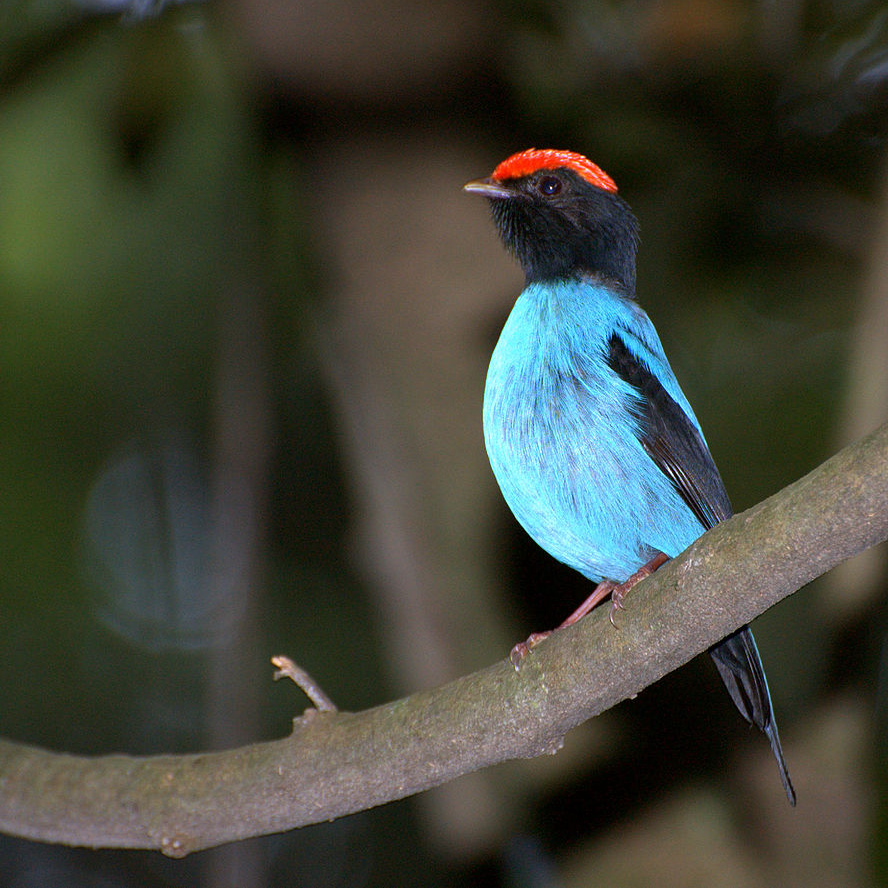
Snow-capped Manakin
Lepidothrix nattereri
Order: Passeriformes / Family: Pipridae

Wikimedia Commons
About the Snow-capped Manakin
The Snow-capped Manakin, scientifically known as Lepidothrix nattereri, is a small, yet strikingly beautiful bird residing primarily in the tropical lowland rainforests of South America. This bird is renowned not only for its dazzling appearance but also for its unique ecological role. The Snow-capped Manakin is predominantly found in the dense canopies of the Amazon Basin, spanning regions in Brazil, Peru, and Bolivia. Its presence in these vital ecosystems highlights the bird's role in seed dispersal, which is crucial for maintaining forest health and biodiversity. The manakin's diet, consisting mainly of small fruits and berries, aids in the proliferation of various plant species, ensuring the continued vitality of these lush environments. During the breeding season, the Snow-capped Manakin exhibits fascinating courtship behaviors, which play a significant role in its ecological niche. Males perform intricate displays to attract females, showcasing their agility and fitness in the dense understory. This seasonal behavior peaks during the rainy season when food resources are abundant. Outside the breeding season, the Snow-capped Manakin tends to be more solitary, yet it remains an essential contributor to the ecological balance of its habitat. Unfortunately, like many other species in the Amazon, the Snow-capped Manakin faces threats from habitat destruction and deforestation. Conservation efforts are crucial to ensure that this splendid bird continues to thrive in its natural habitat. By understanding and protecting the ecosystems the Snow-capped Manakin inhabits, we not only preserve a unique species but also safeguard the intricate web of life that defines these tropical forests.
The Snow-capped Manakin belongs to the family Pipridae, within the order Passeriformes. These birds typically live average 5-7 years..
How to Identify a Snow-capped Manakin
The Snow-capped Manakin is a small bird, measuring about 9 to 10 centimeters in length. Its most distinctive feature is the bright white crown on the male's head, which starkly contrasts with its jet-black body, creating a striking visual effect. Females, on the other hand, are more understated, with an olive-green plumage that provides excellent camouflage in the leafy canopy. Juvenile birds resemble females in coloration, slowly acquiring the male's striking colors as they mature. In flight, the Snow-capped Manakin displays rapid wingbeats and a somewhat erratic flight pattern, typical of many manakin species. Its perching posture is upright, often seen on thin branches in the mid to upper canopy levels. When identifying the Snow-capped Manakin, birders should be cautious not to confuse it with similar species, such as the Opal-crowned Manakin. However, the latter can be distinguished by its more iridescent crown and different geographical range.
Having trouble telling birds apart? Upload a photo to our bird identification tool for an instant species match.
Snow-capped Manakin Habitat and Range
Preferred Habitat
The Snow-capped Manakin thrives in the humid lowland rainforests of South America. These forests provide the dense canopy cover and abundant food resources the bird requires. It is primarily found at elevations from sea level to about 900 meters, although it is most commonly seen in areas with a dense understory and numerous fruiting trees. The bird shows a strong preference for primary forests but can occasionally be spotted in well-preserved secondary forests. Unlike some of its congeners, the Snow-capped Manakin does not typically venture into urban areas, remaining in its forested habitat throughout the year. Seasonal habitat shifts are minimal, reflecting the relatively stable climate of its rainforest home.
Geographic Range
The Snow-capped Manakin's range is limited to the Amazon Basin, primarily concentrated in Brazil, with populations extending into southeastern Peru and northern Bolivia. This bird does not migrate, maintaining a year-round presence in its tropical rainforest habitat. Within this range, population densities vary, often correlating with the availability of fruiting trees and suitable nesting sites. Hotspots for observing the Snow-capped Manakin include the Manu National Park in Peru and the Madidi National Park in Bolivia. Despite its restricted range, the Snow-capped Manakin's population is considered stable, though ongoing deforestation poses a significant threat to its habitat.
Want to know which birds visit your area? Browse our backyard birds by location guides for region-specific species lists.
What Does the Snow-capped Manakin Eat?
The Snow-capped Manakin primarily feeds on fruits and berries, which constitute the bulk of its diet. It plays a crucial role in seed dispersal, aiding the regeneration of its rainforest habitat. The bird's foraging technique involves short, quick flights between branches to pluck ripe fruits. While fruits dominate its diet, the Snow-capped Manakin occasionally supplements its intake with small insects and other invertebrates, particularly during the breeding season when protein demands are higher. The size of prey items is generally small, consistent with its petite stature. Feeding activity peaks during the early morning and late afternoon, coinciding with cooler temperatures and reduced competition.
Snow-capped Manakin Behavior and Social Structure
The Snow-capped Manakin exhibits a solitary lifestyle outside of the breeding season, yet during courtship, males gather in loose leks to perform elaborate displays. These displays involve rapid movements, vocalizations, and wing snaps to attract females. The bird's territorial behavior is most pronounced during the breeding season, with males defending display areas from rivals. The Snow-capped Manakin is generally non-aggressive towards other species, often sharing fruiting trees with other frugivores. In response to predators, it relies on its agile flight and dense canopy cover for protection. Daily activity patterns are diurnal, with peak activity during dawn and dusk.
Snow-capped Manakin Nesting and Reproduction
The Snow-capped Manakin constructs a delicate, cup-shaped nest, typically suspended from a thin branch in the forest understory. The nest is composed of fine plant fibers, spider webs, and moss, providing both camouflage and stability. Females are primarily responsible for nest construction and incubation, laying a clutch of two eggs. The incubation period lasts approximately two weeks, with the female providing all care until hatching. Once the chicks fledge, which occurs about 15 to 18 days post-hatching, they remain dependent on the female for several more weeks. The Snow-capped Manakin usually raises one brood per year, aligning its reproductive cycle with the rainy season's peak food availability.
Snow-capped Manakin Sounds and Vocalizations
The Snow-capped Manakin's primary song is a series of soft, high-pitched notes delivered in rapid succession, often compared to the sound of a squeaky wheel. This song is primarily used during courtship displays, with males vocalizing to attract females. In addition to its song, the bird emits short, sharp call notes used for communication and alarm. The Snow-capped Manakin is most vocal during the early morning hours, participating in a dawn chorus that resonates through the forest. Compared to its more vocal relatives, the Snow-capped Manakin's calls and songs are subtle, reflecting its more solitary nature.
Interesting Facts About the Snow-capped Manakin
- 1The Snow-capped Manakin is one of the few birds with a lek-based courtship system, where males gather to perform for females.
- 2Despite its vibrant appearance, the Snow-capped Manakin is often overlooked due to its secretive nature and preference for dense forests.
- 3Males spend up to 90% of their time during the breeding season practicing and performing courtship displays.
- 4The Snow-capped Manakin's diet consists of over 80% fruits, making it a key seed disperser in its habitat.
- 5The species was named after Johann Natterer, an Austrian naturalist who collected numerous specimens in South America.
- 6Unlike many tropical birds, the Snow-capped Manakin does not migrate, maintaining a year-round presence in its rainforest home.
- 7Females are solely responsible for nest-building and chick care, reflecting a strong division of labor in this species.
Snow-capped Manakin Conservation Status
The Snow-capped Manakin is currently classified as Least Concern by the IUCN, with its population trend considered stable. However, the primary threat to this species is habitat loss due to deforestation in the Amazon Basin. Conservation efforts focus on preserving large tracts of intact rainforest, as these provide the necessary environment for the bird's survival. Additionally, protected areas such as national parks play a crucial role in safeguarding its habitat. Historical population changes are not well-documented, but continued habitat degradation could pose future risks to the species.