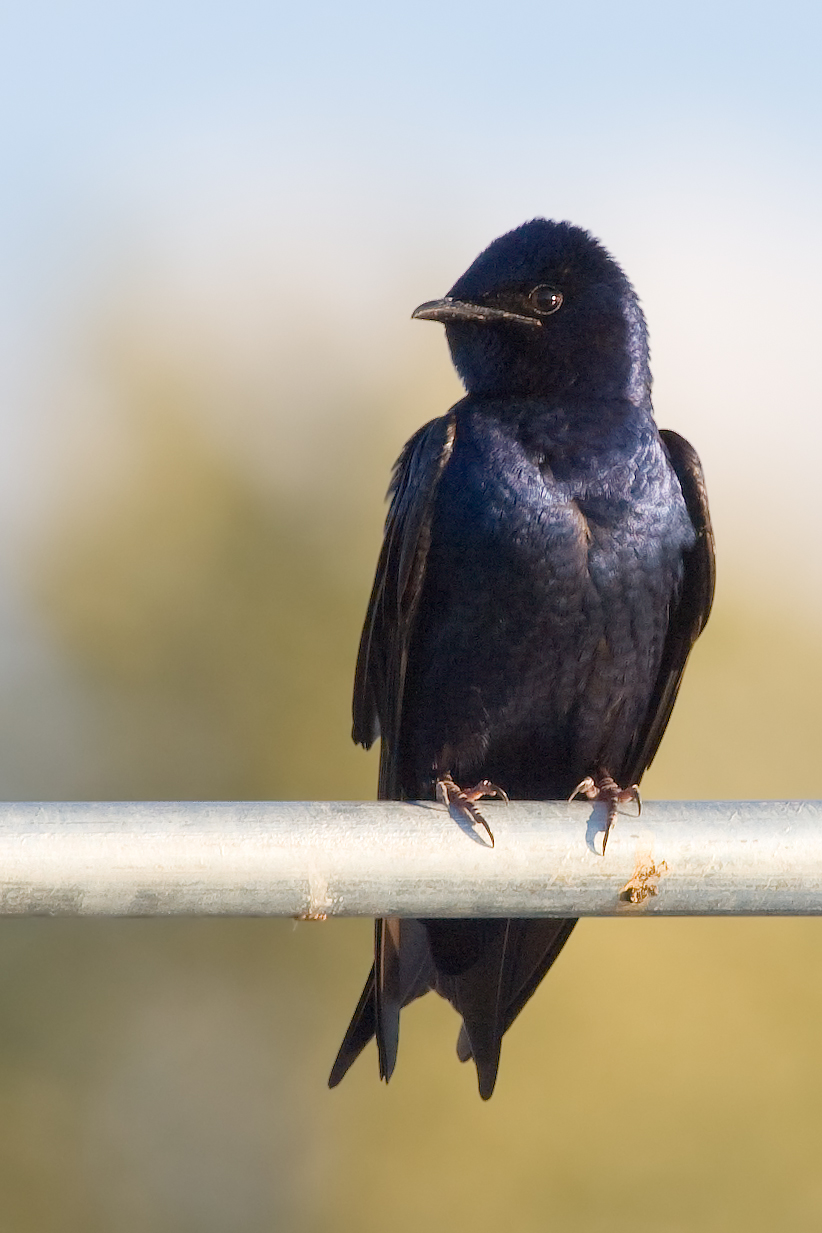
Southern Martin
Progne elegans
Order: Passeriformes / Family: Hirundinidae

Wikimedia Commons
About the Southern Martin
The Southern Martin, scientifically known as Progne elegans, is a striking member of the swallow family, Hirundinidae. This species is predominantly found in South America, with a breeding range that extends from southern Brazil to Argentina. Southern Martins are renowned for their glossy blue-black plumage, which gleams under the sun, making them easily identifiable against the backdrop of open skies. They play a crucial ecological role as insectivores, significantly controlling insect populations in their habitats.
These birds are a migratory species, moving between different regions depending on the season. During the breeding season, which spans from October to March, they favor open grasslands and agricultural areas, where they build their nests. As the seasons shift, the Southern Martin migrates northward to tropical regions in search of more abundant food supplies. Their migration routes are a marvel of avian navigation, illustrating their adaptability to varied ecological conditions.
The Southern Martin contributes to the biodiversity of its ecosystems not only through its dietary habits but also by serving as prey for larger avian predators. They exhibit strong site fidelity, often returning to the same nesting sites year after year. This behavior ensures the maintenance of stable breeding colonies, which are crucial for sustaining their populations. Their presence in both rural and urban environments highlights their adaptability and the significant ecological niches they occupy.
The Southern Martin belongs to the family Hirundinidae, within the order Passeriformes. These birds typically live average 5-8 years, with a maximum recorded of 10 years..
How to Identify a Southern Martin
The Southern Martin is a medium-sized swallow, measuring around 18-20 centimeters in length. Its adult plumage is a lustrous blue-black, with a slight iridescent sheen that distinguishes it from similar species. The males and females appear similar, though females may exhibit slightly duller tones. Juveniles can be identified by their browner coloration and less glossy appearance.
One might confuse the Southern Martin with other swallows, such as the Purple Martin, but the difference lies in their size and plumage nuances. The Southern Martin is slightly smaller and lacks the purple hues of its counterpart. When in flight, the Southern Martin presents a streamlined silhouette with long, pointed wings and a slightly forked tail, typical of the Hirundinidae family.
Perched Southern Martins exhibit a horizontal posture, often seen on telephone wires or open branches. Their compact bodies and swift movements are key identification features. Observing their flight can also aid in identification, as they perform agile maneuvers while foraging for insects.
Having trouble telling birds apart? Upload a photo to our bird identification tool for an instant species match.
Southern Martin Habitat and Range
Preferred Habitat
Southern Martins inhabit a variety of open environments. They prefer grasslands, savannas, and agricultural fields, where they can capitalize on open spaces for foraging. These habitats provide ample opportunities for aerial insect hunting. During the breeding season, they are frequently found at elevations from sea level up to 1,500 meters, where nesting sites are abundant.
In urban settings, Southern Martins have adapted to exploit man-made structures for nesting. They are often seen around barns and bridges, where they find suitable niches to build their nests. Seasonal habitat shifts are observed as they migrate to warmer climates during the non-breeding season, often settling in tropical lowlands.
Urban and rural areas both support Southern Martin populations, though they show a preference for regions with ample insect prey and suitable nesting sites. Their adaptability to various environments highlights their resilience and ecological versatility.
Geographic Range
The Southern Martin's breeding range covers southern South America, with significant populations in Argentina, Uruguay, and southern Brazil. During the breeding season, they concentrate in these areas, taking advantage of the warm climate and abundant food resources.
As the breeding season concludes, the Southern Martins embark on a northward migration, moving towards tropical regions such as northern Brazil and the Amazon Basin. This migration occurs from March to September, driven by the search for more consistent food supplies during the austral winter.
Within their range, population densities vary, with hotspots often found in regions with extensive grasslands and minimal human disturbance. Their migratory pathways are well-established, ensuring connectivity between breeding and non-breeding habitats. The Southern Martin's range reflects their adaptability and the broader ecological patterns of migratory birds in South America.
Want to know which birds visit your area? Browse our backyard birds by location guides for region-specific species lists.
What Does the Southern Martin Eat?
The diet of the Southern Martin consists primarily of flying insects. They are adept aerial foragers, capturing prey mid-flight with impressive agility. Their diet includes a variety of insects such as flies, beetles, and moths, which they hunt using swift, acrobatic flight maneuvers.
Seasonal changes influence their dietary patterns, with some variation in prey availability during different times of the year. During the breeding season, they may focus on larger insects to meet the higher energy demands of rearing young. In contrast, their diet during migration and the non-breeding season may include smaller insects available in tropical regions.
Southern Martins typically feed throughout the day, with peak activity observed in the early morning and late afternoon. Their foraging techniques involve swift sprints through the air, often in groups, as they capitalize on insect swarms. This feeding strategy highlights their role as effective insect population regulators in their habitats.
Southern Martin Behavior and Social Structure
Southern Martins are highly social birds, often observed in flocks during foraging and migration. They exhibit strong territorial behavior during the breeding season, with males defending nesting sites aggressively against intruders. Courtship displays involve aerial chases and vocalizations, as males demonstrate their strength and agility to potential mates.
Flocking patterns shift with the seasons, with large congregations forming during migration. These flocks can number in the hundreds, providing safety in numbers against predators. Southern Martins respond to predators with alarm calls and vigorous aerial displays, often mobbing intruders to deter them.
Daily activity patterns are diurnal, with peak activities coinciding with insect availability. They exhibit a mix of solitary and communal behaviors, depending on the time of year and environmental conditions. Their social structure during the breeding season is more solitary, with pairs focusing on nesting duties.
Southern Martin Nesting and Reproduction
Southern Martins build cup-shaped nests using mud and plant materials. They prefer sites with some degree of shelter, such as eaves, cliffs, or man-made structures, where they can construct nests with minimal disturbance.
The typical clutch size ranges from 3 to 5 eggs, with an incubation period of about 15 to 18 days. Both parents share incubation duties, though females may spend more time on the nest. After hatching, the fledging timeline spans approximately 30 days, during which both parents feed and care for the chicks.
Parental roles are well-defined, with both males and females participating in feeding and protective duties. Southern Martins usually have two broods per year, depending on environmental conditions and food availability. Their nesting strategies are adapted to maximize reproductive success and ensure the survival of their young.
Southern Martin Sounds and Vocalizations
The Southern Martin's primary song is a series of melodious, liquid notes that can carry over long distances. These songs are often heard during courtship and territory establishment. Their calls include sharp, metallic 'tseep' notes, used for communication within flocks and between mates.
Alarm calls are more abrupt and harsh, serving to alert others of potential danger. During the dawn chorus, Southern Martins contribute a distinctive, rhythmic tune that adds to the symphony of bird calls. Their vocalizations are less varied than some songbirds, but they are effective in communication within their social groups.
Interesting Facts About the Southern Martin
- 1Southern Martins can travel over 5,000 kilometers during migration, showcasing their endurance.
- 2These birds use mud to construct their nests, similar to some species of swallows.
- 3Southern Martins form large flocks during migration, sometimes numbering in the thousands.
- 4Their glossy plumage helps them stand out in sunlight, aiding in mate attraction and species recognition.
- 5Despite their migratory nature, Southern Martins often return to the same nesting sites each year.
- 6Southern Martins can consume hundreds of insects daily, playing a vital role in controlling pest populations.
- 7Their aerial acrobatics are not only for feeding but also a display during courtship rituals.
Southern Martin Conservation Status
The Southern Martin currently holds a status of Least Concern according to the IUCN. Population trends appear stable, though localized threats exist, such as habitat loss due to agriculture and urban expansion. Conservation efforts focus on habitat preservation and monitoring population dynamics. Historically, the Southern Martin has shown resilience to moderate environmental changes, maintaining stable populations across its range. Continued conservation efforts are necessary to ensure that this species continues to thrive against the backdrop of human development and climate change.
Other Hirundinidae Species


Birds Similar to the Southern Martin
These species are often confused with the Southern Martin due to similar appearance or overlapping range.