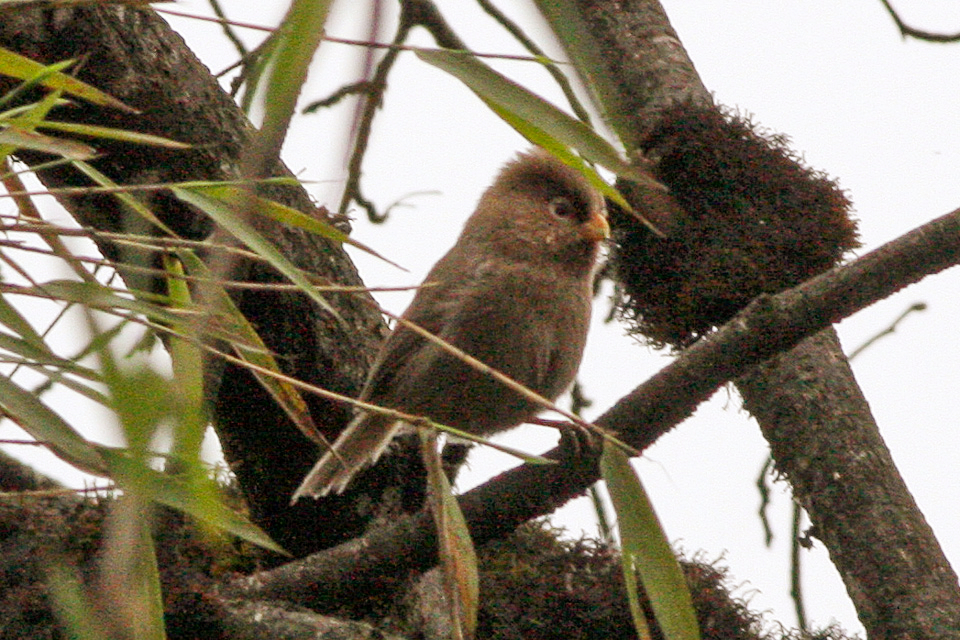
Spectacled Parrotbill
Sinosuthora conspicillata
Order: Passeriformes / Family: Sylviidae

Wikimedia Commons
About the Spectacled Parrotbill
The Spectacled Parrotbill (Sinosuthora conspicillata) is a captivating member of the family Sylviidae. This small passerine bird is notable for its unique appearance and behavior, thriving in the dense thickets and bamboo forests of central China. The bird’s name arises from its striking facial markings, resembling spectacles, which prominently contrast against its overall brown plumage. This species plays an essential ecological role in its habitat by participating in seed dispersal and contributing to insect population control. The Spectacled Parrotbill's range is predominantly within China's provinces, including Sichuan, Hubei, and Yunnan, where it occupies subtropical and temperate zones. Its presence is integral to these ecosystems, where it forages among the understory vegetation.
Primarily a resident species, the Spectacled Parrotbill exhibits local movements driven by food availability rather than long migrations. During breeding seasons, these birds can be found in smaller family groups, often observed flitting through dense underbrush and bamboo stands. The Spectacled Parrotbill's ecological significance is underscored by its role in the food web, providing sustenance to predators while managing insect populations. The bird's adaptability to various microhabitats within its range showcases its importance in maintaining ecological balance.
The Spectacled Parrotbill is particularly fascinating due to its behavior and vocalizations. It is not only a visual delight but also an auditory one, with its calls and songs resonating through its habitat. These vocalizations play a critical role in communication, especially during breeding seasons when males assert territories and attract mates. As a species, the Spectacled Parrotbill exemplifies the interconnections in its ecosystem, demonstrating the complexity of avian life in central China. The bird’s ongoing survival amidst environmental changes highlights the need for conservation efforts to preserve its natural habitat, ensuring that this remarkable parrotbill continues to thrive.
The Spectacled Parrotbill belongs to the family Sylviidae, within the order Passeriformes. These birds typically live average 4-6 years with a maximum recorded of 8 years.
How to Identify a Spectacled Parrotbill
The Spectacled Parrotbill is a small bird, measuring about 16 centimeters in length. Its most distinctive feature is the black eyepatch-like marking around its eyes, earning it the name ‘Spectacled’. The rest of its plumage is primarily brown, with a reddish-brown back and pale underparts. Adults exhibit a stout, parrot-like bill, which is pale and contrasts with the darker face. Juveniles are similar in appearance to adults but may have slightly less pronounced facial markings and a more uniformly brown plumage.
Sexual dimorphism is subtle in this species, with males and females appearing quite similar. However, males might exhibit slightly brighter plumage during the breeding season. The Spectacled Parrotbill may be confused with other parrotbills or babblers, but its distinctive facial markings and stout bill help in accurate identification. In flight, it presents a compact silhouette with short, rounded wings and a relatively short tail, characteristic of birds adapted to maneuvering through dense foliage.
While perching, the Spectacled Parrotbill often adopts a horizontal posture, clinging to the sides of reeds or bamboo stalks. This posture, combined with its distinctive face and small size, makes it identifiable even from a distance. Observers should note its behavior of moving in small, active groups, which is typical of parrotbills and aids in proper identification.
Having trouble telling birds apart? Upload a photo to our bird identification tool for an instant species match.
Spectacled Parrotbill Habitat and Range
Preferred Habitat
The Spectacled Parrotbill predominantly inhabits dense thickets and bamboo forests, thriving in the complex understory of subtropical and temperate forests in central China. It favors environments with abundant foliage that provide both food sources and protection from predators. This bird is typically found at elevations ranging from 500 to 2000 meters, where bamboo growth is extensive.
Seasonal changes may influence local movements within its habitat, as the Spectacled Parrotbill seeks areas with higher food availability during different times of the year. While it primarily resides in rural areas, it occasionally ventures into less disturbed urban fringes where suitable vegetation exists. The presence of dense underbrush and bamboo is a critical factor in its habitat selection, as these structures offer ideal conditions for foraging and nesting.
Despite its preference for specific habitat types, the Spectacled Parrotbill demonstrates some level of adaptability, managing to persist in altered landscapes where native vegetation remains intact. Conservation of its natural habitat is crucial for the survival of this species, as habitat destruction poses a significant threat to its long-term viability.
Geographic Range
The Spectacled Parrotbill's range is largely confined to central China, with populations concentrated in the provinces of Sichuan, Hubei, and Yunnan. This bird inhabits areas within these provinces where dense bamboo and thickets are prevalent. The species is considered a resident, with little evidence of long-distance migration, although it may exhibit some local movements in response to seasonal changes in food availability.
In terms of population density, the Spectacled Parrotbill is most abundant in regions with well-preserved bamboo forests, where it benefits from the rich supply of food and shelter. This bird's distribution does not typically extend beyond China's borders, making it an endemic species of particular interest to ornithologists and conservationists.
While the Spectacled Parrotbill's range is relatively limited geographically, the quality of habitat within its range significantly influences its population health. Conservation efforts in these regions focus on maintaining and restoring suitable habitats to ensure the persistence of this distinctive species.
Want to know which birds visit your area? Browse our backyard birds by location guides for region-specific species lists.
What Does the Spectacled Parrotbill Eat?
The Spectacled Parrotbill primarily subsists on a diet of insects and seeds, reflecting its adaptability and resourcefulness in exploiting available food sources. Insects such as beetles, caterpillars, and other small arthropods form the bulk of its diet, especially during the breeding season when protein demands are higher.
In addition to insects, the Spectacled Parrotbill consumes seeds, which provide a vital energy source. During non-breeding seasons, when insect availability decreases, seeds become more crucial in the bird's diet. The bird employs a variety of foraging techniques, including gleaning insects from foliage and probing into crevices with its stout bill.
The Spectacled Parrotbill typically forages throughout the day, with peak activity during the early morning and late afternoon when insect activity is at its highest. Its dietary flexibility and efficient foraging strategies enable it to thrive in the dense bamboo thickets and underbrush of central China.
Spectacled Parrotbill Behavior and Social Structure
The Spectacled Parrotbill exhibits intriguing social behavior, often forming small family groups or loose flocks, which is typical for parrotbills. This social structure facilitates efficient foraging and offers protection from predators, as more eyes can detect potential threats. The bird is generally non-territorial outside of the breeding season, showing a preference for communal living.
During the breeding season, males may become more vocal and exhibit territorial behavior to attract mates and defend nesting areas. Courtship displays include vocalizations and posturing, enhancing pair bonding. The Spectacled Parrotbill remains active throughout the day, with periods of intense foraging interspersed with rest.
Its response to predators involves alarm calls and coordinated movements to confuse or deter potential threats. The bird’s tendency to remain within dense foliage offers additional protection. The Spectacled Parrotbill's daily activities revolve around foraging, social interactions, and maintaining its territory during the breeding season.
Spectacled Parrotbill Nesting and Reproduction
The Spectacled Parrotbill constructs its nest within dense vegetation, often choosing sites well-concealed within bamboo thickets or shrubs. The nest is a cup-shaped structure made from fine grasses, bamboo leaves, and other plant materials, providing a secure environment for eggs and chicks.
Typically, the Spectacled Parrotbill lays a clutch of three to five eggs. Both parents participate in incubation, which lasts approximately 12 to 14 days. After hatching, both parents also share responsibilities for feeding and caring for the young. The chicks fledge about 12 to 14 days after hatching, although they may remain dependent on their parents for a short period thereafter.
The Spectacled Parrotbill may raise one to two broods per year, depending on environmental conditions and food availability. The nesting habits of this species underscore its reliance on dense vegetation for successful reproduction, highlighting the importance of habitat preservation.
Spectacled Parrotbill Sounds and Vocalizations
The Spectacled Parrotbill's vocalizations are a key aspect of its behavior, with its primary song consisting of a series of rapid, melodious notes that rise and fall in pitch. This song, often described as cheerful and energetic, plays a crucial role in mate attraction and territory defense.
In addition to its primary song, the Spectacled Parrotbill emits short, sharp call notes used for communication within flocks or family groups. Alarm calls are distinct, characterized by a rapid ‘chit-chit’ sequence, alerting others to potential danger.
During the dawn chorus, the Spectacled Parrotbill's song is particularly prominent, contributing to the vibrant soundscape of its habitat. The bird's vocal repertoire, although not as varied as some songbirds, is distinctive and aids in identification.
Interesting Facts About the Spectacled Parrotbill
- 1The Spectacled Parrotbill's distinctive 'spectacle' markings are unique among its family group, helping birdwatchers identify it easily.
- 2Despite its name, the Spectacled Parrotbill is not a true parrot but belongs to the Sylviidae family, which includes warblers.
- 3The bird's stout, parrot-like bill is perfectly adapted for cracking seeds and accessing hard-to-reach insects.
- 4Spectacled Parrotbills are known for their acrobatic foraging behavior, often hanging upside down to reach their prey.
- 5In traditional Chinese culture, the Spectacled Parrotbill is sometimes associated with good fortune and is admired for its beauty.
Spectacled Parrotbill Conservation Status
The Spectacled Parrotbill is currently listed as Least Concern by the IUCN, with its population considered stable. However, habitat destruction poses a significant threat to its long-term survival. Deforestation and land conversion for agriculture reduce the availability of its preferred habitats. Conservation efforts focus on habitat preservation and restoration, particularly in regions with extensive bamboo forests. Protected areas and national parks in central China play a crucial role in safeguarding this species. Historical population data suggest that the Spectacled Parrotbill has maintained stable numbers where suitable habitat remains intact. Continued monitoring and conservation initiatives are essential to ensure that this species remains a thriving component of its ecosystem, particularly in the face of ongoing environmental changes.