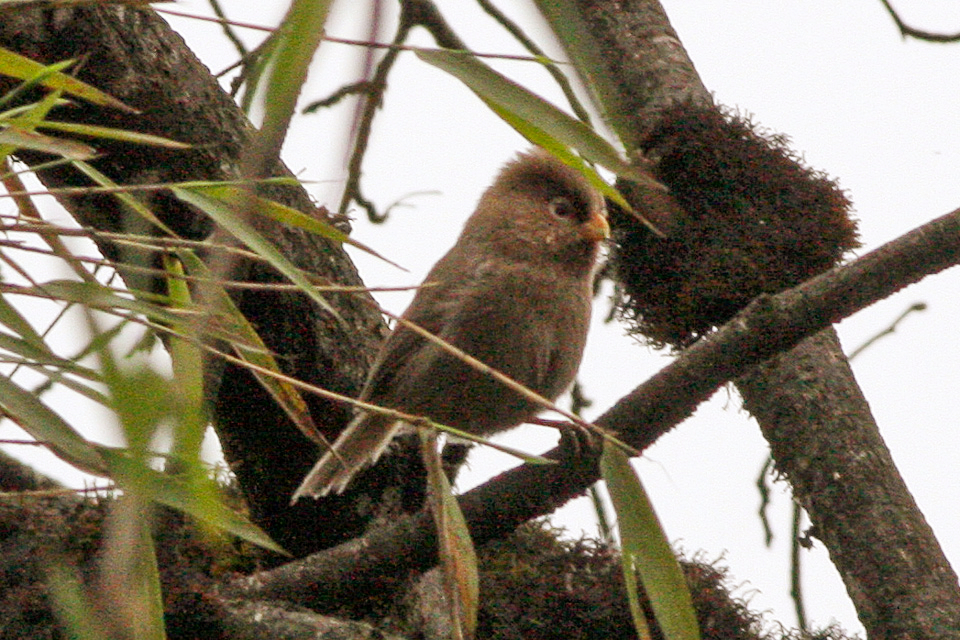
Spot-breasted Parrotbill
Paradoxornis guttaticollis
Order: Passeriformes / Family: Sylviidae

Wikimedia Commons
About the Spot-breasted Parrotbill
The Spot-breasted Parrotbill (Paradoxornis guttaticollis) holds a unique position in the avian world due to its striking appearance and specialized ecological niche. These birds are primarily found in the subtropical and tropical forests of Southeast Asia, particularly in countries like Myanmar, Thailand, Laos, and Vietnam. Their presence in these biodiverse regions underscores their role in the ecological tapestry of the forest understory, where they engage in insect predation and seed dispersal. Historically, the Spot-breasted Parrotbill is significant as it represents a lineage of birds that are uniquely adapted to dense thickets and bamboo groves. Their strong, curved bills are specifically evolved for foraging within these environments, allowing them to deftly extract insects from the foliage and feed on the seeds of bamboo and other grasses. During the breeding season, which typically occurs from April to July, these birds become particularly vocal, using their songs to establish territories and attract mates. In non-breeding seasons, the Spot-breasted Parrotbill engages in more subdued behaviors, often forming mixed-species flocks with other parrotbills and babblers to forage for food.
The Spot-breasted Parrotbill belongs to the family Sylviidae, within the order Passeriformes. These birds typically live average 5 years, with a maximum recorded of 8 years..
How to Identify a Spot-breasted Parrotbill
The Spot-breasted Parrotbill is a medium-sized bird characterized by its robust, finch-like bill and distinctive spotted throat. Adult plumage is primarily warm brown with a paler belly. The throat is marked with dark spots, which is where this bird derives its common name. Males and females generally appear similar in coloration, though females may exhibit slightly duller tones. Juveniles resemble adults but often have less pronounced throat spotting. In flight, the parrotbill's broad wings and short tail create a compact silhouette, a useful feature for navigating through dense vegetation. When perching, they often adopt a horizontal posture, gripping tightly onto branches with their strong feet.
Having trouble telling birds apart? Upload a photo to our bird identification tool for an instant species match.
Spot-breasted Parrotbill Habitat and Range
Preferred Habitat
Spot-breasted Parrotbills typically inhabit subtropical and tropical moist lowland forests, often favoring areas dense with bamboo and undergrowth. They are commonly found at elevations between 500 to 2000 meters, thriving in the thick foliage that provides both cover and food resources. These birds are less commonly observed in urban settings, preferring the seclusion of forest interiors. Seasonal changes can prompt slight altitudinal shifts as they follow food availability, but they generally remain in forested habitats year-round.
Geographic Range
The Spot-breasted Parrotbill's range stretches across Southeast Asia, with populations primarily concentrated in Myanmar, Thailand, Laos, and Vietnam. They are non-migratory, residing year-round within this geographical belt. Within these countries, they are most frequently encountered in forested regions with dense undergrowth, particularly in areas where bamboo is abundant. While their range does not extend into northern or southern extremes, they are a prominent species within the central parts of their range.
Want to know which birds visit your area? Browse our backyard birds by location guides for region-specific species lists.
What Does the Spot-breasted Parrotbill Eat?
The diet of the Spot-breasted Parrotbill consists mainly of insects and seeds, with bamboo seeds being a prominent food source. During the breeding season, when nutritional demands are high, they increase their intake of protein-rich insects. Foraging involves agile movements through dense vegetation, using their strong bills to extract insects from leaves and stems. They feed throughout the day, with peak activity during the cooler morning and late afternoon periods.
Spot-breasted Parrotbill Behavior and Social Structure
Spot-breasted Parrotbills are social birds, often observed in small flocks that include family groups and sometimes other parrotbill species. Their social structure is loosely organized, with pairs forming strong bonds during the breeding season. Courtship displays include vocalizations and mutual preening. They are territorial, especially during breeding, vocally defending their area from intruders. In response to predators, they engage in mobbing behavior, gathering in groups to deter potential threats. Their daily routine involves alternating periods of foraging and rest, with increased vocal activity at dawn.
Spot-breasted Parrotbill Nesting and Reproduction
Spot-breasted Parrotbills construct cup-shaped nests using grasses, bamboo leaves, and other plant fibers, typically positioned in dense vegetation close to the ground. Clutch sizes usually consist of two to four eggs, with both parents sharing incubation duties over a period of approximately two weeks. Post-hatching, both parents continue to care for and feed the fledglings. The fledging period lasts about three weeks, after which the young become more independent. These birds are known to produce one or two broods per year, depending on environmental conditions and food availability.
Spot-breasted Parrotbill Sounds and Vocalizations
The primary song of the Spot-breasted Parrotbill is a series of melodious whistles, often delivered in a rhythmic pattern. These whistles are clear and carry well through the forest, serving both as territorial markers and mating calls. Their call notes include sharp, quick chirps used for communication within flocks. Alarm calls are harsher and more abrupt, alerting others to the presence of predators. During dawn, their vocalizations are particularly vibrant, contributing to the symphony of the forest's dawn chorus.
Interesting Facts About the Spot-breasted Parrotbill
- 1The Spot-breasted Parrotbill's bill is uniquely adapted to pry open dense bamboo thickets to find food.
- 2Despite their name, Spot-breasted Parrotbills are more closely related to babblers than to true parrots.
- 3These birds often participate in mixed-species flocks, enhancing their foraging efficiency and predator detection.
- 4Spot-breasted Parrotbills have a particular affinity for bamboo seeds, aligning their breeding to the bamboo flowering cycle.
- 5Their vocalizations are complex, with regional variations that can serve as vocal 'dialects' distinguishing different populations.
- 6Spot-breasted Parrotbills display strong territorial instincts during breeding, frequently engaging in vocal duels with rivals.
- 7Their nesting success is closely tied to the density of the understory, which provides necessary cover and resources.
Spot-breasted Parrotbill Conservation Status
The Spot-breasted Parrotbill is currently listed as Least Concern by the IUCN, with stable population trends across most of its range. Primary threats include habitat loss due to deforestation and agricultural expansion. Conservation efforts focus on preserving forest habitats and promoting sustainable land-use practices. Historically, the species has maintained stable populations, but ongoing habitat destruction poses a potential risk to their long-term survival.