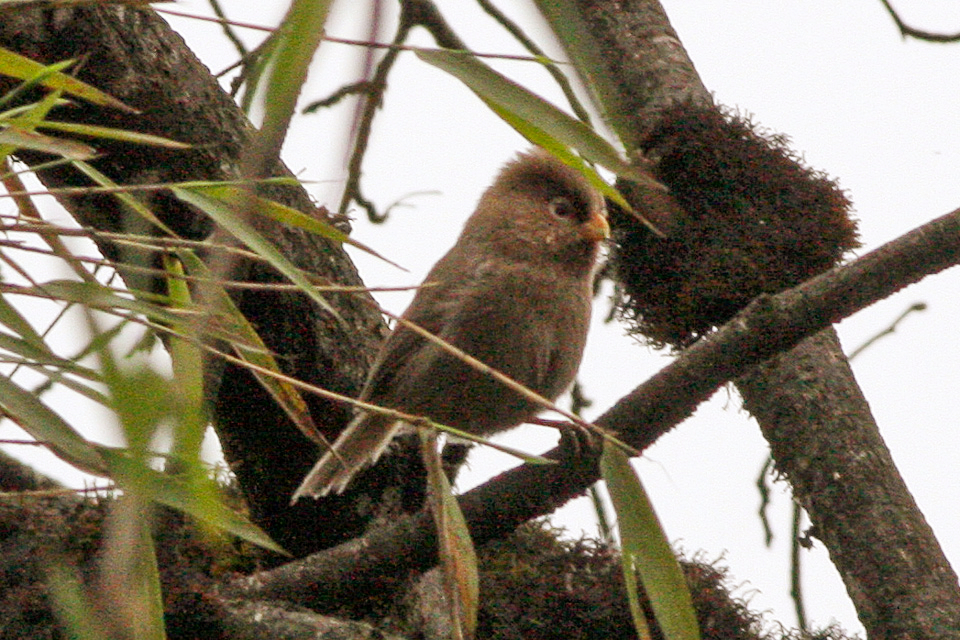
Streak-throated Fulvetta
Fulvetta manipurensis
Order: Passeriformes / Family: Sylviidae

Wikimedia Commons
About the Streak-throated Fulvetta
The Streak-throated Fulvetta (Fulvetta manipurensis) is a medium-sized bird belonging to the Sylviidae family, known for its vibrant presence in the dense montane forests of South and Southeast Asia. This bird, characterized by a streaked throat and a soft, subtle plumage, plays a significant role in its ecosystem as both a seed disperser and an insect predator. Found predominantly in the subtropical and temperate forests, the Streak-throated Fulvetta's range extends through the eastern Himalayas, including regions in Bhutan, Northeast India, and parts of Myanmar. The bird thrives in elevations ranging from 1,500 to 3,500 meters, favoring moist, dense forest understories where it can forage and nest.
Ecologically, the Streak-throated Fulvetta contributes to forest health by controlling insect populations and aiding in seed dispersion, which helps maintain the biodiversity and structure of its habitat. Its presence is often a sign of a healthy forest ecosystem, where it actively participates in the intricate web of life. This bird is particularly noted for its adaptability to varying forest types, including subtropical and temperate broadleaved forests, often found at mid to high elevations.
During different seasons, the Streak-throated Fulvetta's behaviors can shift slightly as it adjusts to changes in food availability and climate conditions. In the breeding season, typically from April to July, this bird becomes more vocal and conspicuous, marking its territory with a series of melodic calls. Outside the breeding season, the Fulvetta often joins mixed-species foraging flocks, which enhances its foraging success and provides protection against predators. Its ability to adapt to seasonal changes in the environment highlights its resilience and ecological importance in the regions it inhabits.
The Streak-throated Fulvetta belongs to the family Sylviidae, within the order Passeriformes. These birds typically live average 5-6 years with a max recorded of 8 years.
How to Identify a Streak-throated Fulvetta
Identifying the Streak-throated Fulvetta involves noting several distinct field marks. Adults exhibit a warm brown upper body with a more rufous tinge on the wings and tail. The underparts are pale with distinctive dark streaks across the throat that give the bird its name. This streaking contrasts with the otherwise uniform coloration, making it a key identification feature. The crown is often a duller shade of brown, providing a subtle contrast with the darker eye stripe that runs from the beak to the nape.
Juveniles resemble adults but have less pronounced streaking on the throat and a generally duller plumage. There is little sexual dimorphism in this species, so males and females appear similar in the field, although males may sometimes display slightly brighter plumage during the breeding season.
The Streak-throated Fulvetta can be confused with other Fulvetta species, but its distinct throat pattern and size help differentiate it. In flight, it presents a compact silhouette with a rapid wingbeat typical of small passerines. When perched, it often holds its tail slightly cocked and exhibits a restless demeanor, frequently flicking its wings and tail as it forages through the understory.
Having trouble telling birds apart? Upload a photo to our bird identification tool for an instant species match.
Streak-throated Fulvetta Habitat and Range
Preferred Habitat
The Streak-throated Fulvetta inhabits dense, moist montane forests where it can be found in the understory and mid-story layers. It shows a preference for subtropical and temperate broadleaved forests, often flourishing in areas with dense foliage and ample insect life. These habitats, typically located at elevations from 1,500 to 3,500 meters, provide the cover and resources necessary for foraging and nesting.
This bird does not typically venture into urban environments, preferring the secluded and quiet areas of mature forests. However, it may occasionally be found in forest edges or small woodland fragments if they provide suitable cover and food sources. During seasonal shifts, the Streak-throated Fulvetta remains within its forested environment, as its habitat offers a consistent source of food and nesting opportunities throughout the year.
Geographic Range
The Streak-throated Fulvetta's range spans across several Asian countries, primarily within the eastern Himalayan region. It is found in Bhutan, the northeastern states of India such as Arunachal Pradesh, Nagaland, and Manipur, and extends into parts of northern Myanmar. This bird does not migrate over long distances but may exhibit altitudinal movements in response to seasonal changes.
During breeding, the Fulvetta is mainly found in the montane forests where it can establish territories and find adequate nesting sites. In winter, it may move slightly lower in elevation to escape harsh weather conditions, although it remains within the forested regions. Population density tends to be higher in areas with dense understory vegetation and rich insect life, such as the forests of Northeast India, where a stable population is supported by the region's biodiversity.
Want to know which birds visit your area? Browse our backyard birds by location guides for region-specific species lists.
What Does the Streak-throated Fulvetta Eat?
The diet of the Streak-throated Fulvetta consists primarily of insects and other small invertebrates, supplemented by seeds and berries when available. During the warmer months, it actively forages for caterpillars, beetles, and ants, which it gleans from foliage and tree bark. This bird exhibits a methodical foraging technique, moving through the forest understory in search of prey, often seen hanging upside down or hovering briefly to reach food.
In colder months, when insect activity decreases, the Fulvetta shifts its diet to include more seeds and berries, taking advantage of the seasonal abundance of fruiting plants. It often forages in mixed-species flocks, which increases its efficiency and reduces the likelihood of predation. The bird's foraging activity peaks during the early morning and late afternoon, aligning with the periods of highest insect activity and seed availability.
Streak-throated Fulvetta Behavior and Social Structure
The Streak-throated Fulvetta exhibits a highly social and active behavior, often forming small flocks outside the breeding season. These flocks, sometimes mixed with other bird species, allow for cooperative foraging and provide safety in numbers against predators. Within the flock, the Fulvetta maintains a complex social hierarchy, with dominant individuals often leading the group during foraging or when evading threats.
Territorial behavior becomes more pronounced during the breeding season. Males sing to establish and defend their territories, using a repertoire of melodious calls that vary slightly between individuals. Courtship displays are subtle, generally involving mutual preening and synchronized movements between pairs.
The Streak-throated Fulvetta is diurnal, with most of its activities occurring during daylight hours. It starts its day with a burst of vocal activity, part of the dawn chorus, which diminishes as the sun rises. In response to predators, such as raptors and snakes, the bird emits sharp alarm calls and engages in evasive maneuvers, often diving into dense cover.
Streak-throated Fulvetta Nesting and Reproduction
The nesting habits of the Streak-throated Fulvetta are well adapted to its forest environment. Nests are typically built low in the undergrowth, often hidden within dense foliage to protect against predators. The nest is an open cup structure, constructed from grasses, leaves, and bark strips, lined with softer materials like feathers and moss to provide insulation and comfort for the eggs.
A typical clutch comprises 3 to 4 eggs, which are incubated by both parents over a period of approximately 14 days. The eggs are pale with speckles, providing some camouflage against potential threats. After hatching, the chicks remain in the nest for about 12 to 14 days before fledging. During this time, both parents share responsibilities for feeding and protecting the young. The Streak-throated Fulvetta may raise one or two broods per year, depending on environmental conditions and food availability.
Streak-throated Fulvetta Sounds and Vocalizations
The Streak-throated Fulvetta is known for its clear and melodious song, which consists of a series of rapid, high-pitched notes delivered in a lively rhythm. The song plays a crucial role during the breeding season, serving to establish territory and attract mates. In addition to its primary song, the Fulvetta produces a variety of call notes, including soft chirps and sharper, alarm calls used to signal danger.
The bird participates in the dawn chorus, adding its voice to the cacophony of forest sounds as day breaks. Its song can be compared to that of other Sylviidae, though it has a unique quality that makes it distinguishable to the trained ear.
Interesting Facts About the Streak-throated Fulvetta
- 1The Streak-throated Fulvetta often forages in mixed-species flocks, enhancing its feeding efficiency and reducing predation risk.
- 2Despite its small size, the Streak-throated Fulvetta plays an important role in seed dispersion, contributing to forest regeneration.
- 3This bird's melodious song serves as a key tool for territory defense and mate attraction during the breeding season.
- 4The Streak-throated Fulvetta can be found at elevations as high as 3,500 meters, showcasing its adaptability to montane environments.
- 5In mixed-species flocks, the Fulvetta benefits from the 'many eyes' effect, which increases vigilance against predators.
- 6The species exhibits slight altitudinal migration, moving to lower elevations in winter to escape severe weather conditions.
- 7The Fulvetta's nest is a meticulously crafted cup of grasses and leaves, lined with moss for insulation and comfort.
Streak-throated Fulvetta Conservation Status
Currently, the Streak-throated Fulvetta is not considered threatened, with a status of Least Concern according to the IUCN Red List. Its population appears stable across much of its range, although localized threats such as habitat loss due to deforestation and agricultural expansion pose potential risks. Conservation efforts focus primarily on habitat protection, ensuring that the montane forests this bird relies on remain intact. In some regions, reforestation and sustainable forestry practices help mitigate the loss of suitable habitats. Historically, the Fulvetta's population has shown resilience to environmental changes, partly due to its adaptability and broad habitat range.