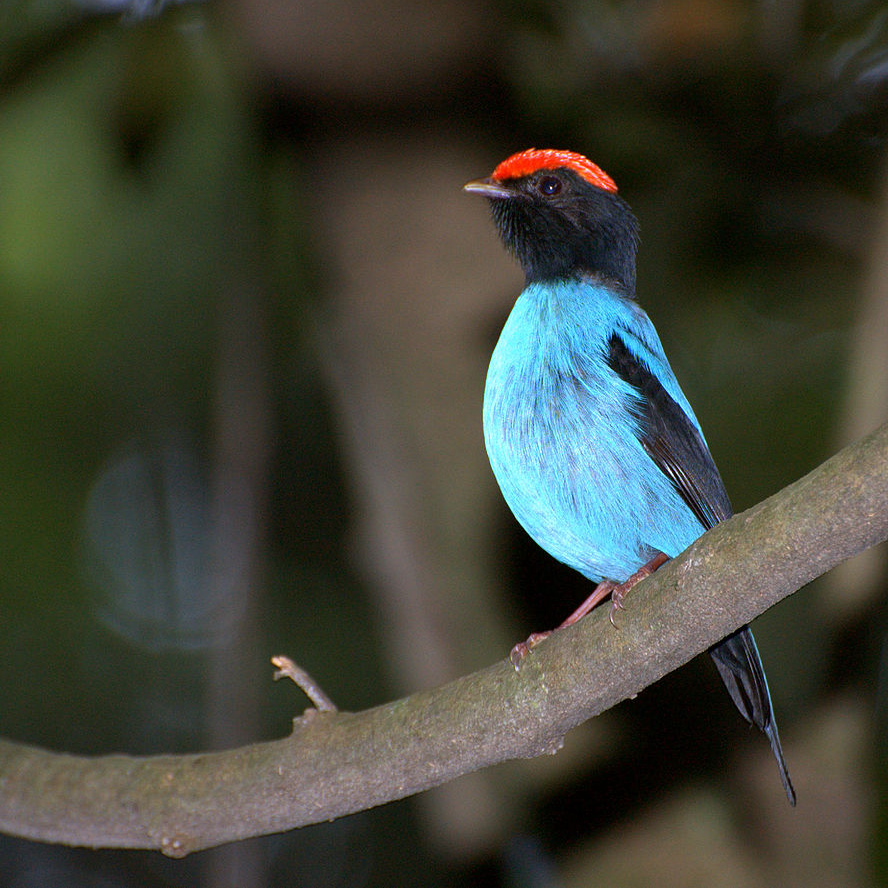
Striolated Manakin
Machaeropterus striolatus
Order: Passeriformes / Family: Pipridae

Wikimedia Commons
About the Striolated Manakin
The Striolated Manakin, known scientifically as Machaeropterus striolatus, is a captivating member of the Pipridae family, renowned for its intricate and vibrant plumage patterns. This bird thrives primarily in the South American jungles, with significant populations found in countries such as Brazil, Peru, Colombia, and Venezuela. The dense, humid forests of the Amazon Basin provide an ideal habitat for this species, offering both abundant food resources and protection from predators. The ecological significance of the Striolated Manakin is multifaceted. As a frugivore, it plays a critical role in the dispersal of seeds throughout its habitat, promoting biodiversity and forest regeneration. During the breeding season, typically from November to March, the male Striolated Manakin performs elaborate courtship displays. These displays are not only fascinating to observe but also serve as a mechanism for sexual selection, ensuring that only the most fit individuals contribute to the gene pool. The Striolated Manakin's presence in these ecosystems underscores the interconnectedness of tropical forest species and highlights the importance of conserving these rich environments. Its seasonal behaviors, such as the aforementioned breeding displays, align with the rhythms of the rainforest, illustrating the deep evolutionary adaptations the species has developed. Throughout the year, the manakin remains an integral part of the forest dynamics, engaging in activities that sustain its role as both a pollinator and seed disperser. The ecological role of Machaeropterus striolatus is vital, reflecting the delicate balance of rainforest ecosystems where it resides.
The Striolated Manakin belongs to the family Pipridae, within the order Passeriformes. These birds typically live average 4-6 years with a maximum recorded of 9 years.
How to Identify a Striolated Manakin
The adult Striolated Manakin exhibits unique field marks that aid in its identification, including its striking striped plumage. The males, in particular, display bright green feathers with thin, pale streaks across their body, a feature less pronounced in females and juveniles. Females and young birds tend to have a more subdued coloration, with their plumage leaning towards a muted olive-green. One should note the bird's small size, with a length typically ranging from 9 to 10 centimeters. The distinct streaks on the male's plumage can sometimes cause confusion with similar species such as the White-crowned Manakin. However, the latter lacks the Striolated Manakin's characteristic striping. In flight, the Striolated Manakin reveals a compact, agile silhouette, often darting swiftly between trees. When perched, it maintains an upright posture, which is typical for manakins. The combination of its bright plumage and unique behaviors make the Striolated Manakin a distinct presence within its forested habitat.
Having trouble telling birds apart? Upload a photo to our bird identification tool for an instant species match.
Striolated Manakin Habitat and Range
Preferred Habitat
The Striolated Manakin primarily inhabits tropical rainforests, favoring the dense, humid lowland forests of the Amazon Basin. These forests provide the bird with ample fruiting trees and a moist environment necessary for its survival. The manakin typically resides at elevations ranging from sea level to about 1,500 meters. While it predominantly occupies undisturbed primary forests, it can also be found in secondary growth areas that offer dense vegetation. The species shows little affinity towards urban environments, maintaining its preference for secluded, forested areas. Seasonal habitat shifts are minimal for the Striolated Manakin, as it resides year-round in the same general regions, taking advantage of the consistent climate and food availability within the rainforest.
Geographic Range
The Striolated Manakin's range is centered in South America, with its distribution spanning across several countries including Brazil, Peru, Colombia, and Venezuela. It is a resident breeder, meaning it does not migrate but rather stays within its established range throughout the year. The greatest population density is observed in the Amazon Basin, where the bird's preferred habitat conditions are met. Within these countries, the manakin occupies suitable forested areas, making it a common sight where conditions are ideal. Despite its relatively broad range, the Striolated Manakin is not found outside the tropical forests of South America, highlighting its reliance on this specific ecosystem.
Want to know which birds visit your area? Browse our backyard birds by location guides for region-specific species lists.
What Does the Striolated Manakin Eat?
The diet of the Striolated Manakin primarily consists of fruits, with a particular preference for small, fleshy berries that are abundant in its rainforest habitat. These fruits provide the necessary nutrients and energy for the manakin, especially during the breeding season. The bird employs a distinctive foraging technique known as 'hover-gleaning', where it hovers briefly in mid-air to pluck fruits directly from branches. This method allows it to access food in areas that are otherwise difficult to reach, maximizing its foraging efficiency. In addition to fruits, the manakin occasionally consumes small insects and arthropods, supplementing its diet with protein. Seasonal changes in fruit availability may lead to slight variations in diet, but the bird's adaptable foraging methods ensure it can meet its nutritional needs throughout the year.
Striolated Manakin Behavior and Social Structure
The Striolated Manakin exhibits a fascinating array of behaviors, particularly during the breeding season. Males are known for their elaborate courtship displays, which involve a series of acrobatic maneuvers, wing snaps, and vocalizations to attract females. These displays occur in designated areas known as leks, where multiple males gather to perform, creating a competitive but social environment. Outside of the breeding season, the Striolated Manakin maintains a relatively solitary existence, although it may join mixed-species flocks when foraging. The bird's territorial behavior is most pronounced during courtship, with males defending their display areas vigorously. In response to predators, the manakin relies on its agility and the dense forest cover to evade capture. Its daily activity pattern includes active foraging in the early morning and late afternoon, while it retreats to the forest canopy for rest during the heat of the day.
Striolated Manakin Nesting and Reproduction
The Striolated Manakin constructs a delicate, cup-shaped nest using fine plant fibers, moss, and spider webs. These nests are typically placed on horizontal branches, well-concealed among the dense foliage of the lower to mid-canopy. The female takes on the primary role in nest building and incubation, laying a clutch of two eggs. The eggs undergo an incubation period of approximately 18 to 21 days, during which the female remains attentive, rarely leaving the nest. Once hatched, the chicks are altricial and dependent on their mother for feeding and protection. The fledging period lasts about 15 to 20 days, after which the young manakins gain independence. The species typically raises one brood per year, although favorable conditions may occasionally allow for a second.
Striolated Manakin Sounds and Vocalizations
The Striolated Manakin's vocalizations are an essential component of its courtship displays. The primary song is a series of high-pitched, rapid trills that can be likened to the sound of a small, mechanical device. These trills vary in rhythm and pitch, creating a distinctive auditory signature that can be heard across the forest. In addition to its song, the bird produces a variety of call notes, including a sharp 'chip' used for communication between individuals. Alarm calls are less frequent but consist of a series of short, harsh notes intended to alert others to potential danger. During the dawn chorus, the Striolated Manakin's song is particularly prominent, adding to the rich tapestry of sounds that characterize its rainforest habitat.
Interesting Facts About the Striolated Manakin
- 1The Striolated Manakin can hover like a hummingbird, a rare ability among birds of its size.
- 2Males perform complex courtship displays that include wing snaps audible from a distance.
- 3Striolated Manakins are crucial seed dispersers, aiding in the regeneration of tropical forests.
- 4Despite their small size, these birds can travel several kilometers a day while foraging.
- 5Their nests are so intricately built that they often appear as natural parts of the tree branches.
Striolated Manakin Conservation Status
Currently, the Striolated Manakin is classified as Least Concern by the IUCN. This status reflects its relatively stable population across its wide range in South America. However, habitat destruction, particularly due to deforestation in the Amazon, poses a significant threat to its long-term viability. Conservation efforts focus on preserving large tracts of intact rainforest to ensure the species' continued survival. Historically, population numbers have remained robust due to the bird's adaptability in undisturbed forest environments. Despite this, ongoing monitoring and habitat protection remain crucial to prevent future declines.