
Tityra personata
Tityra personata
Order: Passeriformes / Family: Cotingidae

Wikimedia Commons
About the Tityra personata
The Masked Tityra (Tityra personata) is a striking member of the Cotingidae family, distinguished by its bold black mask that stands out against its predominantly white plumage. This bird is native to the Neotropical region, primarily inhabiting the lush forests and edges of Central and South America. Its range extends from southern Mexico through Central America, into the Amazonian basin in countries like Brazil, Peru, and Bolivia. The Masked Tityra thrives in humid environments, often found in secondary forests, woodland edges, and plantations. It plays a significant role in its ecosystem, particularly as a seed disperser. By consuming a variety of fruits, the Masked Tityra aids in the propagation of plants, contributing to the maintenance of the forest's biodiversity. Moreover, its presence in diverse habitats, from lowland tropical forests to montane regions, underscores its adaptability and ecological importance. Seasonally, the Masked Tityra demonstrates some altitudinal movements, especially in search of food resources. During the breeding season, which aligns with the rainy season in many parts of its range, the bird becomes more vocal and conspicuous as it establishes territories and forms pairs. The Masked Tityra’s ecological role extends beyond seed dispersal. Its diet includes insects, which it captures with agile flights and acrobatic maneuvers. This feeding behavior helps control insect populations, indirectly benefiting the plant species that these insects might otherwise damage. The Masked Tityra's adaptability to different forest types and human-altered landscapes indicates its resilience amid changing environmental conditions. However, this adaptability does not render the species immune to threats such as deforestation and habitat fragmentation, which continue to impact New World tropical forests significantly.
The Tityra personata belongs to the family Cotingidae, within the order Passeriformes. These birds typically live average 5-7 years, with some living up to 10 years..
How to Identify a Tityra personata
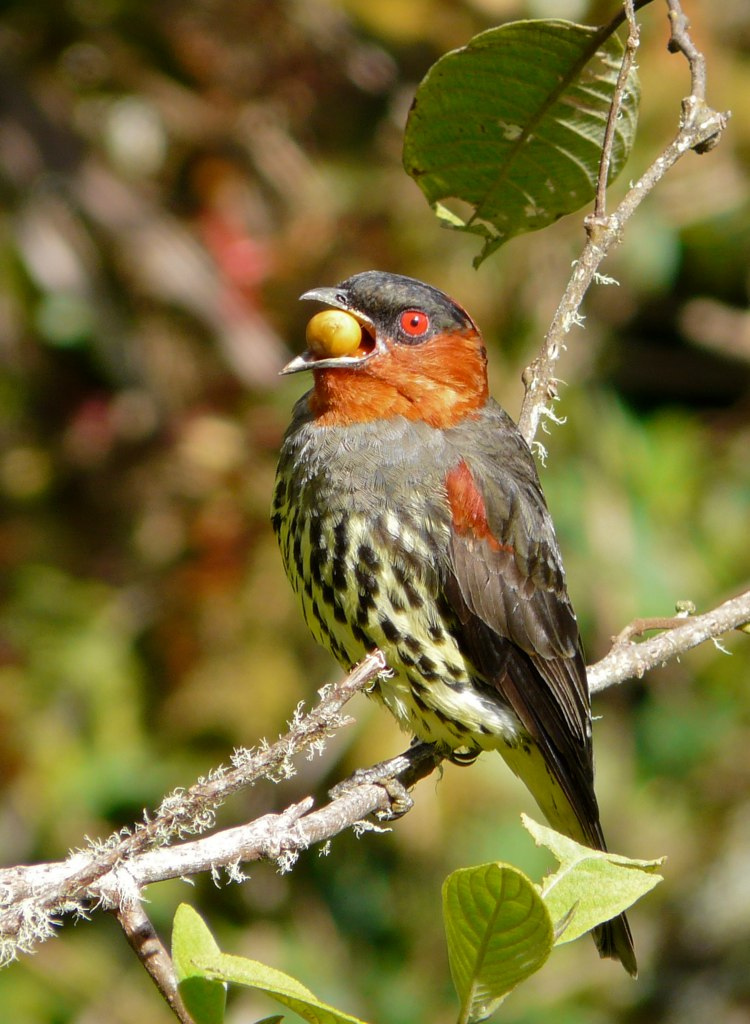
Adult Masked Tityras are easily identified by their unique black facial mask, which contrasts sharply with their white body plumage. The black mask covers the area around the eyes and extends to the nape, contributing to their striking appearance. Males and females appear similar, although females may display slightly duller plumage. Juveniles, on the other hand, have less pronounced black masks and may exhibit a more mottled brownish appearance as their adult plumage develops. In terms of size, Masked Tityras measure approximately 20 cm in length, with a wingspan of around 30 cm. Their robust bodies and short tails make them appear stockier than other passerines. In flight, they display a characteristic strong and direct silhouette. The wings are broad and rounded, aiding in their powerful, purposeful flights through forest canopies. When perched, the Masked Tityra maintains an upright posture, often tilting its head in a curious manner. Its strong bill, slightly hooked, is well-adapted for its varied diet. While its coloration is distinctive, the Masked Tityra can be confused with the Black-crowned Tityra (Tityra inquisitor), which lacks the pronounced facial mask and exhibits a darker crown. Observers can distinguish the Masked Tityra by noting the extent and clarity of the mask, as well as subtle differences in vocalizations and behavior.
Having trouble telling birds apart? Upload a photo to our bird identification tool for an instant species match.
Tityra personata Habitat and Range
Preferred Habitat
The Masked Tityra thrives in a variety of forested environments across its range. It is commonly found in lowland tropical forests, where it occupies both primary and secondary growth areas. This adaptability allows it to inhabit forest edges, clearings, and even plantations, such as those of cacao and coffee, which provide ample foraging opportunities. The bird prefers elevations ranging from sea level to about 1,500 meters, though it is most abundant in the lower tropical zones. During the breeding season, the Masked Tityra may venture into more dense forest interiors to establish nesting sites, taking advantage of the increased cover and resources. Urban presence of the Masked Tityra is relatively rare, as it favors areas with more natural vegetation and less human disturbance. However, in regions where forests have been extensively fragmented, these birds can sometimes be observed in suburban gardens and parks that mimic their natural habitat. Seasonal habitat shifts occur primarily in response to food availability, prompting some local movements rather than long-distance migration.
Geographic Range
The Masked Tityra’s range spans the Neotropical realm, stretching from southern Mexico through Central America to the northern reaches of South America. In Mexico, it inhabits the southern states, including Chiapas and Oaxaca, and extends through the countries of Guatemala, Belize, Honduras, El Salvador, Nicaragua, Costa Rica, and Panama. In South America, the bird's distribution covers large portions of the Amazon Basin, including regions of Venezuela, Colombia, Ecuador, Peru, Bolivia, and Brazil. While the Masked Tityra is not a long-distance migrant, it does exhibit some seasonal movements, particularly in response to food availability and breeding conditions. These movements are generally altitudinal, with the birds potentially relocating from lowland forests to slightly higher elevations during certain times of the year. Population densities of the Masked Tityra tend to be highest in regions where fruiting trees and abundant insect life provide rich feeding grounds. Such hotspots include the Amazonian rainforests and the tropical lowland forests of Central America. Despite its extensive range, the bird's presence can be patchy due to habitat preferences and the impact of deforestation.
Want to know which birds visit your area? Browse our backyard birds by location guides for region-specific species lists.
What Does the Tityra personata Eat?
The Masked Tityra has a varied diet that primarily includes fruits and insects. It exhibits frugivorous tendencies, often seen feeding on berries, small fruits, and figs. These food sources are abundant in the tropical forests it inhabits, and the bird plays a vital role in seed dispersal through its consumption and excretion of seeds. Insects form a secondary component of its diet, with the Masked Tityra actively hunting for beetles, caterpillars, and other arthropods. This insectivorous behavior is most prominent during the breeding season when protein-rich food is essential for raising young. The bird employs a sit-and-wait foraging strategy, perching quietly on branches before sallying forth to capture insects in flight. It also gleans insects from foliage and bark, demonstrating flexibility in its feeding techniques. The Masked Tityra feeds throughout the day, with peaks in activity during the cooler morning and late afternoon hours. Its dietary flexibility allows it to adapt to varying ecological conditions, maintaining its energy needs across different habitats and seasons.
Tityra personata Behavior and Social Structure
Masked Tityras exhibit a range of social and territorial behaviors that are intriguing to observe. They are generally solitary or found in pairs, particularly during the breeding season when they become territorial and vocal. Courtship displays involve the male showcasing his plumage and performing aerial maneuvers to attract a mate. Pairs may engage in mutual preening, reinforcing their bonds. Outside of the breeding season, Masked Tityras may be seen in small, loose groups, often participating in mixed-species flocks. This flocking behavior allows them to benefit from increased foraging efficiency and predator vigilance. When faced with potential threats, the Masked Tityra emits sharp alarm calls and may join with other species in mobbing predators. Daily activity patterns of the Masked Tityra revolve around foraging and resting. They are most active during the cooler parts of the day, retreating to shaded areas during the midday heat. Their flight is strong and direct, and they frequently move between perches in search of food. Despite their striking plumage, Masked Tityras are often inconspicuous, blending into the canopy as they forage quietly. Their ability to adapt to different forest types and participate in mixed-species flocks highlights their ecological versatility.
Tityra personata Nesting and Reproduction
Masked Tityras have an interesting nesting strategy that involves utilizing existing cavities, often in dead trees or abandoned woodpecker holes. This cavity-nesting behavior provides protection from predators and environmental elements. The chosen nest site is typically located several meters off the ground, ensuring a safe environment for raising young. The female plays a significant role in nest preparation, lining the cavity with materials such as leaves, feathers, and fine plant fibers to create a suitable environment for egg laying. Clutch size generally ranges from 2 to 3 eggs, which are white with brownish speckles. The incubation period lasts approximately 17 to 18 days, with both parents participating in incubation and feeding duties. After hatching, the chicks remain in the nest for about 24 to 28 days, during which they receive constant care and feeding from the parents. Masked Tityras typically raise one brood per year, although favorable conditions may occasionally allow for a second brood. The fledglings are dependent on their parents for several weeks post-fledging, gradually learning to forage independently.
Tityra personata Sounds and Vocalizations
The Masked Tityra's vocalizations are distinctive and serve as a key identification feature in the dense forest habitats it occupies. Its primary song consists of a series of sharp, nasal notes that can be described as 'whee-o whee-o', often repeated in quick succession. This song is most frequently heard during the breeding season, as males establish territories and attract mates. In addition to its song, the Masked Tityra produces a variety of call notes, including harsh, raspy sounds used in communication between mates and to warn of danger. Alarm calls are more abrupt and emphatic, serving to alert nearby birds of potential threats. During dawn and dusk, the Masked Tityra participates in the forest's vocal chorus, contributing its unique calls to the symphony of sounds. These vocalizations, while not as melodious as some songbirds, are highly effective in maintaining social bonds and asserting territorial claims.
Interesting Facts About the Tityra personata
- 1The Masked Tityra is often mistaken for a flycatcher due to its insect-catching skills, but it's actually a member of the Cotingidae family.
- 2Despite its striking appearance, the Masked Tityra is quite elusive, blending into the canopy and remaining silent when not breeding.
- 3The bird's distinctive black mask is not just for show; it may play a role in social signaling and mate selection.
- 4Masked Tityras sometimes use human-altered landscapes like plantations, making them more adaptable than many other forest-dependent species.
- 5Its strong, direct flight pattern allows the Masked Tityra to cover large areas of forest quickly in search of food.
- 6The Masked Tityra's diet flexibility, including both fruits and insects, ensures its survival across diverse habitats.
- 7Its role as a seed disperser highlights the Masked Tityra's importance in maintaining the biodiversity of tropical forests.
Tityra personata Conservation Status
The Masked Tityra currently holds a conservation status of Least Concern according to the IUCN Red List, indicating a relatively stable global population. However, the species faces ongoing threats from habitat destruction, primarily due to deforestation and land conversion for agriculture and urban development. These activities lead to the fragmentation of its natural forest habitats, potentially impacting local populations. Conservation efforts for the Masked Tityra focus on habitat protection and the establishment of reserves in key regions of its range. Promoting sustainable land-use practices and reforestation initiatives can help preserve suitable habitats for the species. Despite these challenges, the Masked Tityra's adaptability to secondary habitats and fragmented landscapes provides some resilience against environmental changes. Monitoring of population trends and habitat conditions remains essential to ensure long-term conservation success.
Other Cotingidae Species



Birds Similar to the Tityra personata
These species are often confused with the Tityra personata due to similar appearance or overlapping range.

