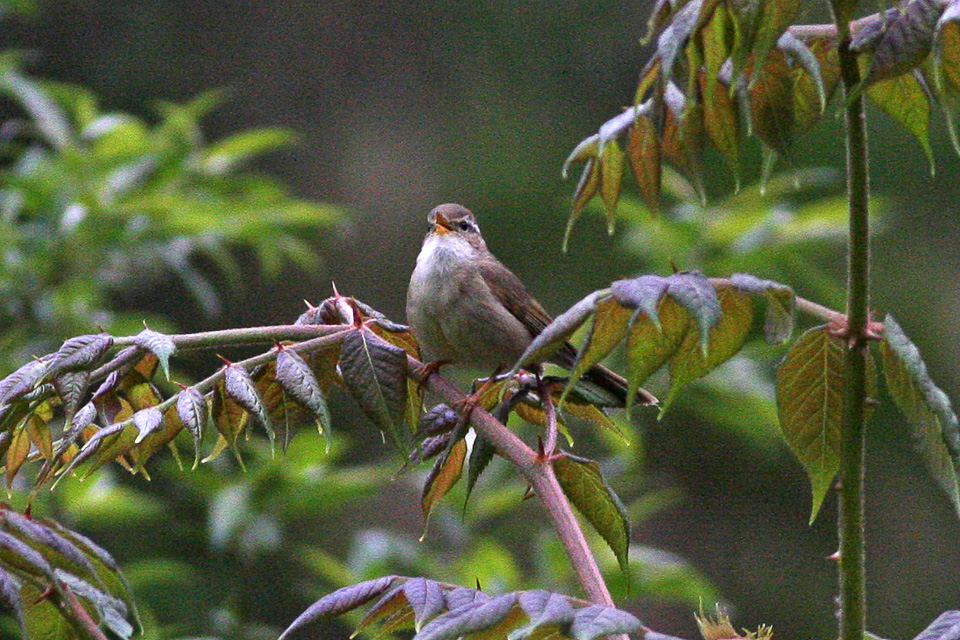
Uganda Woodland-Warbler
Phylloscopus budongoensis
Order: Passeriformes / Family: Phylloscopidae

Wikimedia Commons
About the Uganda Woodland-Warbler
The Uganda Woodland-Warbler (Phylloscopus budongoensis) is a vibrant member of the family Phylloscopidae, endemic to the montane and lowland forests of Uganda. This small passerine is a key species in its ecosystem, playing a significant role in controlling insect populations. It thrives in the forested regions of the Albertine Rift, particularly within the Budongo and Kibale forests, where dense foliage offers both food and shelter. The Uganda Woodland-Warbler is highly adapted to its environment, often found flitting among the understory and mid-canopy layers, where it forages for insects and other small invertebrates. Its presence indicates a healthy forest ecosystem, as it relies on an abundance of insect prey and dense vegetation for nesting and protection. This warbler exhibits seasonal behaviors, becoming more vocal and visible during the breeding season, which occurs from March to June. During these months, males engage in elaborate singing to establish territories and attract mates. Outside the breeding season, the Uganda Woodland-Warbler remains relatively inconspicuous, blending seamlessly into the verdant backdrop of its habitat. Its ecological role extends beyond insect control; the warbler also participates in seed dispersal and pollination indirectly by its interactions with flowering plants. As a resident species, it does not undertake long migrations, although slight altitudinal movements may occur in response to climatic changes. Conservation of its forest habitat is crucial for the continued survival of the Uganda Woodland-Warbler, as deforestation poses a significant threat to its populations.
The Uganda Woodland-Warbler belongs to the family Phylloscopidae, within the order Passeriformes. These birds typically live average 3-5 years, with a maximum recorded of 6 years..
How to Identify a Uganda Woodland-Warbler
The Uganda Woodland-Warbler is a small, agile bird characterized by its olive-green upperparts and paler underparts. Adults typically exhibit a subtle yellow wash on their throats and ventral areas, making them well-camouflaged among the leaves. Juveniles resemble adults but may have duller plumage. While the sexes are similar in appearance, males can sometimes be distinguished by their slightly more vibrant coloration during the breeding season. This species may be confused with other Phylloscopus warblers, but it can be distinguished by its distinctive song and habitat preference. In flight, the Uganda Woodland-Warbler displays a slender silhouette with a rapid, fluttering wingbeat. When perched, it often holds its body erect, cocking its tail upward. This posture, combined with its characteristic, active foraging behavior, aids birdwatchers in identification. The warbler's call, a series of high-pitched notes, further assists in differentiation from similar species, such as the Yellow-browed Warbler, which has a more pronounced eye-stripe and different vocalizations.
Having trouble telling birds apart? Upload a photo to our bird identification tool for an instant species match.
Uganda Woodland-Warbler Habitat and Range
Preferred Habitat
The Uganda Woodland-Warbler inhabits dense, humid forests across its range, primarily within the Albertine Rift. It is most commonly associated with mid-elevation evergreen forests, thriving at altitudes between 900 and 2,400 meters. This species prefers areas with a well-developed understory and abundant leaf litter, which provide ample foraging opportunities and nesting sites. While it is predominantly found in rural, forested environments, the warbler occasionally ventures into forest edges and secondary growth areas. Seasonal habitat shifts are minimal, with the bird maintaining a consistent presence in its favored forest habitats throughout the year. The Uganda Woodland-Warbler is not typically found in urban settings, as it relies heavily on the structural complexity and biodiversity of pristine forest ecosystems.
Geographic Range
The Uganda Woodland-Warbler is endemic to the East African region, with its range primarily restricted to Uganda. Within the country, it inhabits the western and southwestern forest blocks, notably the Budongo, Kibale, and Bwindi Impenetrable National Parks. This species does not engage in long-distance migrations, although some individuals may exhibit local movements within the forested regions in response to seasonal food availability. Population density hotspots correspond to areas with extensive, undisturbed forest cover. The warbler's distribution is tightly linked to the health of these forest ecosystems, making conservation efforts in these areas critical for its survival.
Want to know which birds visit your area? Browse our backyard birds by location guides for region-specific species lists.
What Does the Uganda Woodland-Warbler Eat?
The Uganda Woodland-Warbler primarily feeds on insects and other small arthropods, which it gleans from the foliage and bark of trees. Its diet includes caterpillars, beetles, and spiders, which it catches using its agile movements and sharp, pointed bill. During the breeding season, the warbler may increase its consumption of protein-rich prey to meet the demands of raising young. Seasonal diet changes are minimal, as the warbler's forest habitat provides a consistent supply of insects year-round. The bird forages actively, often in mixed-species flocks, using a combination of gleaning and short sallying flights to catch prey. Its feeding schedule is largely diurnal, with peak activity periods in the early morning and late afternoon.
Uganda Woodland-Warbler Behavior and Social Structure
The Uganda Woodland-Warbler exhibits a solitary and secretive nature outside the breeding season. During breeding, males become highly territorial, using their melodious songs to establish dominance over a particular area. This territoriality is most pronounced from March to June, when courtship displays are common. These include fluttering flights and vocal performances designed to attract females. The warbler is a diurnal species, engaging in most of its foraging and social activities during daylight hours. It forms mixed-species flocks with other insectivorous birds, enhancing foraging efficiency and reducing predation risks. In response to predators, the warbler exhibits cryptic behavior, utilizing its camouflaged plumage and quick, agile movements to evade detection. Its daily activity pattern includes periods of intense foraging interspersed with rest and preening.
Uganda Woodland-Warbler Nesting and Reproduction
The Uganda Woodland-Warbler constructs its nest in the dense understory of forest habitats, often choosing locations among the thick foliage of shrubs or small trees. The nest is a small, cup-shaped structure crafted from fine grasses, leaves, and spider silk, providing camouflage and insulation for the eggs. Clutch sizes typically range from two to four eggs, with an incubation period of approximately 14 days. Both parents share in the incubation duties and subsequent feeding of the hatchlings. The fledging period lasts about two weeks, during which the young develop rapidly under the watchful care of their parents. The warbler may produce one to two broods per year, depending on environmental conditions and food availability.
Uganda Woodland-Warbler Sounds and Vocalizations
The Uganda Woodland-Warbler's song is a melodious series of high-pitched, clear notes, often delivered in rapid succession. Its primary song features a rhythmic pattern, with a sweet and fluting quality that carries well through the forest canopy. Call notes are short, sharp chips, used in communication between mates and to signal alarm. During the dawn chorus, the Uganda Woodland-Warbler often contributes its voice, adding to the symphony of sounds that fills the forest. The bird's calls can be compared to those of the Willow Warbler, though it lacks the descending cadence characteristic of its relative.
Interesting Facts About the Uganda Woodland-Warbler
- 1The Uganda Woodland-Warbler has an unusually long breeding season, stretching from March to June, which allows for multiple broods.
- 2Despite its small size, the Uganda Woodland-Warbler plays a big role in controlling insect populations in its forest habitat.
- 3This warbler's melodious song can be heard echoing through the forests of Uganda, particularly during the breeding season.
- 4The Uganda Woodland-Warbler is a key indicator species, reflecting the health of the forest ecosystems it inhabits.
- 5Unlike many other warblers, the Uganda Woodland-Warbler remains in its forest habitat year-round, showing minimal migratory behavior.
Uganda Woodland-Warbler Conservation Status
The Uganda Woodland-Warbler is currently classified as Least Concern by the IUCN, reflecting its relatively stable population. However, ongoing deforestation poses a significant threat to its habitat, particularly in areas outside protected reserves. Conservation efforts focus on preserving the forested regions of the Albertine Rift, with initiatives aimed at curbing illegal logging and promoting sustainable land use. Historical population changes are not well-documented, but habitat degradation and fragmentation are known to negatively impact the species. Continued monitoring and habitat protection are essential to ensure the long-term survival of the Uganda Woodland-Warbler.