Ward's Flycatcher
Pseudobias wardi
Order: Passeriformes / Family: Vangidae

Wikimedia Commons
About the Ward's Flycatcher
Ward's Flycatcher, scientifically known as Pseudobias wardi, is a fascinating bird species endemic to the lush forests of Madagascar. As a member of the Vangidae family, this small passerine plays a crucial role in the ecological balance of its native habitats. Found primarily in the eastern lowland rainforests and montane regions of Madagascar, the Ward's Flycatcher thrives in areas abundant with insect life, which forms the core of its diet. Its presence is a positive indicator of forest health, as it helps control insect populations and, in turn, supports the growth of native flora. The significance of Ward's Flycatcher within its ecosystem cannot be overstated, as it maintains the delicate balance of predator and prey, contributing to the overall biodiversity of the region. This bird is not just an essential part of the forest's food web but also serves as a key species for studies on the effects of habitat fragmentation and climate change on avian life in Madagascar. Ward's Flycatcher exhibits notable seasonal behaviors, such as slight altitudinal migrations, in response to changes in food availability and weather conditions. During the breeding season, which aligns with Madagascar's rainy months from November to April, Ward's Flycatcher becomes more conspicuous as it engages in vocal displays and territorial defense. In contrast, the non-breeding season sees a reduction in vocal activity, with the birds focusing on building up energy reserves. The ecological adaptability of Ward's Flycatcher, coupled with its role as an insectivore, underscores its importance in maintaining the health and functionality of Madagascar's forest ecosystems.
The Ward's Flycatcher belongs to the family Vangidae, within the order Passeriformes. These birds typically live typically around 6-8 years, but specific data is limited..
How to Identify a Ward's Flycatcher
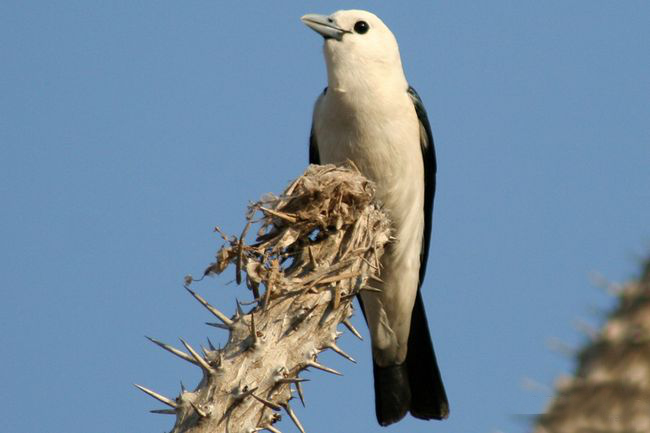
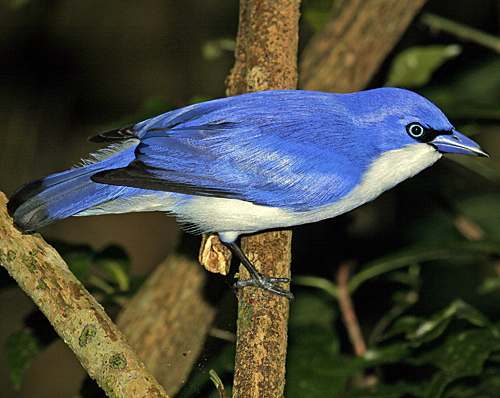
Ward's Flycatcher is a medium-sized bird, easily recognized by its distinctive black-and-white plumage. Adults display a striking contrast between their dark, glossy black heads and backs and the bright white underparts, which extend from the throat to the belly. The wings are black with white patches, creating a bold pattern that assists in identification in the field. The eyes are dark, with a slight white eye-ring that adds to its distinct appearance. Juvenile Ward's Flycatchers, while similar in size to adults, have a more subdued coloration, with browner tones replacing the stark black, and their underparts are tinged with a buff hue. Both sexes appear similar in plumage, but males may appear slightly more vibrant due to the glossiness of their feathers. Ward's Flycatcher can be confused with other flycatcher species in Madagascar, such as the Madagascar Magpie-Robin, but it can be distinguished by its unique wing pattern and overall coloration. In flight, Ward's Flycatcher displays a swift, agile silhouette, characterized by rapid wing beats and short glides. When perched, it often adopts an upright posture, sitting prominently on branches as it surveys for prey.
Having trouble telling birds apart? Upload a photo to our bird identification tool for an instant species match.
Ward's Flycatcher Habitat and Range
Preferred Habitat
Ward's Flycatcher inhabits primarily the eastern lowland rainforests of Madagascar, with a preference for dense, humid environments rich in insect life. These forests, such as those found in areas like the Masoala National Park, provide the ideal conditions for feeding and breeding. The species is also found in montane forests at elevations ranging from sea level up to 1,800 meters, reflecting its adaptability to different forest types. During the breeding season, Ward's Flycatcher is more commonly observed in dense, primary forests, where it can find suitable nesting sites and abundant food sources. In contrast, during the non-breeding season, it may venture into secondary forests and forest edges, although it generally avoids open areas and heavily degraded landscapes. While Ward's Flycatcher is not typically found in urban settings, its presence in rural forest communities emphasizes the importance of forest conservation in maintaining its habitat.
Geographic Range
Ward's Flycatcher is endemic to Madagascar, with its range confined to the eastern and northern parts of the island. The bird's breeding range primarily includes the rainforests stretching from the north, such as the Marojejy National Park, extending southwards to regions like the Andasibe-Mantadia National Park. During the breeding season, it is concentrated in these dense, humid forests, where it can find abundant food and nesting opportunities. It does not undertake long-distance migrations, but it exhibits altitudinal movements, shifting to slightly lower elevations during certain times of the year to exploit different food resources. Population density is highest in areas with well-preserved forest cover, where the availability of insects is greatest. In recent years, habitat loss due to deforestation has led to localized declines, making the protection of Madagascar's remaining forest tracts critical for the conservation of Ward's Flycatcher.
Want to know which birds visit your area? Browse our backyard birds by location guides for region-specific species lists.
What Does the Ward's Flycatcher Eat?
Ward's Flycatcher primarily feeds on insects, making it an important insectivore within its ecosystem. Its diet consists of a wide variety of arthropods, including beetles, flies, and caterpillars, which it skillfully captures with rapid aerial sallies and gleaning from foliage. During the breeding season, when the demand for protein-rich food is high, Ward's Flycatcher intensifies its hunting efforts, often seen foraging in the lower to mid-canopy levels where insect activity is abundant. In the non-breeding season, its diet may expand to include small fruit and berries, providing additional nutrition when insects are less plentiful. The bird typically forages alone or in pairs, using its acrobatic flight abilities to snatch prey mid-air or from leaves and branches. Its feeding schedule is most active during the cooler hours of the morning and late afternoon, avoiding the midday heat. The flycatcher's varied diet not only supports its own energy needs but also plays a role in controlling insect populations within its habitat.
Ward's Flycatcher Behavior and Social Structure
Ward's Flycatcher exhibits a solitary or paired social structure, particularly during the breeding season, when pairs engage in territorial displays to defend their chosen nesting sites. These displays often involve vocalizations and visual signals, such as wing flicking and tail fanning, to deter intruders. Courtship involves the male performing aerial displays and offering food to the female, strengthening pair bonds. Outside the breeding season, Ward's Flycatcher may join mixed-species foraging flocks, taking advantage of the increased feeding efficiency and predator detection. It is a diurnal bird, with peak activity occurring during the early morning and late afternoon, aligning with periods of high insect activity. Ward's Flycatcher exhibits a vigilant response to predators, using alarm calls to alert conspecifics and nearby birds to potential threats. Its daily activity pattern includes periods of active foraging interspersed with rest, often in the shelter of dense foliage.
Ward's Flycatcher Nesting and Reproduction
Ward's Flycatcher constructs a cup-shaped nest using fine plant materials, such as twigs, grasses, and moss, which it binds together with spider silk for added strength and flexibility. The nest is usually positioned in the fork of a tree branch, well concealed by foliage to protect it from predators. The bird favors nesting sites in the mid-canopy level, where the microclimate is stable and food is accessible. A typical clutch consists of two to three eggs, which both parents incubate for about 14 to 16 days. After hatching, the chicks remain in the nest for approximately 15 to 18 days before fledging. During this time, both parents share feeding duties, providing a steady supply of insects to the growing chicks. Ward's Flycatcher generally raises one brood per year, although favorable conditions may allow for a second. Parental care continues post-fledging, with parents guiding their young to foraging sites and teaching them essential survival skills.
Ward's Flycatcher Sounds and Vocalizations
The song of Ward's Flycatcher is a series of melodious whistles and trills, characterized by a rhythmic pattern that rises and falls in pitch. Its primary song serves both to establish territory and attract mates, often delivered from a high perch in the forest canopy. Call notes are sharp and metallic, used for communication between mates and signaling alarm. When disturbed, Ward's Flycatcher emits a rapid, chattering alarm call to alert others of potential danger. During the dawn chorus, its song blends with the calls of other forest birds, creating a vibrant avian symphony. The distinctive quality of its song, coupled with its regular calling habits, makes Ward's Flycatcher a notable presence in the Madagascan forests.
Interesting Facts About the Ward's Flycatcher
- 1Ward's Flycatcher was named after the British ornithologist Francis Ward, highlighting its historical ties to early bird research in Madagascar.
- 2Despite its name, Ward's Flycatcher is not closely related to true flycatchers; it belongs to the unique Vangidae family endemic to Madagascar.
- 3The species' use of spider silk in nest construction provides flexibility and strength, a technique shared by many small passerines.
- 4Ward's Flycatcher plays a significant role in controlling insect populations, consuming hundreds of insects daily during the breeding season.
- 5Its distinctive black-and-white plumage makes Ward's Flycatcher one of the more easily recognizable birds in Madagascar's diverse avian community.
- 6The bird's adaptability to different altitudinal ranges allows it to exploit various ecological niches within its forested habitat.
- 7Ward's Flycatcher is part of a diverse group of birds that evolved on Madagascar after it separated from the African continent 88 million years ago.
Ward's Flycatcher Conservation Status
Ward's Flycatcher is currently classified as Least Concern by the IUCN, but its population is experiencing pressures due to deforestation and habitat fragmentation. The primary threats include slash-and-burn agriculture and illegal logging, which reduce the extent of suitable forest habitats. Conservation efforts focus on protecting Madagascar's remaining forests through the establishment of protected areas and community-based conservation programs. Historical population changes have seen a decline in some regions, making ongoing monitoring essential to ensure the species' long-term survival. Habitat restoration and sustainable land management practices are critical components of conservation strategies aimed at preserving both Ward's Flycatcher and its forest ecosystem.