Western Tinkerbird
Pogoniulus coryphaea
Order: Piciformes / Family: Lybiidae

Wikimedia Commons
About the Western Tinkerbird
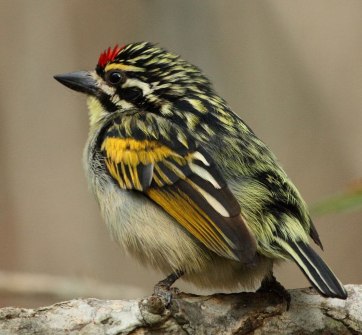
The Western Tinkerbird (Pogoniulus coryphaea) is a small bird that plays a significant role in the ecosystems of West and Central Africa. This bird belongs to the family Lybiidae and is a member of the order Piciformes. Its vibrant yellow plumage and distinctive black-and-white head pattern make it a striking presence in its natural habitat. The Western Tinkerbird is most commonly found in tropical rainforests, montane forests, and woodland areas, where it contributes to the ecological balance by engaging in seed dispersal and maintaining insect populations. This species is especially prevalent in countries such as Nigeria, Cameroon, and Gabon, where it thrives in lush forested environments. The Western Tinkerbird is primarily a resident species, meaning it does not undertake long migratory journeys like some of its avian counterparts. Instead, it remains within its preferred habitats year-round, taking advantage of the consistent food supply and favorable climate. During the breeding season, which generally occurs during the wet months, the Western Tinkerbird exhibits fascinating courtship behaviors. Males engage in vocalizations and visual displays to attract mates, often using their unique call to establish and defend territory. This bird's ecological role extends beyond mere survival; it influences the structure and composition of plant communities through its feeding habits. By consuming various fruits and insects, the Western Tinkerbird aids in controlling insect populations and facilitating the dispersal of seeds. This, in turn, promotes the growth and regeneration of the forest, highlighting the bird's contribution to its environment. In summary, the Western Tinkerbird is an integral component of its ecosystem. Its presence ensures the health and vitality of tropical forests in West and Central Africa. The bird's ecological significance, combined with its striking appearance and unique behaviors, make it a subject of interest for ornithologists and nature enthusiasts alike.
The Western Tinkerbird belongs to the family Lybiidae, within the order Piciformes. These birds typically live typically 6-8 years, with some recorded living up to 10 years..
How to Identify a Western Tinkerbird
The Western Tinkerbird is a small bird, measuring approximately 9-10 cm in length. It is easily identified by its bright yellow underparts, contrasting sharply with its black-and-white striped head. The adult plumage is characterized by a vivid yellow breast and belly, while the back is olive-green, providing effective camouflage when perched among foliage. Juveniles, in contrast, have a duller appearance, with a more muted yellow and less defined head pattern. Males and females are similar in appearance, although subtle differences in coloration and size may occur. One of the most distinguishing features of the Western Tinkerbird is its stout, conical bill, which is well adapted for its diet of fruits and insects. In the field, the bird's flight is direct and rapid, typically low over the canopy. When perched, the Western Tinkerbird often adopts an upright posture, allowing for optimal scanning of its surroundings. It is sometimes confused with the Yellow-rumped Tinkerbird, but the Western Tinkerbird can be differentiated by its more pronounced yellow underparts and lack of a distinct yellow rump. Observing these field marks, along with its unique vocalizations, can help birders accurately identify the Western Tinkerbird in its natural habitat.
Having trouble telling birds apart? Upload a photo to our bird identification tool for an instant species match.
Western Tinkerbird Habitat and Range
Preferred Habitat
The Western Tinkerbird inhabits a range of forested environments, including lowland tropical rainforests, montane forests, and open woodland areas. It prefers regions with dense foliage, which provide ample cover and food resources. These birds are typically found at elevations ranging from sea level up to about 2,000 meters, depending on the specific region. The Western Tinkerbird shows a preference for primary forests but can also be found in secondary growth forests and forest edges, where it takes advantage of the diverse plant life and insect populations. Unlike some other bird species, the Western Tinkerbird does not frequent urban areas, preferring the seclusion and resources of more natural, undisturbed habitats. Seasonal shifts in habitat are minimal, as the bird tends to remain within the same general area throughout the year, taking advantage of the consistent climate and food availability in its tropical environment.
Geographic Range
The Western Tinkerbird is primarily found in West and Central Africa, with its range extending from southern Nigeria through Cameroon, Gabon, and into parts of the Democratic Republic of the Congo. This bird does not migrate over long distances, and its range remains relatively consistent throughout the year. While the Western Tinkerbird is not considered migratory, it may exhibit some local movements in response to seasonal changes in food availability and breeding conditions. Within its range, population densities vary, with certain regions such as the rainforests of Cameroon and Gabon serving as hotspots for this species. These areas provide the ideal combination of climate, food resources, and habitat structure necessary for the Western Tinkerbird's survival and reproduction. The bird's presence in these regions highlights its adaptability to various forested environments, as well as its importance within the ecosystems it inhabits.
Want to know which birds visit your area? Browse our backyard birds by location guides for region-specific species lists.
What Does the Western Tinkerbird Eat?
The Western Tinkerbird's diet primarily consists of a variety of fruits and insects, reflecting its role as both a frugivore and insectivore. The bird actively forages for small berries and figs, which provide essential nutrients and energy. This diet is supplemented by the consumption of insects such as beetles, caterpillars, and ants, which are abundant in its forest habitat. The Western Tinkerbird employs a methodical foraging technique, often observed moving slowly and deliberately through the foliage as it searches for food. It uses its stout bill to pluck fruits and capture insects with precision. During the breeding season, the bird's diet may shift slightly to include more protein-rich insects, meeting the increased nutritional demands of raising young. This dietary flexibility ensures the Western Tinkerbird remains well-nourished throughout the year, regardless of seasonal changes in food availability. Its ability to exploit a range of food resources is a testament to its adaptability and resilience within its ecological niche.
Western Tinkerbird Behavior and Social Structure
The Western Tinkerbird exhibits a range of behaviors that reflect its adaptability and ecological niche. It is primarily a solitary bird, although it may occasionally be observed in pairs or small family groups, especially during the breeding season. Territorial behavior is prominent, with males using their distinctive calls to establish and defend their space from rivals. These vocalizations serve as both a deterrent to potential intruders and an attraction to potential mates. During courtship, the Western Tinkerbird engages in a series of displays, which may include wing-fluttering and mutual preening, to strengthen pair bonds. The bird is generally diurnal, with most of its activity occurring during the daylight hours. It is known for its methodical foraging behavior, often seen moving through the canopy in search of food. The Western Tinkerbird exhibits a strong response to predators, using alarm calls to alert other birds of potential threats. When faced with danger, it may freeze or retreat into dense foliage to avoid detection. These behaviors, along with its adaptability to various forest environments, underscore the Western Tinkerbird's role in maintaining ecological balance.
Western Tinkerbird Nesting and Reproduction
The Western Tinkerbird constructs its nest in tree cavities, often selecting natural hollows or abandoned woodpecker holes. The nest is typically lined with soft materials such as feathers, plant fibers, and moss, providing a comfortable and insulated environment for the eggs and chicks. The preferred nesting sites are found within dense forested areas, where the bird can take advantage of the cover and food resources. The female lays a clutch of 2-4 eggs, which are incubated for approximately 13-15 days. Both parents share in the responsibilities of incubation and feeding the chicks. After hatching, the chicks remain in the nest for about 20-23 days before fledging. The Western Tinkerbird may raise 1-2 broods per year, depending on environmental conditions and food availability. The shared parental duties and the choice of secure nesting sites contribute to the successful rearing of young, ensuring the continuation of the species within its habitat.
Western Tinkerbird Sounds and Vocalizations
The Western Tinkerbird's primary song is a series of rapid, high-pitched notes that resemble a tinkling sound, often described as similar to the repetitive striking of a small bell. This song is used to establish territory and attract mates, and it is most frequently heard during the early morning hours, contributing to the dawn chorus. In addition to its song, the Western Tinkerbird produces various call notes, including sharp, metallic chips used for communication between mates or family members. Alarm calls are harsher and more abrupt, signaling the presence of predators or other threats. The clarity and rhythmic quality of the Western Tinkerbird's vocalizations make it a recognizable presence in its forest habitat, aiding in both territorial defense and social interactions.
Interesting Facts About the Western Tinkerbird
- 1The Western Tinkerbird is capable of producing up to 100 distinct vocalizations, aiding in complex communication.
- 2Despite its small size, the Western Tinkerbird can consume a wide variety of fruit, contributing to significant seed dispersal.
- 3The species is known to be monogamous, with pairs forming long-lasting bonds that can persist across multiple breeding seasons.
- 4Western Tinkerbirds have been observed using their bills to drum on branches, a behavior thought to aid in territory defense.
- 5Its name 'Tinkerbird' comes from the tinkling sound of its song, reminiscent of a blacksmith's hammer striking metal.
- 6The Western Tinkerbird's bright yellow plumage provides excellent camouflage among the dappled sunlight of the forest canopy.
- 7Although primarily frugivorous, the Western Tinkerbird's insect consumption helps control pest populations in its habitat.
Western Tinkerbird Conservation Status
The Western Tinkerbird is currently classified as Least Concern by the IUCN. Its population trend is considered stable, although habitat loss due to deforestation poses an ongoing threat. Conservation efforts focus on preserving the bird's natural habitat by promoting sustainable forestry practices and establishing protected areas. Historically, the Western Tinkerbird's population has remained relatively stable due to its adaptability and resilience in the face of environmental changes. Continued conservation efforts are essential to ensure the long-term survival of this species, particularly in regions facing increased deforestation and habitat fragmentation.
Other Lybiidae Species


Birds Similar to the Western Tinkerbird
These species are often confused with the Western Tinkerbird due to similar appearance or overlapping range.