
Red-fronted Tinkerbird
Pogoniulus pusillus
Order: Piciformes / Family: Lybiidae
Wikimedia Commons
About the Red-fronted Tinkerbird
The Red-fronted Tinkerbird, known scientifically as Pogoniulus pusillus, is a small but vibrant member of the Lybiidae family. This species is widespread across sub-Saharan Africa, inhabiting various regions from Senegal and Gambia in the west to Kenya and Tanzania in the east. The Red-fronted Tinkerbird thrives in a range of environments but predominantly occupies woodlands, savannas, and forests, particularly in areas rich with acacia and other broad-leaved trees. Its presence is significant not only for its role in seed dispersal but also as a pollinator, contributing to the ecological balance of its habitat.
This bird's ecological role extends beyond mere survival; it actively participates in the regeneration of its environment. Seasonal behaviors are evident in its routine, particularly during the breeding season when the bird becomes more vocal and conspicuous. The Red-fronted Tinkerbird's characteristic 'tink-tink-tink' call, which resembles the sound of a distant hammer, becomes a constant backdrop in regions where it resides.
Ecologically, the Red-fronted Tinkerbird plays a part in controlling insect populations. It forages for insects, spiders, and small invertebrates, keeping their numbers in check. Its preference for fruit, particularly berries, helps in seed dispersal, allowing for the propagation of various plant species. This species is not migratory but may exhibit some local movement in search of food resources, especially during drought conditions. The Red-fronted Tinkerbird's adaptability to various habitats, including urban gardens and plantations, underscores its resilience and ability to coexist with human-modified landscapes.
The Red-fronted Tinkerbird belongs to the family Lybiidae, within the order Piciformes. These birds typically live around 6-9 years, with potential to live longer in favorable conditions..
How to Identify a Red-fronted Tinkerbird
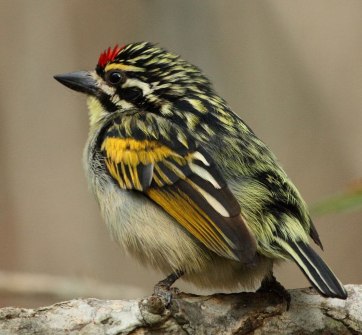
The Red-fronted Tinkerbird is a small, stout bird with a distinctive appearance. Adults measure about 9 to 10 cm in length, with a weight range of 7 to 13 grams. The bird's most striking feature is its bright red forehead, set against a black crown. Its upperparts are a dark olive green, which contrasts with the white streaking on its underparts. The wings and tail are similarly dark, with subtle yellowish edges that may not be easily visible from a distance.
Juvenile Red-fronted Tinkerbirds resemble adults but have a duller red forehead and less distinct streaking on their underparts. Males and females look alike, making it challenging to differentiate between the sexes in the field. When perched, this bird often adopts a slightly forward-leaning posture, which, coupled with its rapid and jerky movements, can help in identification.
In flight, the Red-fronted Tinkerbird’s silhouette is compact, with rapid wingbeats typical of many small passerines. It might be confused with other tinkerbirds, such as the Yellow-fronted Tinkerbird, but the latter lacks the vivid red forehead and has more pronounced yellow markings. The Red-fronted Tinkerbird is often detected first by its call before it is spotted visually.
Having trouble telling birds apart? Upload a photo to our bird identification tool for an instant species match.
Red-fronted Tinkerbird Habitat and Range
Preferred Habitat
Red-fronted Tinkerbirds inhabit a variety of environments, primarily favoring woodlands and savannas. They show a marked preference for areas with a mix of open ground and tree coverage, such as acacia-dominated landscapes. This bird is commonly found at elevations ranging from sea level to about 2,500 meters, although it usually stays below 1,500 meters.
Seasonal changes do not significantly alter its habitat preference, although it may move within its range to locate fruiting trees or abundant insect populations. In urban settings, the Red-fronted Tinkerbird adapts well to gardens and parks, often seen in areas with dense shrubbery or isolated trees. Its ability to thrive in both rural and urban landscapes highlights its adaptability and resilience.
Geographic Range
The Red-fronted Tinkerbird has a broad range across sub-Saharan Africa. Its breeding range extends from Senegal and Gambia in the west, across to Ethiopia and Tanzania in the east. The species is a resident bird, meaning it does not undertake long migrations but may engage in local movements to exploit food resources.
Within its range, the Red-fronted Tinkerbird is commonly found in countries such as Nigeria, Uganda, and Kenya. It is particularly abundant in areas with a mix of forest and savanna, where food resources are plentiful. Population density is highest in regions where fruiting trees and insect prey are abundant, such as the lush woodlands of central and eastern Africa.
Want to know which birds visit your area? Browse our backyard birds by location guides for region-specific species lists.
What Does the Red-fronted Tinkerbird Eat?
The diet of the Red-fronted Tinkerbird primarily consists of fruits and insects. It shows a marked preference for berries and small fruits, which it plucks from trees with precision. Common fruit sources include figs and berries from various indigenous trees. Insects, particularly beetles and caterpillars, form a significant part of its diet, especially during the breeding season when protein demand increases.
Seasonal changes influence its diet, with a higher reliance on fruits during the dry season when insects are less abundant. Foraging techniques include gleaning insects from leaves and branches and sometimes capturing prey in mid-flight. The Red-fronted Tinkerbird typically forages alone or in pairs, maintaining a busy schedule throughout the day.
Red-fronted Tinkerbird Behavior and Social Structure
Red-fronted Tinkerbirds exhibit a range of interesting behaviors that reflect their social and ecological roles. These birds are generally solitary or found in pairs. They maintain territories, which they defend vigorously through vocalizations and displays. Their call, a rhythmic 'tink-tink-tink', serves both to establish territory and to communicate with mates.
During courtship, males may perform displays that include wing flicking and offering food to the female. These displays are typically accompanied by more frequent vocalizations. While they do not form large flocks, Red-fronted Tinkerbirds may occasionally join mixed-species feeding flocks, particularly when food resources are concentrated.
The Red-fronted Tinkerbird is diurnal, spending most daylight hours foraging and engaging in territorial defense. It shows alertness to predators, using alarm calls to warn conspecifics. Its small size and rapid flight help evade many potential threats.
Red-fronted Tinkerbird Nesting and Reproduction
Red-fronted Tinkerbirds are cavity nesters, utilizing natural tree hollows or excavating holes in soft wood. They prefer sites with some cover, such as dense foliage or vines, providing protection from predators. The nesting cavity is lined with soft materials, including leaves, feathers, and sometimes fur.
A typical clutch contains 2 to 3 eggs, which both parents incubate. The incubation period lasts approximately 13 to 15 days, with both male and female sharing duties. After hatching, chicks remain in the nest for about 20 to 25 days before fledging. Both parents participate in feeding and caring for the young, ensuring a high survival rate. The Red-fronted Tinkerbird usually raises one brood per year, although favorable conditions can lead to a second attempt.
Red-fronted Tinkerbird Sounds and Vocalizations
The primary song of the Red-fronted Tinkerbird is a repetitive, metallic 'tink-tink-tink', resembling the sound of a small hammer striking metal. This song serves as a territorial marker and is often heard at dawn and dusk. The rhythm is consistent, with each note evenly spaced, creating a continuous auditory presence in its habitat.
Call notes include a sharp 'chip' used in communication between mates or as an alarm when predators are near. The dawn chorus sees an increase in frequency and volume of calls, as the bird asserts its presence and maintains its territory.
Interesting Facts About the Red-fronted Tinkerbird
- 1The call of the Red-fronted Tinkerbird can be heard up to 300 meters away, making it one of the most easily recognizable sounds in the African woodlands.
- 2Despite their small size, Red-fronted Tinkerbirds can be aggressive when defending their territory, often chasing away larger birds.
- 3These birds can consume up to 20% of their body weight in fruit daily, playing a significant role in seed dispersal.
- 4The Red-fronted Tinkerbird's nesting holes can sometimes be used by other species, including small mammals, after the birds have vacated.
- 5The Red-fronted Tinkerbird's ability to adapt to urban areas allows it to thrive in city parks and gardens, often alongside human activity.
- 6Unlike many birds, the Red-fronted Tinkerbird is not highly migratory, staying within its range throughout the year.
- 7Their bright red forehead is not only a visual marker but also aids in species recognition during interactions.
Red-fronted Tinkerbird Conservation Status
The Red-fronted Tinkerbird is currently classified as Least Concern by the IUCN, with stable population trends across its range. While the species faces threats such as habitat loss due to deforestation and agricultural expansion, its adaptability to varied environments helps mitigate these pressures. Conservation efforts focus on habitat preservation and sustainable land-use practices. The historical population has remained relatively stable, benefiting from the bird's ability to thrive in both natural and human-altered landscapes.
Other Lybiidae Species


Birds Similar to the Red-fronted Tinkerbird
These species are often confused with the Red-fronted Tinkerbird due to similar appearance or overlapping range.

