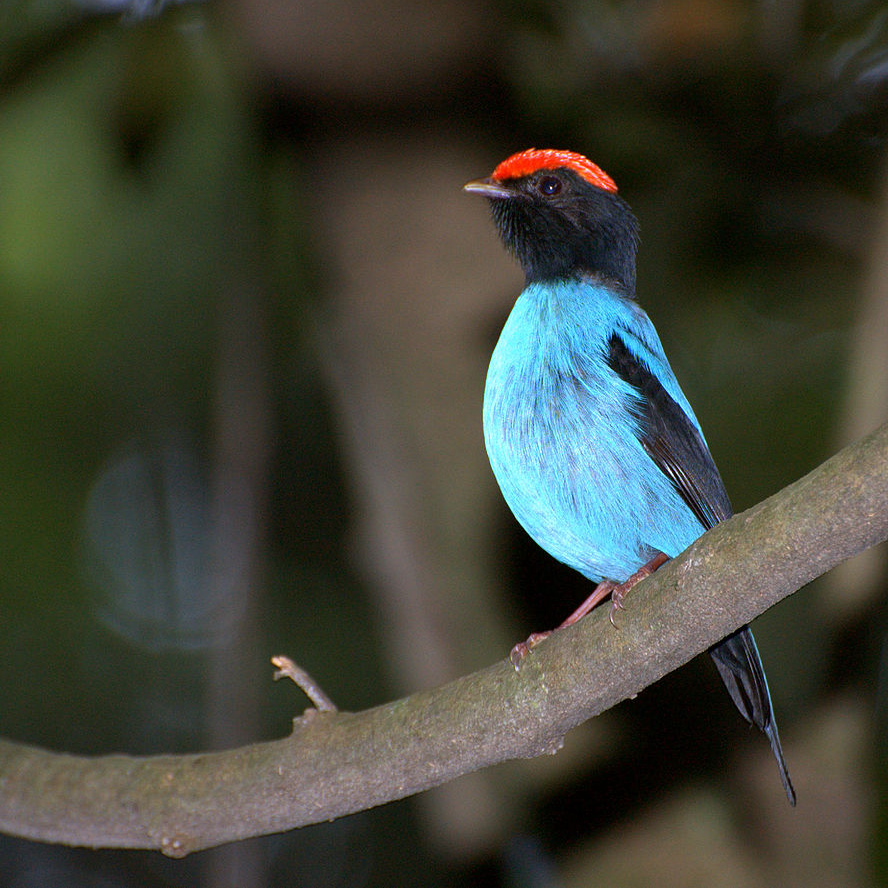
White-bearded Manakin
Manacus manacus
Order: Passeriformes / Family: Pipridae

Wikimedia Commons
About the White-bearded Manakin
The White-bearded Manakin (Manacus manacus) is a small, charismatic bird belonging to the Pipridae family, renowned for its unique courtship rituals and striking appearance. This bird inhabits the tropical and subtropical forests of Central and South America, extending from Panama to northern Argentina and Paraguay. Its presence is particularly notable in the Amazon Basin, where dense, humid forests provide ideal conditions for its survival. The White-bearded Manakin plays a vital ecological role as a seed disperser, contributing to the maintenance and regeneration of its forest habitat. Its preference for lowland evergreen and semi-deciduous forests positions it as a critical participant in these ecosystems.
During the breeding season, which typically occurs during the wet season from November to March, male White-bearded Manakins engage in elaborate courtship displays. These displays occur in leks, where males congregate to perform for visiting females. The males execute a series of jumps and snaps, using their modified wing feathers to produce loud, snapping sounds. These displays not only attract females but also establish dominance hierarchies among males. Females, on the other hand, select mates based on the vigor and skill of these displays, ensuring the propagation of strong genetic lines.
The White-bearded Manakin's presence extends beyond its courtship rituals. It serves as an indicator species, reflecting the health of its forest environment. Its reliance on primary and secondary forests highlights the importance of forest conservation efforts. Deforestation and habitat fragmentation pose significant threats to its populations, as they do to many forest-dependent species. Consequently, the White-bearded Manakin underscores the need for sustainable land management practices that protect these vital ecosystems. As forest habitats become increasingly threatened, the role of the White-bearded Manakin in ecosystem dynamics and its influence on plant biodiversity become even more critical.
The White-bearded Manakin belongs to the family Pipridae, within the order Passeriformes. These birds typically live average 6-8 years with a maximum recorded of 14 years.
How to Identify a White-bearded Manakin
The White-bearded Manakin is a small bird, measuring approximately 10-11 cm in length and weighing around 15-20 grams. Adult males are readily identifiable by their stark black upperparts contrasted with a bright white throat and chest, from which the bird derives its name. The white 'beard' stands out prominently against the dark plumage, particularly during the breeding season when the bird is most active. Females and juveniles differ significantly in appearance, sporting olive-green plumage that provides effective camouflage in the dense forest understory.
The male's distinctive plumage helps distinguish it from similar species, such as the closely related Wire-tailed Manakin, which has elongated tail feathers absent in the White-bearded Manakin. Furthermore, the White-bearded Manakin's flight silhouette is compact, with rapid, direct flight patterns typical of small forest birds. When perched, it often adopts an upright posture, allowing its white throat to remain visible, a trait that aids in its identification.
Sexual dimorphism is pronounced, with males being more visually conspicuous than females. This visual difference aids in minimizing confusion between sexes in the field. Observers should note the varied plumage when identifying this species, particularly in mixed-species flocks, where it may associate with other small birds.
Having trouble telling birds apart? Upload a photo to our bird identification tool for an instant species match.
White-bearded Manakin Habitat and Range
Preferred Habitat
The White-bearded Manakin inhabits a variety of forested environments, with a strong preference for primary and secondary lowland forests. It is frequently found in the Amazon rainforest, thriving in the dense understory where it can forage and display. These birds are typically found at elevations ranging from sea level up to 1,200 meters, although they are most common in lowland areas. Seasonal habitat shifts occur during the breeding season, with males congregating in lek sites within the forest.
In urban and rural settings, the White-bearded Manakin is less common but may inhabit forest fragments and reserves with adequate cover. These birds are adaptable to some degree of habitat disturbance, often appearing in secondary growth areas, but they avoid open and heavily modified landscapes. Conservation of forest habitats, both extensive tracts and small patches, is crucial for maintaining viable populations of this species.
Geographic Range
The White-bearded Manakin's range extends across a broad swath of Central and South America. It is a non-migratory species, residing year-round in its preferred habitats. Its range includes Panama, Colombia, Venezuela, Trinidad and Tobago, and the Guianas, extending southward through the Amazon Basin to northern Argentina and eastern Paraguay. In Brazil, populations are widespread, particularly in the Amazonian and Atlantic forests.
This bird does not undertake long migratory journeys, instead displaying local movements in response to food availability and breeding cycles. Population densities are highest in regions where dense, unfragmented forests persist, particularly in the western Amazon. While the bird is generally common throughout its range, local population densities can vary significantly based on habitat quality and availability.
Want to know which birds visit your area? Browse our backyard birds by location guides for region-specific species lists.
What Does the White-bearded Manakin Eat?
The diet of the White-bearded Manakin primarily consists of fruit, making it a frugivore. It plays a significant role in seed dispersal within its forest ecosystem. The bird favors small berries and fruits, which it plucks from trees and shrubs while hovering or perching. During the breeding season, its diet remains largely consistent, although it may also consume small insects and spiders to meet increased energy demands.
Foraging typically occurs in the forest understory, where the bird's agility allows it to navigate through dense vegetation efficiently. The White-bearded Manakin may feed solitarily or in small groups, often participating in mixed-species flocks that provide increased foraging opportunities and protection from predators. Its foraging behavior is diurnal, with peak activity occurring in the early morning and late afternoon, coinciding with periods of high fruit availability.
White-bearded Manakin Behavior and Social Structure
The social structure of the White-bearded Manakin is characterized by its lekking behavior, a form of polygyny where males gather in small territories to perform courtship displays. These territories are vital for mating success, and males invest significant time and energy in maintaining and defending them. The displays involve a series of acrobatic flights, wing snaps, and vocalizations designed to attract females.
Outside of the breeding season, the White-bearded Manakin is relatively solitary but may join mixed-species flocks for foraging. Its territorial behavior extends to feeding areas, although aggression is more pronounced during the lekking period. Predation pressure influences its behavior, with the bird remaining alert to the presence of raptors and other predators. It employs rapid, evasive flight when threatened.
Daily activity patterns are influenced by light levels, with peak activity occurring during dawn and dusk. The bird's reliance on specific lek sites underscores the importance of habitat continuity for maintaining populations.
White-bearded Manakin Nesting and Reproduction
The White-bearded Manakin constructs its nest in the dense foliage of the forest understory, where concealment from predators is maximized. The nest is a shallow cup composed of fine plant fibers, leaves, and mosses, often placed on a horizontal branch or within a forked twig. This strategic placement provides stability and shelter from the elements.
A typical clutch consists of two eggs, which undergo an incubation period of approximately 18-21 days. The female alone incubates the eggs and tends to the young, emphasizing her role in reproductive duties. After hatching, the nestlings fledge in about 15-20 days, during which the female continues to provide food. The species typically raises one brood per year, although in optimal conditions, a second brood is possible.
White-bearded Manakin Sounds and Vocalizations
The vocalizations of the White-bearded Manakin are integral to its courtship displays. The primary song consists of a series of sharp, snapping sounds produced by the male's wing feathers, which are interspersed with high-pitched whistles. These sounds are rhythmic and rapid, creating a distinctive auditory signature in the forest.
The bird also emits call notes that are short and sharp, serving as communication signals within the lek. Alarm calls are less common but typically involve harsh, staccato notes when predators approach. During the dawn chorus, the bird's vocalizations contribute to the vibrant soundscape of tropical forests.
Interesting Facts About the White-bearded Manakin
- 1White-bearded Manakins are known for their explosive wing snaps, which can be heard from over 100 meters away.
- 2Despite their small size, White-bearded Manakin males can perform up to 70 displays per hour during peak courtship.
- 3The lekking behavior of the White-bearded Manakin is one of the most studied among manakins, providing insights into sexual selection.
- 4White-bearded Manakins have a fascinating ability to hover like hummingbirds while feeding on fruit.
- 5Their lek sites are often reused annually, with some sites hosting generations of males over decades.
- 6The white 'beard' of the male White-bearded Manakin is actually modified throat feathers used in courtship displays.
- 7White-bearded Manakins are part of the subfamily Piprinae, which includes some of the most colorful and acrobatic bird species.
White-bearded Manakin Conservation Status
According to the IUCN Red List, the White-bearded Manakin is currently classified as 'Least Concern,' reflecting its relatively stable population across a wide range. However, habitat loss due to deforestation poses a significant threat. The destruction of primary and secondary forests reduces available habitat and lek sites, potentially impacting long-term population viability. Conservation efforts focus on protecting large tracts of forest, implementing sustainable land-use practices, and establishing protected areas. Historically, populations have experienced fluctuations due to habitat changes, underscoring the importance of monitoring and adaptive management strategies to ensure their continued survival.