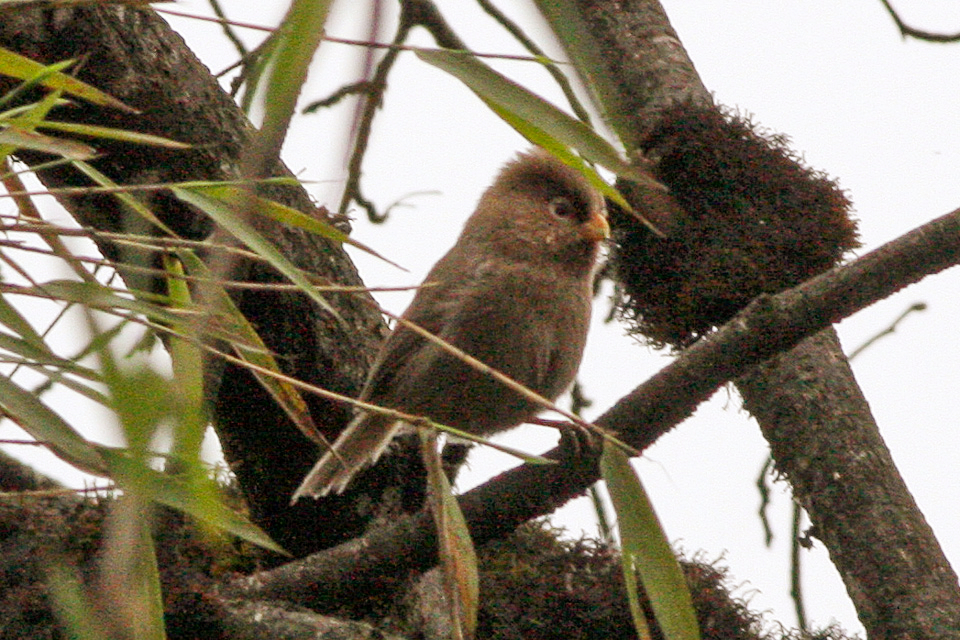
White-browed Fulvetta
Fulvetta vinipectus
Order: Passeriformes / Family: Sylviidae

Wikimedia Commons
About the White-browed Fulvetta
The White-browed Fulvetta (Fulvetta vinipectus) is a small passerine bird belonging to the Sylviidae family. It is predominantly found in the montane forests of the Himalayas, spanning regions from India to Bhutan and extending into parts of China and Nepal. These birds are an integral part of the forest ecosystems they inhabit, often seen flitting through dense underbrush and foraging in mixed-species flocks.
Their ecological role is significant as they partake in seed dispersal and insect population control. These fulvettas play a crucial role in maintaining the health and balance of their habitats. During the breeding season, which aligns with the spring and early summer months, they become more territorial, yet maintain their social nature by continuing to participate in mixed flocks.
The White-browed Fulvetta is noted for its adaptability to different elevations, typically residing between 2,000 and 4,000 meters above sea level. This adaptability allows it to inhabit both primary and secondary forests, though it shows a preference for areas with thick undergrowth. Seasonal movements are influenced by food availability, prompting altitudinal shifts rather than long migrations. The White-browed Fulvetta's presence in these forests is a testimony to the rich biodiversity of the Himalayan region and its importance in the avian community.
The White-browed Fulvetta belongs to the family Sylviidae, within the order Passeriformes. These birds typically live typically around 7 years in the wild, with some individuals reaching up to 9 years..
How to Identify a White-browed Fulvetta
The White-browed Fulvetta is a medium-sized bird, measuring approximately 14 cm in length. It is easily recognized by its broad, conspicuous white eyebrow stripe, which contrasts sharply with its darker head. The plumage is predominantly brown with a subtle grayish tinge on the underparts, and the wings and tail are streaked with lighter and darker shades of brown.
Juvenile White-browed Fulvettas resemble adults but exhibit less distinct markings, particularly around the head, and their plumage tends to be slightly duller. Males and females are similar in appearance, making sex differentiation in the field challenging without behavioral cues.
In flight, the White-browed Fulvetta presents a characteristic silhouette, with a rounded body and short, broad wings. When perched, they often adopt an upright posture, showcasing their prominent supercilium. This species can be confused with other fulvettas or similar-sized birds like certain babblers, but the distinctive white eyebrow remains a reliable field mark.
Having trouble telling birds apart? Upload a photo to our bird identification tool for an instant species match.
White-browed Fulvetta Habitat and Range
Preferred Habitat
The White-browed Fulvetta thrives in subtropical and temperate forests, particularly favoring montane regions with dense underbrush. They are commonly found at elevations ranging from 2,000 to 4,000 meters, where they inhabit a variety of forest types, including oak and rhododendron forests.
They show a preference for areas with ample shrubbery and undergrowth, which provide both food resources and protection from predators. While primarily a forest-dwelling species, they may occasionally be observed in more open habitats during seasonal movements, especially when food becomes scarce in their primary habitats.
In terms of urban presence, the White-browed Fulvetta is rarely found in city environments, as it is more adapted to the complexities of forest ecosystems. However, in rural areas adjacent to suitable forest habitats, they may occasionally venture into orchards or gardens.
Geographic Range
The range of the White-browed Fulvetta extends across the Himalayan region, covering countries such as India, Nepal, Bhutan, and parts of southern China. They are predominantly found in the eastern Himalayas, with significant populations in the Indian states of Sikkim and Arunachal Pradesh.
This species does not undertake long migrations but may exhibit altitudinal movements within its range, descending to lower elevations during harsher winter months. During the breeding season, they are more likely to remain at higher elevations where suitable nesting sites are abundant.
Population density tends to be higher in well-forested areas, where mixed-species flocks offer additional protection and foraging opportunities. While not globally threatened, the White-browed Fulvetta's distribution is closely tied to the health of its forest habitats.
Want to know which birds visit your area? Browse our backyard birds by location guides for region-specific species lists.
What Does the White-browed Fulvetta Eat?
The White-browed Fulvetta's diet primarily consists of insects and other small invertebrates, which they actively forage from the forest understory. They exhibit a preference for soft-bodied insects like caterpillars and larvae, which are abundant in their montane habitats.
During certain seasons, when insect availability diminishes, they may supplement their diet with seeds and small berries. This dietary flexibility allows them to adapt to seasonal changes in food resources.
Foraging often takes place in mixed-species flocks, where the White-browed Fulvetta's active feeding style involves quickly gleaning prey from foliage and occasionally hovering to pluck insects off leaves. Their feeding schedule is primarily diurnal, with peaks in activity during the early morning and late afternoon.
White-browed Fulvetta Behavior and Social Structure
White-browed Fulvettas are social birds, frequently seen in mixed-species flocks that provide safety in numbers and increase foraging efficiency. They maintain small territories during the breeding season, where pairs become more vocal and display increased territoriality.
Courtship displays are subtle, often involving mutual preening and quiet calls between mates. These displays reinforce pair bonds and ensure coordination during the nesting period.
Outside the breeding season, they are less territorial and more focused on foraging. In response to predators, White-browed Fulvettas rely on their flocking behavior to reduce individual risk, often joining other small birds in alarm calls to mob potential threats. Their daily activity patterns align with daylight, with most foraging and social interactions occurring during the morning and afternoon.
White-browed Fulvetta Nesting and Reproduction
The White-browed Fulvetta constructs its nest low in dense shrubbery or small trees, typically at heights of 1 to 3 meters. The nest is a small, cup-shaped structure made from grass, moss, and fibrous materials, often lined with softer substances like feathers or fur for insulation.
Clutch size ranges from two to four eggs, which are pale with speckled markings. Both parents participate in incubation, which lasts approximately 12 to 14 days. This shared responsibility extends to feeding the chicks, which fledge about 12 to 15 days after hatching.
The species often raises two broods per year, taking advantage of the extended breeding season offered by the temperate climate of their montane habitats. Parental roles are well-defined, with both sexes taking turns in feeding and protecting the young, ensuring high survival rates for the offspring.
White-browed Fulvetta Sounds and Vocalizations
The primary song of the White-browed Fulvetta is a series of soft, melodious notes delivered at a moderate pace. Each phrase typically consists of two to three notes, repeated in a rhythmic pattern that is both soothing and distinctive.
Call notes are short, sharp chirps that serve as communication between flock members. During alarm situations, these calls become more rapid and high-pitched, alerting other birds to potential danger.
At dawn, White-browed Fulvettas often join in the chorus of the forest, contributing their gentle song to the morning symphony. Their vocalizations can be compared to a soft whistle, carrying a quality that blends harmoniously with the ambient sounds of their montane habitats.
Interesting Facts About the White-browed Fulvetta
- 1The White-browed Fulvetta is part of mixed-species flocks, often associating with more than 10 other bird species.
- 2Despite their small size, White-browed Fulvettas exhibit a remarkable range of vocalizations suited for different social interactions.
- 3These birds play a crucial role in seed dispersal in their habitats, contributing to forest regeneration.
- 4The White-browed Fulvetta has a wide range of altitudinal habitats, from 2,000 to 4,000 meters, showcasing its adaptability.
- 5Unlike many birds, the White-browed Fulvetta remains active throughout the day, with peaks in activity during morning and late afternoon.
White-browed Fulvetta Conservation Status
The White-browed Fulvetta is currently listed as Least Concern by the IUCN, with stable population trends. The primary threat to this species is habitat loss due to deforestation and land conversion for agriculture. Conservation efforts focus on preserving montane forest habitats and promoting sustainable land-use practices in regions where the White-browed Fulvetta is found. Protected areas and national parks in countries like Bhutan and Nepal play a crucial role in safeguarding suitable habitats. Historically, the White-browed Fulvetta has maintained a stable population, owing to its adaptability and wide range. Continued conservation attention is necessary to ensure that habitat degradation does not escalate into more significant threats.