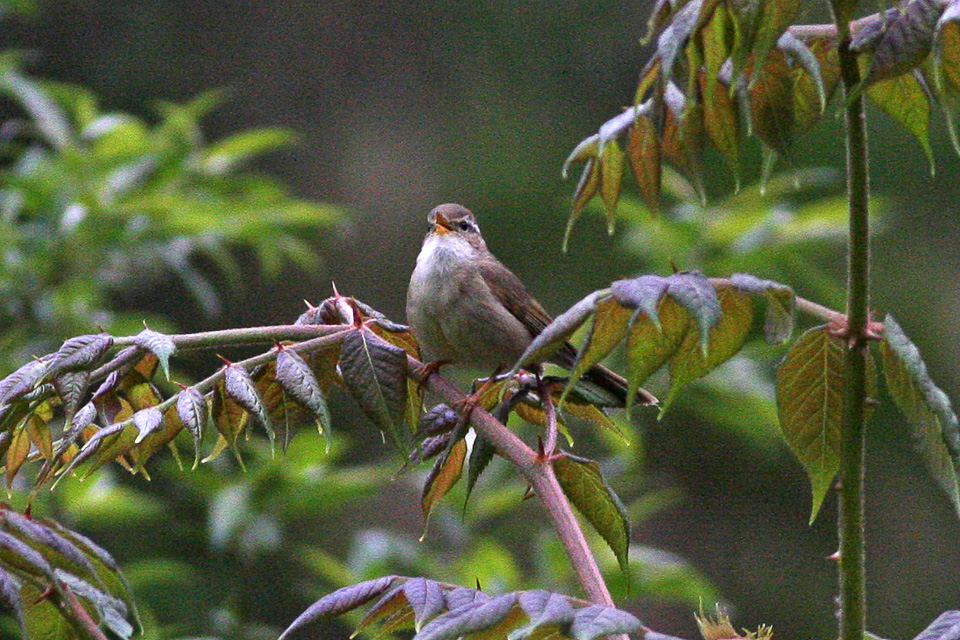
White-spectacled Warbler
Seicercus affinis
Order: Passeriformes / Family: Phylloscopidae

Wikimedia Commons
About the White-spectacled Warbler
The White-spectacled Warbler, scientifically known as Seicercus affinis, is a small passerine bird belonging to the Phylloscopidae family. This warbler is known for its preference for subtropical and tropical moist lowland and montane forests. The bird's habitat spans across Southeast Asia, including countries like Thailand, Myanmar, and Laos, where it plays a significant role in insect population control. Its presence in these regions indicates a healthy, biodiverse forest ecosystem. The warbler is a vital component of its ecosystem, as it actively participates in controlling insect populations, thus maintaining ecological balance. During the breeding season, which generally occurs from March to June, the White-spectacled Warbler can be found in abundance, especially in the dense undergrowth of forests. Its breeding activities coincide with the period when insects are most plentiful, ensuring a steady food supply for its offspring. Outside the breeding season, the White-spectacled Warbler remains relatively sedentary, although some altitudinal movement might occur in response to food availability and climatic conditions. This species is known for its adaptability to various forest types, although it shows a preference for areas with dense foliage. The White-spectacled Warbler's ecological role extends beyond mere insect control. As a forager, it contributes to the aeration and mixing of the forest floor, aiding in nutrient cycling. Its presence also serves as an indicator of forest health, as it thrives only in well-preserved habitats. Conservation of this species is essential, not just for its survival, but for the overall health of the forest ecosystems it inhabits. Protecting the White-spectacled Warbler and its habitat ensures the continued biodiversity and ecological function of these vital forest regions.
The White-spectacled Warbler belongs to the family Phylloscopidae, within the order Passeriformes. These birds typically live average 3-5 years with a maximum recorded of 7 years.
How to Identify a White-spectacled Warbler
Identifying the White-spectacled Warbler involves noting several key field marks. The adult plumage predominantly showcases olive-green upperparts with a contrasting yellowish-white underside. A distinct feature of this warbler is its white eye-ring, which gives the bird its common name. The eye-ring is set against a slightly darker head, making it stand out prominently. Juveniles closely resemble adults but may exhibit a slightly duller plumage. Male and female White-spectacled Warblers appear similar, with no significant sexual dimorphism in plumage. This lack of differentiation can make field identification challenging during non-breeding periods. When comparing the White-spectacled Warbler to similar species, such as the Yellow-bellied Warbler, the latter lacks the pronounced white eye-ring, helping observers make a clear distinction. In flight, the White-spectacled Warbler exhibits a swift, undulating pattern typical of small passerines, with short, rapid wingbeats. When perched, it often holds a slightly upright posture, with its tail flicking frequently as it moves through the undergrowth. This behavior, combined with its distinctive markings, aids birders in spotting and correctly identifying this species in its natural habitat.
Having trouble telling birds apart? Upload a photo to our bird identification tool for an instant species match.
White-spectacled Warbler Habitat and Range
Preferred Habitat
The White-spectacled Warbler inhabits subtropical and tropical moist lowland and montane forests. It is often found in regions such as northern Thailand, Myanmar, and southern China, where dense foliage provides ample cover and food resources. Typically, this warbler prefers elevations ranging from 200 to 1,800 meters, although it may venture higher during certain seasonal shifts. This habitat preference underscores its reliance on forested areas, where it can forage effectively. Unlike some other warblers, the White-spectacled Warbler does not favor urban environments, as its adaptation is strongly tied to dense forest habitats. Seasonal habitat shifts are minor, often influenced by changes in food availability rather than large-scale migration. Despite its preference for forests, it can occasionally be found in secondary growth areas, provided there is sufficient underbrush.
Geographic Range
The White-spectacled Warbler's range includes parts of Southeast Asia, with a breeding range extending across northern Thailand, Myanmar, and into parts of Laos and southern China. Within these countries, it occupies specific regions where suitable forest habitats exist. During the breeding season, populations remain relatively localized to these areas, taking advantage of the abundant insect life. Outside of the breeding season, the warbler exhibits minimal migratory behavior, with some populations possibly moving to lower altitudes in search of food. The warbler does not engage in long-distance migration, unlike many other warbler species. Population density tends to be higher in regions where forest cover is dense and diverse, providing the necessary resources for survival. Conservation efforts in countries like Thailand aim to preserve these habitats, ensuring the warbler's continued presence in its native range.
Want to know which birds visit your area? Browse our backyard birds by location guides for region-specific species lists.
What Does the White-spectacled Warbler Eat?
The White-spectacled Warbler primarily feeds on insects and other small invertebrates. Its diet includes a variety of insects such as caterpillars, beetles, and spiders, which it skillfully extracts from foliage using its sharp bill. During the breeding season, the warbler's diet remains consistent, as insects are abundant and provide the necessary protein for raising young. Outside the breeding season, the warbler may expand its diet slightly to include small fruits and seeds, particularly in times of insect scarcity. Foraging occurs primarily in the lower to mid-canopy levels, where the warbler employs a methodical gleaning technique. This involves inspecting leaves and branches closely, flicking its tail as it searches for prey. Feeding activity is most intense during the early morning and late afternoon, coinciding with peak insect activity. The warbler's role as an insectivore makes it an essential component of its ecosystem, helping to control insect populations and maintain ecological balance.
White-spectacled Warbler Behavior and Social Structure
The White-spectacled Warbler exhibits a range of behaviors that are characteristic of small, forest-dwelling passerines. It is generally a solitary bird, although it may form loose associations with mixed-species flocks, especially outside the breeding season. These flocks typically include other insectivorous birds, allowing for cooperative foraging opportunities. Territorial behavior is most pronounced during the breeding season, when males vigorously defend their chosen areas from intruders. Courtship displays involve the male singing from a prominent perch, accompanied by fluttering flights to attract a mate. Once paired, the warbler maintains a monogamous bond for the season. Flocking behavior diminishes significantly during breeding, with pairs focusing on nesting duties. The White-spectacled Warbler's response to predators involves a series of alarm calls, often accompanied by a rapid retreat into dense foliage. This strategy helps minimize predation risk while alerting nearby birds to danger. Daily activity patterns align with those of other small insectivores, with heightened activity during dawn and dusk, coinciding with peak insect availability.
White-spectacled Warbler Nesting and Reproduction
The nesting habits of the White-spectacled Warbler are closely tied to the dense forest habitats it prefers. Nests are typically constructed in low shrubs or small trees, often less than two meters above ground. The nest itself is a cup-shaped structure made from woven grass, leaves, and fine roots, lined with softer materials such as feathers and plant down. Clutch size generally ranges from three to five eggs, with both parents participating in incubation. The incubation period lasts approximately 12 to 14 days, after which the altricial young hatch. Fledging occurs about 10 to 12 days post-hatching, with the young remaining under parental care for a short period after leaving the nest. The White-spectacled Warbler typically raises one brood per year, although favorable conditions may occasionally allow for a second. Parental roles are shared, with both male and female involved in feeding and caring for the young, ensuring high survival rates.
White-spectacled Warbler Sounds and Vocalizations
The White-spectacled Warbler's song is a distinctive series of high-pitched, melodic notes delivered in rapid succession. This song, often described as a trilling or tinkling sound, serves as a territorial and mating call. Call notes are shorter and sharper, used primarily in communication between birds, especially in dense foliage where visibility is limited. Alarm calls are more abrupt and harsh, signaling potential threats to other warblers in the vicinity. The dawn chorus of the White-spectacled Warbler is particularly notable, as it can be heard echoing through the forest as the first light of day breaks. This vocal behavior not only establishes territory but also reinforces pair bonds and facilitates social interactions within mixed-species flocks.
Interesting Facts About the White-spectacled Warbler
- 1The White-spectacled Warbler's eye-ring is not just for show; it plays a role in species recognition during the breeding season.
- 2Despite its small size, the White-spectacled Warbler is an effective predator of insects, consuming hundreds daily to support its energetic lifestyle.
- 3The warbler's song can carry over long distances, allowing it to communicate effectively in dense forest environments.
- 4During courtship, the male White-spectacled Warbler performs a distinctive fluttering flight display, a behavior unique to its species.
- 5The species is named 'affinis' due to its close resemblance to other warblers in the same genus, reflecting its shared evolutionary lineage.
- 6Unlike many warblers, the White-spectacled Warbler does not undertake long migrations, remaining in or near its breeding range year-round.
- 7The warbler's preference for dense undergrowth makes it a challenging yet rewarding species for birdwatchers to observe in the wild.
White-spectacled Warbler Conservation Status
The White-spectacled Warbler is currently classified as Least Concern on the IUCN Red List, with populations considered stable across its range. While deforestation poses a significant threat to its habitat, the warbler's adaptability to secondary growth areas has helped mitigate some impacts. Conservation efforts in Southeast Asia focus on preserving forest habitats through protected areas and sustainable land management practices. Historical population changes have been minimal, with the species maintaining a relatively stable presence across its native range. Continued conservation initiatives are essential to ensure the survival of the White-spectacled Warbler and the ecosystems it supports.