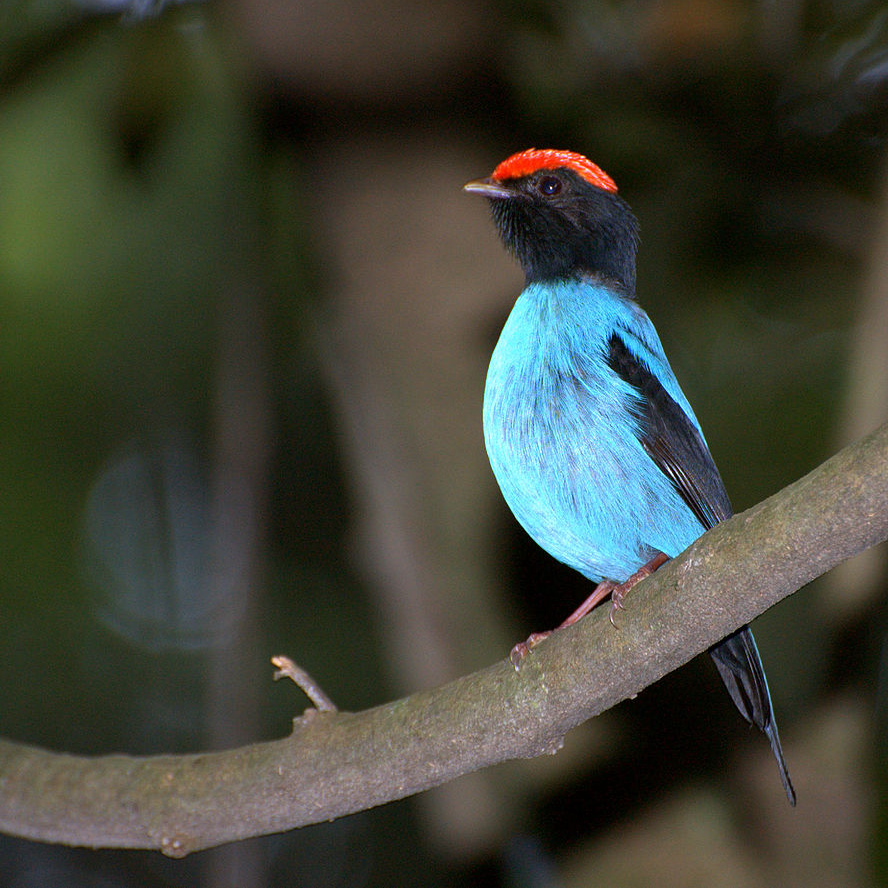
White-throated Manakin
Corapipo gutturalis
Order: Passeriformes / Family: Pipridae

Wikimedia Commons
About the White-throated Manakin
The White-throated Manakin, scientifically known as Corapipo gutturalis, is a small passerine bird belonging to the family Pipridae. This species is a vivid example of the rich avian biodiversity found in the neotropical forests of South America. Predominantly inhabiting the Amazon Basin, it is encountered across countries like Brazil, Peru, Ecuador, and Colombia. The bird thrives in subtropical or tropical moist lowland forests, where it plays a crucial ecological role as both a seed disperser and an insect predator. The dense foliage of the Amazon provides an ideal habitat for this elusive bird, offering both a bounty of food and ample cover from predators. Seasonal changes in this region often influence the White-throated Manakin's behavior, particularly its breeding patterns which are closely aligned with the wet season when resources are most abundant. During this period, the male White-throated Manakin engages in its intricate courtship displays, a characteristic behavior that underscores its ecological significance as a species that contributes to the dynamic interplay of forest life. The White-throated Manakin's presence in these forests indicates healthy, undisturbed ecosystems, as it relies on intact habitats to sustain its life cycle. Despite its small size, this bird is a vital component of its ecosystem, aiding in the control of insect populations and the dispersal of plant seeds, thereby sustaining the biodiversity of its native forests. Its role in these processes highlights the interconnectedness of species within these rich habitats, showcasing the Manakin's contribution to the ecological balance of the Amazonian environment.
The White-throated Manakin belongs to the family Pipridae, within the order Passeriformes. These birds typically live average 8 years with a maximum recorded of 12 years..
How to Identify a White-throated Manakin
The White-throated Manakin is a diminutive bird, measuring approximately 10-11 cm in length. Adult males are particularly striking, with their velvety black plumage contrasted by a bright white throat and belly. The stark contrast between the black and white coloring is a key field mark for identification. Females, on the other hand, possess a more subdued appearance, with olive-green upperparts and a lighter, whitish belly, which helps them blend into the forest understory. Juveniles resemble females but may have a less distinct throat patch. While in flight, the White-throated Manakin appears as a swift, compact silhouette, with rapid wingbeats that are typical of the family. Its perching posture is often upright, and it can frequently be spotted perched on thin branches in the mid-story of the forest. The male's distinct white throat and contrasting black plumage can sometimes be confused with the Snow-capped Manakin in overlapping regions; however, the Snow-capped Manakin has a distinctive white cap, which the White-throated lacks. Observing these subtle differences is crucial for accurate identification in the field.
Having trouble telling birds apart? Upload a photo to our bird identification tool for an instant species match.
White-throated Manakin Habitat and Range
Preferred Habitat
The White-throated Manakin inhabits tropical moist lowland forests, often thriving in the dense undergrowth and mid-story layers of these habitats. It is predominantly found in the Amazon Basin, where the rich bio-diversity provides ample resources. Ideal elevations for this bird range from sea level up to around 1,200 meters, allowing it to exploit various forest types while avoiding high-altitude environments. Unlike some birds that adapt to urban settings, the White-throated Manakin remains tied to pristine forest environments, rarely venturing into human-altered landscapes. Its dependence on forest cover means it is sensitive to habitat degradation and deforestation, which can lead to shifts in its distribution. During the wet season, the forest becomes even more lush, providing an abundance of food resources, which influences the Manakin's nesting and breeding activities.
Geographic Range
The range of the White-throated Manakin extends primarily throughout the northern reaches of the Amazon Basin. It is found in countries such as Brazil, Colombia, Ecuador, and Peru. Unlike migratory birds, the White-throated Manakin is largely sedentary, maintaining its range year-round due to the relative stability of the tropical climate. Within these regions, the bird's population density is highest in undisturbed primary forests, where its ecological requirements are fully met. The presence of this bird in these areas can often indicate a healthy forest ecosystem. While its range is quite expansive within the Amazon, localized population trends can vary, with some regions supporting denser populations due to better habitat conditions.
Want to know which birds visit your area? Browse our backyard birds by location guides for region-specific species lists.
What Does the White-throated Manakin Eat?
The diet of the White-throated Manakin primarily consists of fruits and insects, making it a key frugivore and insectivore within its ecosystem. The bird frequently forages in the mid-story of the forest, exhibiting a preference for small, fleshy fruits from a variety of plants, including those of the family Melastomataceae. This dietary choice plays a role in seed dispersal, aiding in forest regeneration. Insect consumption provides essential proteins, especially during the breeding season when nutritional demands increase. The Manakin employs a sallying technique to capture flying insects, a method that involves short, agile flights from a perch to snatch prey mid-air. Feeding activity peaks in the early morning and late afternoon, times when both fruits and insects are most abundant and active. Seasonal variations in fruit availability can influence the dietary composition, with a heavier reliance on insects during periods when fruits are scarce.
White-throated Manakin Behavior and Social Structure
The White-throated Manakin exhibits fascinating social and courtship behaviors. Males are known for their elaborate lekking displays, a behavior where they gather in small groups to perform intricate dances to attract females. These displays involve a series of jumps, flips, and wing snaps, often accompanied by mechanical sounds produced by their wings. Territoriality is pronounced during the breeding season, with males fiercely defending their lek sites. Outside the breeding season, the White-throated Manakin tends to be more solitary or found in small mixed-species flocks, which offer protection from predators. The bird is diurnal, with peak activity occurring in the cooler hours of the day. When threatened, the Manakin relies on its cryptic plumage and the dense forest cover to evade predators, using quick, darting flights to escape danger.
White-throated Manakin Nesting and Reproduction
The White-throated Manakin constructs a small, cup-shaped nest built from plant fibers and leaves, typically located a few meters above the ground in a well-concealed spot within the forest understory. The female is solely responsible for nest building, incubation, and chick rearing. She lays one to two eggs per clutch, which are incubated for approximately 18-21 days. The chicks are altricial, meaning they are born blind and helpless, requiring significant parental care. Fledging occurs about 20-24 days after hatching, at which point the young are capable of limited flight. The species usually raises one brood per year, timing breeding to coincide with the peak availability of food resources during the wet season.
White-throated Manakin Sounds and Vocalizations
The vocalizations of the White-throated Manakin are subtle yet distinctive. The primary song consists of a series of soft, high-pitched notes delivered in rapid succession, resembling a gentle, whistling trill. These vocalizations are often heard during the early morning hours as part of the dawn chorus. The call notes are short and sharp, used primarily for communication between individuals. Alarm calls are less common but may involve a more abrupt and louder note to signal the presence of predators. The mechanical sounds produced during courtship displays, such as wing snaps, add another layer to the bird's acoustic repertoire and are crucial for attracting mates.
Interesting Facts About the White-throated Manakin
- 1Male White-throated Manakins perform courtship displays that can involve up to 20 jumps per minute.
- 2These manakins contribute to forest regeneration by dispersing seeds from over 30 different plant species.
- 3The species is non-migratory, maintaining a consistent range within the Amazon Basin year-round.
- 4Despite their small size, White-throated Manakins can consume fruits nearly half their body weight in a day.
- 5Their lekking behavior is one of the most energy-intensive courtship displays among birds.
- 6White-throated Manakins can be identified by their distinctive wing snaps during courtship displays.
- 7They are crucial insectivores, helping control populations of forest insects and maintaining ecological balance.
White-throated Manakin Conservation Status
The White-throated Manakin is currently classified as Least Concern by the IUCN, with its population considered stable across its range. However, habitat destruction due to deforestation poses a significant threat to its long-term survival. Conservation efforts focus on protecting large tracts of primary forest within the Amazon Basin to ensure the continued existence of this and other species dependent on these environments. Historical data suggest that the bird's population has remained relatively stable, but ongoing monitoring is essential to detect any future declines. Collaborative efforts between governments and conservation organizations aim to mitigate habitat loss through sustainable land management practices.