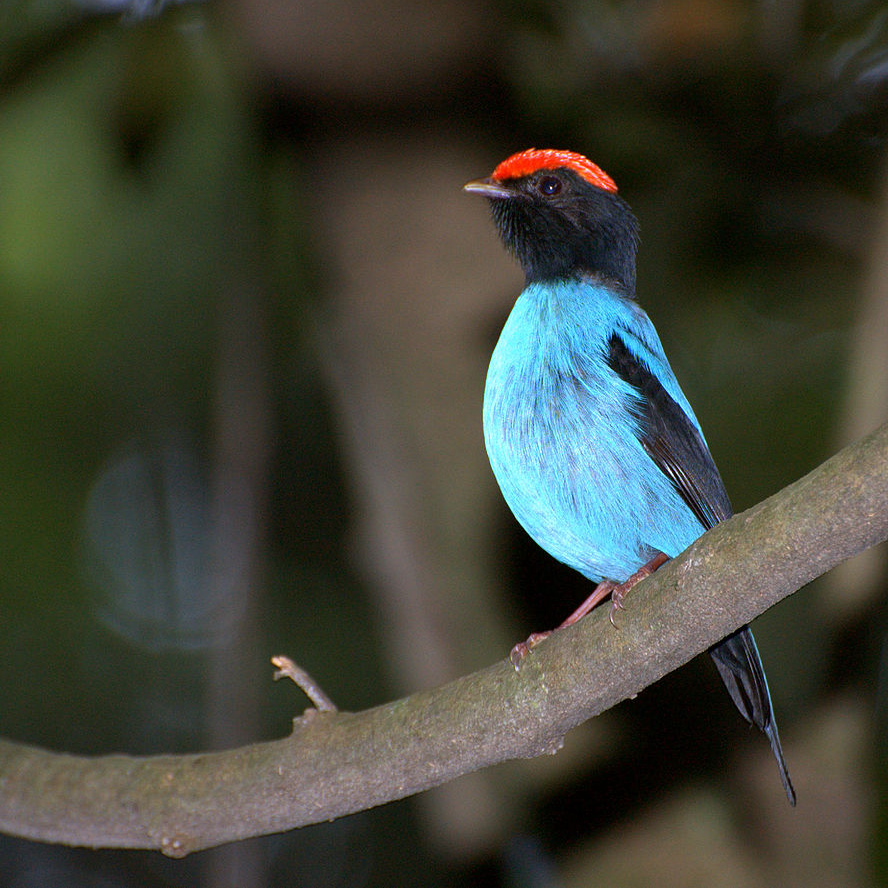
Yellow-headed Manakin
Xenopipo flavicapilla
Order: Passeriformes / Family: Pipridae

Wikimedia Commons
About the Yellow-headed Manakin
The Yellow-headed Manakin (Xenopipo flavicapilla) is a small, strikingly colored bird native to the dense forests of South America. This bird is renowned for its bright yellow head, contrasting sharply with its otherwise dark plumage. Found primarily in Colombia, Ecuador, and Peru, the Yellow-headed Manakin inhabits the lower strata of humid lowland and foothill forests. These areas provide the dense foliage and complex structure necessary for its survival and reproductive success.
This bird plays a crucial ecological role as both a seed disperser and a pollinator. By consuming a variety of fruits, the Yellow-headed Manakin aids in the dispersal of seeds across the forest floor, thus contributing to forest regeneration. Additionally, as it forages among flowers, it inadvertently assists in pollination, benefiting a range of plant species.
Seasonal behaviors of the Yellow-headed Manakin are closely tied to the fruiting patterns of the forest. During the wet season, when fruit is abundant, these birds are more active and visible, engaging in courtship displays and nesting activities. In contrast, the dry season sees a shift in activity patterns as they focus on foraging to maintain energy levels.
The significance of the Yellow-headed Manakin extends beyond its ecological contributions. Its presence is an indicator of forest health and biodiversity. Conservationists monitor this species to assess the impacts of deforestation and habitat fragmentation. By understanding the needs and behaviors of the Yellow-headed Manakin, efforts to preserve its habitat can be better directed, ensuring the survival of this vibrant species.
The Yellow-headed Manakin belongs to the family Pipridae, within the order Passeriformes. These birds typically live average lifespan is around 6 years, with some individuals reaching up to 10 years..
How to Identify a Yellow-headed Manakin
The Yellow-headed Manakin is easily identifiable by its vivid yellow crown, a feature that stands out against its otherwise dark greenish-black body. Adult males exhibit this distinctive head coloration, which is used in their elaborate courtship displays. Females and juveniles, however, present a more subdued appearance, with olive-green plumage and less pronounced yellow on their heads, making them more challenging to spot in dense foliage.
In terms of size, the Yellow-headed Manakin is a small bird, measuring approximately 10 to 11 centimeters in length. Its compact body and short tail contribute to its agile movements among the trees. When perched, the bird maintains a upright posture, often seen flitting between branches or hovering briefly to snatch insects or fruit.
The Yellow-headed Manakin can be confused with other manakin species that share its habitat, but its unique head coloration serves as a reliable field mark. In flight, the bird's rapid wingbeats and direct flight pattern help distinguish it from similarly sized passerines. Observers should note the bird's preference for lower forest levels, where it can often be heard before it is seen.
Having trouble telling birds apart? Upload a photo to our bird identification tool for an instant species match.
Yellow-headed Manakin Habitat and Range
Preferred Habitat
The Yellow-headed Manakin primarily inhabits humid lowland and foothill forests, thriving in areas that provide dense, complex vegetation. These forests, found at elevations ranging from sea level to about 1,200 meters, offer the structural diversity needed for foraging and nesting. The bird's preference for lower canopy levels allows it to exploit food resources that are less accessible to larger species.
Seasonal shifts in habitat use are minimal for the Yellow-headed Manakin, which tends to remain within its forested environment year-round. However, during the breeding season, it may venture into slightly more open areas within the forest to perform courtship displays. While urban presence is rare, the bird has occasionally been observed in forest fragments near human settlements, provided that these areas maintain sufficient vegetation density.
Conservation of its habitat is critical, as deforestation and land conversion pose significant threats. By preserving large tracts of intact forest, we can ensure the continued survival of the Yellow-headed Manakin and the myriad other species that share its home.
Geographic Range
The Yellow-headed Manakin's range is confined to the tropical regions of South America, specifically within Colombia, Ecuador, and Peru. This range encompasses both the Pacific and Amazonian slopes of the Andes, where the species thrives in the humid lowland and foothill forests.
Breeding occurs within these areas, as the consistent climate and abundant resources provide ideal conditions for raising young. The bird is generally non-migratory, residing in its preferred forest habitats throughout the year. However, some local movements may occur in response to food availability or environmental changes.
Population density tends to be higher in regions where forest cover remains relatively undisturbed. Areas such as the Chocó-Darién moist forests and parts of the Amazon Basin are particularly important strongholds for the species. Conservation efforts in these regions focus on mitigating habitat loss and promoting sustainable land use practices to maintain the ecological integrity of these biodiverse ecosystems.
Want to know which birds visit your area? Browse our backyard birds by location guides for region-specific species lists.
What Does the Yellow-headed Manakin Eat?
The diet of the Yellow-headed Manakin predominantly consists of fruits and berries, which it forages from the lower and mid-level canopy. This frugivorous diet plays a key role in seed dispersal within its forest habitat. Seasonally, the bird may also consume insects and other small invertebrates, particularly during the breeding season when additional protein is required for egg production and chick rearing.
Foraging typically occurs during the early morning and late afternoon, coinciding with peak activity periods for many fruiting plants and insects. The Yellow-headed Manakin employs a hover-and-pluck technique, deftly maneuvering to snatch food items from foliage or branches. This method allows it to access a variety of food sources while minimizing time spent exposed to potential predators.
In times of scarcity, the Yellow-headed Manakin may expand its foraging radius or adjust its diet composition, demonstrating a level of adaptability crucial for survival in fluctuating environments. Observations of its feeding habits contribute to our understanding of its ecological role and the dynamics of forest ecosystems.
Yellow-headed Manakin Behavior and Social Structure
The Yellow-headed Manakin exhibits fascinating behaviors, particularly in its social and courtship activities. Males are known for their complex and energetic courtship displays, which are performed in leks, or communal display areas. These displays involve a series of acrobatic maneuvers, including rapid wing flicks and short, bouncing flights, all designed to attract the attention of females.
Socially, the Yellow-headed Manakin tends to be solitary or found in loose associations, particularly outside the breeding season. However, during lekking, males gather in small groups, each defending a display perch while attempting to outdo rivals with elaborate performances.
Territorial behavior is pronounced in males, who vigorously defend their chosen display sites against competitors. Despite their bold display tactics, the birds remain vigilant against predators, utilizing their dense habitat to quickly escape threats.
Daily activity patterns are largely diurnal, with peak activity occurring during the cooler morning and late afternoon hours. The bird's energetic courtship displays and foraging activities are balanced by periods of rest and preening, essential for maintaining its vibrant plumage.
Yellow-headed Manakin Nesting and Reproduction
The nesting habits of the Yellow-headed Manakin are characterized by a preference for well-concealed locations within dense foliage. Nests are typically built by the female alone, who constructs a small, cup-shaped structure using fine plant materials such as grass, fibers, and moss. These nests are often situated on horizontal branches or within the fork of a tree, offering protection from predators and environmental elements.
Clutch size is generally two eggs, which are incubated solely by the female for about 18 to 21 days. The male does not participate in incubation or chick-rearing, as his efforts are primarily focused on attracting additional mates through courtship displays.
Once hatched, chicks are altricial, requiring significant parental care. The female provides all feeding and protection until fledging, which occurs approximately 15 to 20 days after hatching. The Yellow-headed Manakin typically raises one brood per year, though favorable conditions may occasionally lead to a second.
Understanding the nesting ecology of the Yellow-headed Manakin provides insight into the reproductive strategies of tropical bird species and underscores the importance of habitat preservation for successful breeding.
Yellow-headed Manakin Sounds and Vocalizations
The vocalizations of the Yellow-headed Manakin are not as prominent as their visual displays, but they play a crucial role in communication and courtship. The primary song consists of a series of high-pitched, rapid notes that can be described as a 'tsee-tsee-tsee' sequence. This song is often heard during the breeding season as males advertise their presence from display perches.
In addition to their song, Yellow-headed Manakins produce a variety of call notes, including softer 'chip' and 'chuck' sounds used in social interactions and to maintain contact with mates or offspring. Alarm calls are typically more urgent and are used to alert conspecifics of potential threats.
During the dawn chorus, the Yellow-headed Manakin's subtle vocalizations contribute to the rich tapestry of sounds characteristic of tropical forests. While not as loud or complex as some other species, their calls are distinct enough to aid in identification when the birds are not visible.
Interesting Facts About the Yellow-headed Manakin
- 1The Yellow-headed Manakin's vibrant yellow crown is not just for show; it plays a crucial role in courtship displays, helping males attract females.
- 2This species aids in forest regeneration by dispersing the seeds of various fruiting plants, highlighting its ecological importance.
- 3Unlike many birds, the Yellow-headed Manakin does not migrate, instead residing in the same tropical forests year-round, relying on local food sources.
- 4The energetic courtship displays of male Yellow-headed Manakins occur in leks, where multiple males perform elaborate rituals to win over females.
- 5Despite its flashy plumage, the Yellow-headed Manakin can be surprisingly elusive, often remaining hidden within the dense undergrowth of its forest habitat.
- 6Female Yellow-headed Manakins are responsible for nest building and chick rearing, while males focus on attracting mates through persistent displays.
- 7The Yellow-headed Manakin's song, though not as complex as some other species, is distinct and aids in identifying this colorful bird among the forest cacophony.
Yellow-headed Manakin Conservation Status
The Yellow-headed Manakin currently holds a status of Least Concern according to the IUCN Red List, but its populations face pressures from deforestation and habitat degradation. These threats result from agricultural expansion, logging, and infrastructure development, which reduce the extent and quality of available habitat. Population trends for the Yellow-headed Manakin are not well-documented, but habitat loss suggests a potential decline in numbers. Conservation efforts focus on protecting critical forest habitats through the establishment of reserves and the promotion of sustainable land management practices. Historical records indicate that the range of the Yellow-headed Manakin has remained relatively stable, although localized declines highlight the need for continued monitoring and habitat protection. By maintaining and restoring forest ecosystems, conservationists aim to ensure the long-term survival of this and other forest-dependent species.