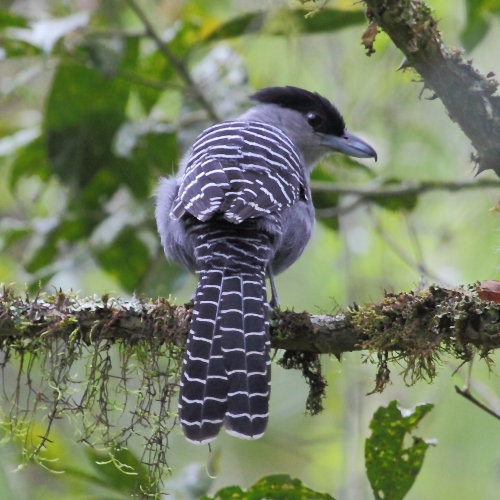
Amazonian Antshrike
Thamnophilus amazonicus
Order: Passeriformes / Family: Thamnophilidae

Wikimedia Commons
About the Amazonian Antshrike
The Amazonian Antshrike (Thamnophilus amazonicus) is a distinctive member of the Thamnophilidae family, found predominantly in the lush, biodiverse regions of the Amazon Basin. This bird plays a critical role in the ecosystem, primarily inhabiting dense forest undergrowth where it acts as both predator and prey, contributing to the balance of its habitat. It thrives in a variety of forested environments, including terra firme and varzea forests, and is frequently observed in the lowland rainforests of Brazil, Peru, Colombia, and Ecuador. The Amazonian Antshrike is a non-migratory resident, adapting to seasonal changes within its environment by shifting its diet and foraging strategies. During the wet season, when insect abundance peaks, it becomes more active and vocal, utilizing the increased insect activity to feed and nurture its young. In the dry season, its activity may decline as it conserves energy in the face of reduced food availability. Importantly, the Amazonian Antshrike is a sentinel species, its presence indicating a healthy forest ecosystem. The bird’s reliance on dense understory habitat makes it especially vulnerable to deforestation and habitat fragmentation, highlighting the need for comprehensive conservation efforts in these regions. By maintaining its role in the food web, the Amazonian Antshrike helps control insect populations and, in turn, supports the diverse array of life that depends on these forests. Observers often note its role in mixed-species foraging flocks, where it cooperates with other birds to find food, showcasing its significance not only as an individual species but as part of a larger ecological community.
The Amazonian Antshrike belongs to the family Thamnophilidae, within the order Passeriformes. These birds typically live average 4-5 years, with a maximum recorded of 6 years..
How to Identify a Amazonian Antshrike
The Amazonian Antshrike is a small bird with a length of about 15 cm, making it a medium-sized member of the antbird family. Adult males feature striking black plumage with bold white markings on the wings and a distinctive white stripe above the eye, giving them a somewhat masked appearance. Females differ significantly, displaying a more subdued brown coloration with similar white wing markings but lacking the bold facial stripe. Juveniles resemble females but exhibit more mottled patterns as they transition to adult plumage. In the field, the Amazonian Antshrike can be confused with other antshrikes in its range, such as the Barred Antshrike, but is differentiated by its lack of barring and smaller size. When perched, the Amazonian Antshrike adopts a horizontal posture, often flicking its tail, a behavior that can aid in its identification. Its flight is short and direct, reflecting its adaptation to a life spent mostly in dense vegetation where quick maneuvers are essential. Observers should note the bird's preference for remaining within the shadows of the understory, where its contrasting plumage can be surprisingly effective at camouflage.
Having trouble telling birds apart? Upload a photo to our bird identification tool for an instant species match.
Amazonian Antshrike Habitat and Range
Preferred Habitat
The Amazonian Antshrike predominantly inhabits the dense, humid understory of tropical lowland forests, particularly in the Amazon Basin. It thrives in varied forest types, including terra firme forests, which remain unflooded, and seasonally flooded varzea forests. This bird is typically found at elevations ranging from sea level to 1,000 meters, although it prefers the richness of lower elevations. It shows little tolerance for open areas or heavily disturbed habitats, making its presence an indicator of intact forest ecosystems. Unlike some other antbird species, the Amazonian Antshrike is rarely found in urban or suburban areas, adhering strictly to its forest habitats. Seasonal habitat shifts are minimal, as it is a year-round resident, though it may adjust its microhabitat use in response to seasonal changes in the forest structure, such as leaf fall during dry periods or increased water levels in flooded forests.
Geographic Range
The Amazonian Antshrike's range extends across much of northern South America, predominantly within the Amazon Basin. It is found in countries such as Brazil, Peru, Colombia, Ecuador, and Bolivia. This species is non-migratory, and its range is largely restricted to its preferred forest habitats. Within these countries, it is most commonly observed in the vast expanses of the Amazon rainforest, a critical biodiversity hotspot. In Brazil, its presence is notable in the states of Amazonas and Pará. Despite its extensive range, the bird is not uniformly distributed, with higher population densities occurring in areas of intact primary forest. The fragmentation of its habitat due to deforestation poses a significant threat, potentially leading to population declines in heavily affected regions. However, in protected areas and remote parts of the Amazon, the Amazonian Antshrike remains a common and integral component of the avian community.
Want to know which birds visit your area? Browse our backyard birds by location guides for region-specific species lists.
What Does the Amazonian Antshrike Eat?
The Amazonian Antshrike primarily feeds on insects and other small arthropods, which it gleans from leaves and branches in the understory. Its diet includes ants, beetles, spiders, and occasionally small vertebrates such as lizards. The bird employs a methodical foraging technique, often observed hanging upside down to access prey hidden beneath leaves. Seasonal changes influence its diet, with an increase in fruit consumption during periods when insect availability declines. Foraging typically occurs during the cooler parts of the day, particularly in the early morning and late afternoon, allowing it to avoid the midday heat common to its tropical habitat. Its role as an insectivore is crucial, as it helps control insect populations within its ecosystem. Observers often spot the Amazonian Antshrike participating in mixed-species foraging flocks, a strategy that minimizes competition and maximizes foraging efficiency.
Amazonian Antshrike Behavior and Social Structure
The Amazonian Antshrike is a territorial bird, with pairs often remaining within a defined area throughout the year. This bird exhibits monogamous pairing, with both members of a pair participating in territory defense through vocal displays and occasional physical confrontations with intruders. During the breeding season, which coincides with the wet season, males engage in courtship displays that include wing-flicking and vocal duets with their mate. The species is generally solitary or found in pairs outside of the breeding season, although it frequently joins mixed-species flocks to forage. Its response to predators involves a combination of vocal alarms and evasive movements through dense foliage, where it relies on its agility to escape. The Amazonian Antshrike is most active during daylight hours, with peak activity in the morning and late afternoon, aligning with the availability of its insect prey.
Amazonian Antshrike Nesting and Reproduction
The Amazonian Antshrike constructs a cup-shaped nest, which it places in the fork of a low tree or shrub, typically 1 to 3 meters above the ground. The nest is composed of twigs, leaves, and plant fibers, intricately woven to provide a secure environment for its eggs and chicks. The female typically lays a clutch of two eggs, which both parents incubate for about 14 days. Upon hatching, the altricial chicks remain in the nest for approximately 10 to 12 days before fledging. Both parents share responsibilities in feeding the chicks and removing fecal sacs to maintain nest cleanliness. The species may raise two broods per year, depending on food availability and environmental conditions. The extended parental care provided by both sexes is crucial for the successful rearing of their young in the challenging forest environment.
Amazonian Antshrike Sounds and Vocalizations
The Amazonian Antshrike's primary song consists of a series of clear, whistled notes delivered in a rising and falling pattern. This characteristic song serves as both a territorial proclamation and a means of communication between mates. In addition to its song, the bird produces a variety of call notes, including a sharp 'chip' used as an alarm call in response to predators. During the dawn chorus, the Amazonian Antshrike's song is one of the first to be heard, cutting through the layered sounds of the forest. Its vocalizations are reminiscent of the clear whistles produced by some thrushes, providing a distinctive acoustic signature that aids in field identification.
Interesting Facts About the Amazonian Antshrike
- 1The Amazonian Antshrike is often heard before it is seen due to its distinctive whistled song that pierces the forest's ambient noise.
- 2Despite its vibrant black and white plumage, the Amazonian Antshrike blends seamlessly into the dappled shadows of the forest understory.
- 3The species is a key participant in mixed-species foraging flocks, which can include up to 30 different bird species working together.
- 4Amazonian Antshrikes use their strong legs and feet to hang upside down while foraging, a unique behavior among many passerines.
- 5In territories where deforestation is rampant, the Amazonian Antshrike serves as an indicator species for forest health.
- 6Amazonian Antshrikes are monogamous, with pairs often staying together for multiple breeding seasons.
- 7Their alarm calls can alert not only their own species but also other birds in the forest to the presence of predators.
Amazonian Antshrike Conservation Status
The Amazonian Antshrike is currently listed as Least Concern by the IUCN, reflecting its relatively stable population across its extensive range. However, the primary threat to its survival is habitat loss due to deforestation and land conversion in the Amazon Basin. Conservation efforts focus on preserving large tracts of continuous forest, which are essential for maintaining viable populations of this and other forest-dependent species. Historically, the bird's population has remained stable in remote areas, but increased deforestation rates pose a significant risk to its future. Advocating for sustainable land-use practices and expanding protected areas are key strategies in ensuring the long-term survival of the Amazonian Antshrike.