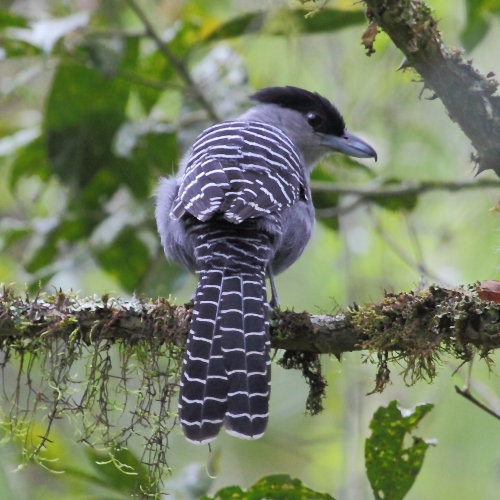
Ash-breasted Antbird
Myrmoborus lugubris
Order: Passeriformes / Family: Thamnophilidae

Wikimedia Commons
About the Ash-breasted Antbird
The Ash-breasted Antbird (Myrmoborus lugubris), native to the vast Amazon Basin, is a remarkable bird within the family Thamnophilidae. Exhibiting a complex ecological role, it inhabits the dense tropical forests primarily in Brazil, Peru, and Bolivia. The bird's significance extends beyond aesthetics, contributing to the intricate food web. Its preference for dense, humid undergrowth makes it a key player in insect population control. As an insectivorous species, the Ash-breasted Antbird is crucial in managing insect populations, which directly influences plant health and forest dynamics. This antbird often participates in mixed-species flocks, enhancing its survival by benefiting from collective vigilance against predators. Seasonally, the Ash-breasted Antbird exhibits subtle behavioral shifts. During the wet season, when insect abundance peaks, this bird becomes more active, expanding its foraging range. Conversely, in the dry season, it might limit its movements to well-vegetated areas where moisture and food remain. This adaptability ensures its survival across various environmental conditions. In terms of conservation, the Ash-breasted Antbird currently holds a stable population status, although deforestation poses a looming threat. The bird's presence across multiple protected areas highlights its significance in biodiversity conservation. With ongoing habitat loss, the Ash-breasted Antbird serves as an indicator species for forest health, emphasizing the need for sustainable forestry practices. Overall, the Ash-breasted Antbird's ecological contributions, coupled with its adaptability, underscore its importance within the Amazon's complex ecosystems.
The Ash-breasted Antbird belongs to the family Thamnophilidae, within the order Passeriformes. These birds typically live average 3-4 years, with a maximum recorded of 6 years..
How to Identify a Ash-breasted Antbird
Identifying the Ash-breasted Antbird involves observing its distinct plumage and behavior. Adult males display a predominant ash-gray breast, contrasting with their darker gray wings and back. This coloration provides excellent camouflage against the forest floor. In contrast, females exhibit a slightly browner hue, with a paler breast, aiding in differentiation between sexes. Juveniles often resemble females but with more pronounced brown tones. The bird's slender build and medium size, approximately 14 centimeters in length, set it apart from other forest inhabitants. Its distinguishing feature is the subtle white patch beneath the tail, visible during perching or flight. When in flight, the Ash-breasted Antbird maintains a low, direct trajectory, reflecting its preference for the understory. Perching posture typically involves a slightly hunched stance, often accompanied by short, deliberate movements. This antbird can be confused with similar species like the Black-faced Antbird. However, the Ash-breasted Antbird's lighter breast and lack of a prominent facial mask aid in accurate identification. Observers should note the bird's preference for dense undergrowth, as this behavior often differentiates it from other antbirds that occupy higher strata.
Having trouble telling birds apart? Upload a photo to our bird identification tool for an instant species match.
Ash-breasted Antbird Habitat and Range
Preferred Habitat
The Ash-breasted Antbird primarily inhabits dense tropical forests, favoring areas with thick undergrowth and abundant leaf litter. It thrives in the Amazon Basin, particularly within the lowland rainforests of Brazil, Peru, and Bolivia. These regions provide the humid, shadowed environment that the bird prefers. The elevation range for this species typically spans from sea level to about 1,200 meters, aligning with the distribution of humid forest zones. While primarily associated with primary forests, the Ash-breasted Antbird can also adapt to secondary growth, provided sufficient undergrowth exists. Its presence decreases significantly in urban areas, as it relies on the dense cover of natural habitats for survival. Seasonal habitat shifts are minimal, as the bird remains within its forested home year-round. However, during the wet season, it might explore areas with increased insect activity due to moisture. The Ash-breasted Antbird's reliance on undisturbed undergrowth highlights the importance of preserving these critical habitats.
Geographic Range
The Ash-breasted Antbird occupies a range concentrated in the heart of South America, primarily within the Amazon Basin. Its breeding and resident range spans Brazil, Peru, and Bolivia, encompassing vast tracts of lowland tropical rainforest. In Brazil, the bird is commonly found in the states of Amazonas and Acre, where dense forest habitats dominate. In Peru, the species inhabits eastern regions such as Loreto and Ucayali, while in Bolivia, it resides in northern territories like Pando. The Ash-breasted Antbird is non-migratory, maintaining a stable presence throughout its range year-round. This sedentary nature underscores its dependence on consistent forest environments. Population density tends to be higher in areas with undisturbed primary forests, where the bird can effectively exploit insect prey. While not considered globally rare, the Ash-breasted Antbird's range is restricted to specific ecological niches within these countries, emphasizing the need for targeted conservation efforts to maintain its habitat.
Want to know which birds visit your area? Browse our backyard birds by location guides for region-specific species lists.
What Does the Ash-breasted Antbird Eat?
The Ash-breasted Antbird primarily feeds on insects, playing a critical role in controlling forest insect populations. Its diet consists of ants, beetles, spiders, and caterpillars, which it gleans from the forest floor and low vegetation. The bird employs a methodical foraging technique, using its sharp eyesight to detect movements in the leaf litter. During the wet season, when insect activity surges, the Ash-breasted Antbird may expand its diet to include a wider variety of insects, taking advantage of the abundance. The dry season prompts a focus on areas with consistent insect availability, such as near water sources. The bird typically forages alone or in pairs, occasionally joining mixed-species flocks, which enhances foraging efficiency and predator avoidance. Prey size ranges from small ants to larger beetles, with the bird showing remarkable adaptability in its hunting strategy. The Ash-breasted Antbird's feeding schedule is primarily diurnal, with peak activity occurring during the early morning and late afternoon, aligning with insect activity patterns.
Ash-breasted Antbird Behavior and Social Structure
The Ash-breasted Antbird exhibits intriguing behaviors that reflect its adaptability and ecological role. Socially, it typically forages in pairs or small family groups, maintaining loose associations with mixed-species flocks. This behavior increases foraging success and enhances predator detection. The bird displays territorial behavior, often defending its territory through vocalizations and physical presence. Males engage in courtship displays, involving subtle wing flicks and posturing to attract females. These displays, though understated, play a crucial role in pair bonding. In response to predators, the Ash-breasted Antbird employs a strategy of freezing or retreating into dense cover, relying on its camouflaged plumage. Its daily activity pattern centers around active foraging during the cooler parts of the day, with a tendency to rest during the midday heat. This pattern aligns with the bird's energy conservation needs and the availability of prey. The Ash-breasted Antbird's behaviors underscore its integration into the forest ecosystem, emphasizing its role in the dynamic balance of tropical forest life.
Ash-breasted Antbird Nesting and Reproduction
The Ash-breasted Antbird constructs a nest that reflects its meticulous nature. Typically, the nest is a cup-shaped structure, made from twigs, leaves, and rootlets, positioned low in the understory. This placement, often near the base of small shrubs or saplings, provides concealment from predators. The preferred nesting sites are in areas with dense vegetation, offering both camouflage and protection. The clutch size usually consists of two eggs, which are creamy white with slight speckling. The incubation period spans approximately 14 days, with both parents sharing responsibilities. Post-hatching, both male and female participate in feeding and caring for the young, demonstrating a strong parental bond. The fledging timeline occurs about 12-14 days after hatching, with the young remaining under parental guidance for several weeks thereafter. Typically, the Ash-breasted Antbird produces one brood per year, though favorable conditions may occasionally result in a second brood. The bird's nesting strategies reflect its adaptation to the dense and competitive environment of the tropical forest.
Ash-breasted Antbird Sounds and Vocalizations
The Ash-breasted Antbird's vocal repertoire is a critical aspect of its behavior and identification. Its primary song consists of a series of sharp, staccato notes delivered in rapid succession, often described as a 'kip-kip-kip' sound. This song serves both as a territorial proclamation and a means of communication between mates. The pitch is moderately high, and the rhythm varies slightly depending on the bird's mood or environmental conditions. In addition to the song, the Ash-breasted Antbird produces a variety of call notes, ranging from soft 'churrs' to sharp 'chips,' used in alarm or to maintain contact within pairs or flocks. The bird's calls become more frequent during the dawn chorus, as it engages in vocal exchanges with neighbors. When alarmed, the bird emits a rapid series of harsh notes, alerting conspecifics to potential threats. The Ash-breasted Antbird's vocalizations are a vital component of its survival strategy, facilitating both territory defense and social interactions.
Interesting Facts About the Ash-breasted Antbird
- 1The Ash-breasted Antbird often joins mixed-species flocks, benefiting from collective vigilance.
- 2Despite its name, the Ash-breasted Antbird feeds on a variety of insects, not just ants.
- 3The bird's subtle white tail patch is primarily visible during flight or perching.
- 4The Ash-breasted Antbird plays a crucial role in controlling insect populations in the Amazon.
- 5Males and females of the species can be distinguished by their subtle differences in plumage.
- 6The Ash-breasted Antbird's song, a 'kip-kip-kip,' is a key identifier in dense forests.
- 7This bird's reliance on dense undergrowth highlights the importance of preserving tropical habitats.
Ash-breasted Antbird Conservation Status
Currently, the Ash-breasted Antbird is classified as Least Concern by the IUCN, with a stable population trend. However, its dependence on dense tropical forests makes it vulnerable to habitat loss due to deforestation and land-use change. The primary threats include logging, agricultural expansion, and infrastructure development within the Amazon Basin. Conservation efforts focus on habitat preservation and the establishment of protected areas, which play a crucial role in safeguarding the bird's habitat. Historical population changes have been relatively stable, with localized declines in regions experiencing significant deforestation. Continued conservation initiatives aim to mitigate these threats by promoting sustainable land-use practices and expanding protected area networks. The Ash-breasted Antbird serves as an indicator species, its population trends reflecting the health of its forest environment, emphasizing the need for ongoing conservation vigilance.