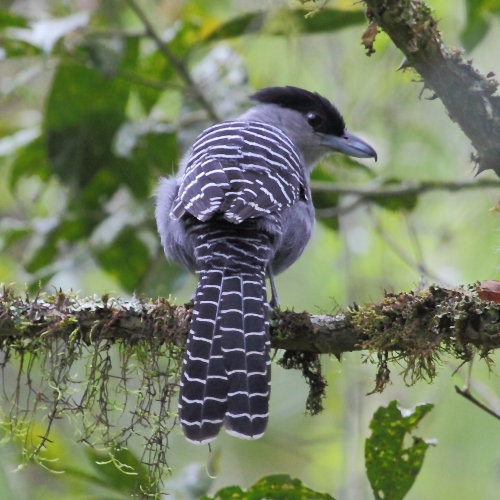
Band-tailed Antbird
Hypocnemoides maculicauda
Order: Passeriformes / Family: Thamnophilidae

Wikimedia Commons
About the Band-tailed Antbird
The Band-tailed Antbird, scientifically known as Hypocnemoides maculicauda, is a fascinating member of the Thamnophilidae family, which comprises over 200 species of antbirds. This species is predominantly found in the Amazon Basin, spanning across countries such as Brazil, Peru, and Bolivia. It inhabits dense, humid lowland forests and is often encountered near water bodies or along forest edges. The Band-tailed Antbird plays a significant ecological role as both a predator and prey, contributing to the intricate balance of the forest ecosystem.
This bird measures approximately 13 cm in length, making it a small, agile bird well-suited to navigating its dense habitat. The Band-tailed Antbird's presence is vital for controlling insect populations, as it primarily feeds on ants and other small insects. It is also an important prey species for larger predators within the ecosystem, thus supporting the food web. The bird's seasonal behaviors include subtle shifts in foraging patterns and vocal activities, especially during the breeding season when its calls become more prominent.
The Band-tailed Antbird exhibits intriguing behaviors related to its social and territorial dynamics. It is typically found in pairs or small family groups, rather than large flocks. These birds are highly territorial, often defending their space vigorously against intruders. During the breeding season, they display increased vocal activity, using a variety of calls to communicate with mates and warn off potential threats. Their ecological significance is further emphasized by their role as bioindicators, as changes in their population can reflect broader environmental changes within the Amazon forest.
The Band-tailed Antbird belongs to the family Thamnophilidae, within the order Passeriformes. These birds typically live average 4-5 years with a max recorded of 8 years..
How to Identify a Band-tailed Antbird
The Band-tailed Antbird can be identified by its distinctive plumage and markings. Adult males and females exhibit similar coloration, with a predominantly gray body, but males tend to be slightly darker. The most notable feature is their banded tail, which features alternating black and white bands. This characteristic tail pattern is key to distinguishing the species from other antbirds.
Juveniles resemble adults but have a less pronounced banding pattern and may display a duller overall coloration. The Band-tailed Antbird also has a white eye stripe that contrasts with its darker head, aiding in identification. In flight, their silhouette is relatively compact with rounded wings, suited for maneuvering through dense foliage.
Confusion with other species is possible, particularly with the closely related Blackish Antbird. However, the Band-tailed Antbird's tail banding is a reliable distinguishing feature. Their perching posture is often upright, with the tail flicked slightly upwards, a behavior that can serve as an additional identification clue.
Having trouble telling birds apart? Upload a photo to our bird identification tool for an instant species match.
Band-tailed Antbird Habitat and Range
Preferred Habitat
The Band-tailed Antbird inhabits lowland tropical forests with a preference for dense understory areas near water sources. These birds are most commonly found in the Amazon Basin, covering areas in Brazil, Peru, and Bolivia. They thrive in humid environments with abundant leaf litter and dense foliage, providing ample foraging opportunities and cover from predators.
This species typically resides at elevations ranging from sea level to 500 meters. Although primarily a forest dweller, the Band-tailed Antbird can occasionally be observed at the edges of forests where the habitat transitions into open areas. Unlike many other bird species, it does not exhibit significant seasonal habitat shifts, remaining in its preferred habitat year-round. The Band-tailed Antbird is less common in urban and highly disturbed areas, as it relies heavily on the intact forest ecosystem for survival.
Geographic Range
The Band-tailed Antbird's range is predominantly within the Amazon Basin, a vast area known for its rich biodiversity. This bird can be found in the lowland forests of Brazil, Peru, and Bolivia. It is a non-migratory species, residing in these regions throughout the year.
Population density is highest in areas where the forest understory is dense and undisturbed. While the Band-tailed Antbird is widespread within its range, its presence is closely tied to the availability of suitable habitat. Deforestation and habitat fragmentation pose significant threats to its distribution, potentially leading to population declines in certain areas.
There are no known migration corridors for this species, as it does not engage in long-distance seasonal movements. Instead, the Band-tailed Antbird tends to remain within a relatively small home range, where it can access consistent food sources and maintain territories.
Want to know which birds visit your area? Browse our backyard birds by location guides for region-specific species lists.
What Does the Band-tailed Antbird Eat?
The Band-tailed Antbird primarily feeds on insects, with a particular preference for ants, hence its name. Its diet includes a variety of small arthropods such as beetles, spiders, and caterpillars. These birds forage by gleaning insects from leaves and branches, often using short, rapid movements to capture prey.
During the wet season, when insect abundance peaks, the Band-tailed Antbird's diet remains consistent, allowing it to thrive. However, in drier months, it may expand its diet to include small fruits and seeds, adapting to seasonal changes in food availability. Prey size typically ranges from small to medium-sized insects, which are abundant in its dense forest habitat.
The Band-tailed Antbird employs a methodical foraging technique, often working in pairs or small groups to cover more ground. Their feeding schedule is most active during the early morning and late afternoon, taking advantage of the cooler temperatures and increased insect activity during these times.
Band-tailed Antbird Behavior and Social Structure
The Band-tailed Antbird exhibits a range of intriguing behaviors, particularly in social and territorial contexts. These birds are generally monogamous, forming strong pair bonds that persist throughout the year. They are highly territorial, with both males and females actively defending their space from intruders through vocal displays and occasional physical confrontations.
Courtship displays involve a series of coordinated calls and subtle posturing, with males often showcasing their banded tails to attract mates. Although they are not known for large-scale flocking, Band-tailed Antbirds sometimes associate with mixed-species flocks, benefiting from the increased foraging efficiency and predator detection offered by such groups.
In response to predators, the Band-tailed Antbird employs a combination of vocal alarms and evasive maneuvers. They are diurnal, with peak activity occurring in the early morning and late afternoon. As the day progresses, they retreat to denser cover to avoid the midday heat and potential predators.
Band-tailed Antbird Nesting and Reproduction
The Band-tailed Antbird constructs cup-shaped nests using materials such as leaves, twigs, and grass, camouflaging them within dense undergrowth or shrubs. Nests are typically placed low to the ground, often near water sources, which provide both concealment and access to resources.
A typical clutch consists of two eggs, which both parents incubate over a period of 14 to 16 days. Once hatched, the chicks remain in the nest for approximately 12 to 15 days before fledging. Both male and female Band-tailed Antbirds are involved in feeding and caring for the young, showcasing a strong parental investment.
This species usually raises one or two broods per year, depending on environmental conditions and food availability. The nesting cycle aligns with the rainy season, ensuring an abundance of food during the critical stages of chick development.
Band-tailed Antbird Sounds and Vocalizations
The primary song of the Band-tailed Antbird is a series of melodious whistles, characterized by a rhythmic, rising pitch that can be heard echoing through the dense forest. This vocalization serves as both a territorial marker and a means of communication between mates.
In addition to their song, these birds emit sharp call notes when disturbed or alarmed, alerting their partners to potential threats. During the dawn chorus, their calls are notably more frequent, contributing to the rich tapestry of sounds that define the Amazonian dawn.
Their vocal repertoire is essential for maintaining pair bonds and coordinating activities within dense vegetation, where visual contact may be limited.
Interesting Facts About the Band-tailed Antbird
- 1The Band-tailed Antbird's banded tail is not just for show; it plays a key role in communication and mate attraction.
- 2These birds are highly territorial and will vigorously defend their small patch of forest from other intruding antbirds.
- 3Despite their name, Band-tailed Antbirds feed on a variety of insects, not just ants, making them versatile foragers.
- 4The species thrives in lowland tropical forests, often found near water bodies where insect prey is plentiful.
- 5Band-tailed Antbirds are known for their strong pair bonds, with mated pairs often staying together year-round.
- 6Their nests are cleverly camouflaged in dense undergrowth, providing protection against predators.
- 7The Band-tailed Antbird's melodious whistles contribute to the rich soundscape of the Amazon rainforest.
Band-tailed Antbird Conservation Status
According to the IUCN Red List, the Band-tailed Antbird is currently classified as Least Concern, suggesting a stable population trend. However, ongoing deforestation and habitat loss within the Amazon Basin pose significant threats to its long-term survival. Conservation efforts focus on preserving and restoring critical habitats, with particular emphasis on protected areas that ensure the continuity of its forest environment. Historical data indicates that while the species was once more widespread, human activities have fragmented much of its suitable habitat. To mitigate further declines, conservationists advocate for sustainable land-use practices and increased protection of the Amazon's unique ecosystems.