
Band-tailed Manakin
Pipra fasciicauda
Order: Passeriformes / Family: Pipridae

Wikimedia Commons
About the Band-tailed Manakin
The Band-tailed Manakin (Pipra fasciicauda) is a small, vibrantly colored bird that inhabits the understory of tropical forests and woodland edges across South America. This species is particularly noted for its vivid red crown and the distinct black band on its tail, which gives it its name. The Band-tailed Manakin plays a pivotal role in the ecosystem as both a pollinator and a disperser of seeds. By feeding on fruits, it helps in the propagation of various plant species, thereby contributing to forest regeneration and biodiversity. This species is typically found in countries such as Brazil, Bolivia, Paraguay, and Peru, often in regions like the Amazon Basin and the Pantanal. The Band-tailed Manakin is a year-round resident, exhibiting only minor local movements in response to seasonal fruit availability. During the breeding season, which coincides with the rainy season, males engage in elaborate courtship displays to attract females. These displays are not only a spectacle for birdwatchers but also an essential element of their reproductive success. The Band-tailed Manakin's ecological role extends beyond pollination and seed dispersal; it serves as prey for larger predators, thus contributing to the food web. Its presence indicates a healthy forest ecosystem, as it thrives in areas with rich biodiversity. Conservation of this species involves preserving its habitat, which is increasingly threatened by deforestation and habitat fragmentation. Understanding the Band-tailed Manakin's significance enhances our appreciation of tropical forest ecosystems and the interdependent relationships within them.
The Band-tailed Manakin belongs to the family Pipridae, within the order Passeriformes. These birds typically live average 8 years, with a maximum recorded of 11 years..
How to Identify a Band-tailed Manakin
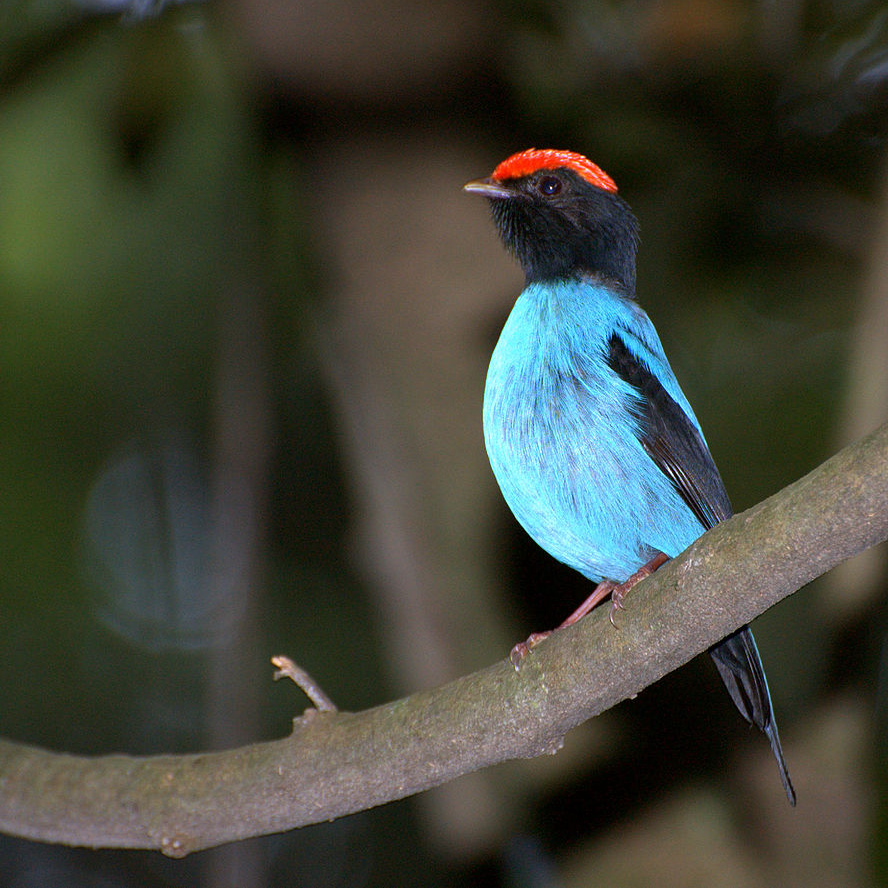
Adult male Band-tailed Manakins are easily recognizable by their bright red crowns, contrasting sharply with the rich black of the rest of their head and the upperparts. Their underparts are olive-green, providing a subtle backdrop to the striking red and black. The distinct black band across the tail is a key feature that differentiates them from similar species. Females and juveniles, however, are more subdued in color, exhibiting an overall olive-green plumage with less pronounced markings. Females lack the red crown, making them less conspicuous in their natural habitat. While the Band-tailed Manakin is unique, its vibrant colors and small size might lead to confusion with other manakin species, such as the Blue-crowned Manakin. However, the tail band and red crown of the Band-tailed Manakin are reliable distinguishing features. In flight, this bird exhibits a rapid, direct pattern, typically low over the forest floor, while its perching posture is upright, often in the mid-levels of the forest canopy.
Having trouble telling birds apart? Upload a photo to our bird identification tool for an instant species match.
Band-tailed Manakin Habitat and Range
Preferred Habitat
The Band-tailed Manakin inhabits tropical and subtropical forests, primarily in humid lowland and foothill regions. Its preferred habitats include the Amazon rainforest, the Atlantic Forest, and the gallery forests along rivers. This species typically resides at elevations ranging from sea level to about 1,000 meters. Habitat selection is influenced by the availability of fruiting trees, which are essential for its diet. During the breeding season, the Band-tailed Manakin often remains in the same area, but it may shift locations slightly in search of abundant food sources. Unlike many other birds, it tends to avoid urban areas, thriving instead in densely forested regions where human disturbance is minimal.
Geographic Range
The Band-tailed Manakin's range extends across several South American countries, including Brazil, Bolivia, Paraguay, and Peru. It is most commonly found in the Amazon Basin, a hotspot for biodiversity. The species is non-migratory, maintaining a stable presence year-round in its preferred habitats. While its distribution is relatively wide, population densities vary, with some areas like the eastern Amazon hosting a higher concentration of individuals. The Band-tailed Manakin's range overlaps with other manakin species, which can lead to competition for resources in some regions.
Want to know which birds visit your area? Browse our backyard birds by location guides for region-specific species lists.
What Does the Band-tailed Manakin Eat?
The Band-tailed Manakin primarily feeds on a variety of fruits, which make up the bulk of its diet. It shows a particular preference for small berries and drupes, often sourced from plants like figs and melastomes. During fruit scarcity, it may supplement its diet with insects, particularly ants and small beetles, providing additional protein. Foraging occurs mainly in the early morning and late afternoon, when the bird actively searches for food within the forest understory. The Band-tailed Manakin employs a hover-gleaning technique, delicately plucking fruits from branches while in flight. This method allows it to access food sources that might be difficult for other birds to reach.
Band-tailed Manakin Behavior and Social Structure
The Band-tailed Manakin exhibits distinctive social and territorial behaviors, particularly during the breeding season. Males perform elaborate courtship displays in leks, where they gather to compete for female attention through a series of acrobatic flights and vocalizations. These displays are crucial for mating success. Outside the breeding season, Band-tailed Manakins are relatively solitary, although they may form loose associations with mixed-species flocks when foraging. The bird maintains a defined territory, which it defends vigorously against intruders. In terms of daily activity, it is most active during the cooler parts of the day, with a preference for foraging early in the morning and late in the afternoon. When faced with predators, Band-tailed Manakins rely on their agility and dense foliage for cover, often freezing mid-motion to avoid detection.
Band-tailed Manakin Nesting and Reproduction
The Band-tailed Manakin constructs a delicate cup-shaped nest made of fine plant fibers and spider silk. These nests are strategically placed on the horizontal branches of shrubs or small trees, usually within a few meters of the ground. The female is solely responsible for nest building, incubation, and chick rearing. A typical clutch consists of two eggs, which are incubated for about 18-20 days. Upon hatching, the chicks are altricial, requiring extensive parental care. The fledging period lasts approximately 15-20 days, during which the female continues to feed and protect the young. The Band-tailed Manakin usually raises one brood per year, timing its breeding season to coincide with the rainy season, ensuring ample food supply.
Band-tailed Manakin Sounds and Vocalizations
The call of the Band-tailed Manakin is a repetitive series of sharp, high-pitched notes, often described as 'zee-zee-zee.' These calls are most frequently heard during the breeding season, serving both to attract mates and to establish territory. The male's song is a distinctive whistle, with a rhythmic pattern that can carry through the dense forest. In addition to its song and call notes, the Band-tailed Manakin produces a variety of mechanical sounds during its courtship displays, created by wing snaps and rapid movements. Unlike many other birds, it does not participate extensively in a dawn chorus, preferring to project its calls during the later morning hours.
Interesting Facts About the Band-tailed Manakin
- 1Male Band-tailed Manakins are known for their complex courtship dances, which can involve up to a dozen males displaying together.
- 2The Band-tailed Manakin's diet includes over 30 different fruit species, highlighting its role in seed dispersal.
- 3Unlike many birds, the Band-tailed Manakin does not migrate, instead adapting to seasonal changes in its environment.
- 4The vibrant plumage of male Band-tailed Manakins is a result of carotenoid pigments, which they obtain from their fruit-heavy diet.
- 5Band-tailed Manakins have been observed using specific perches repeatedly during their courtship displays, indicating strong site fidelity.
- 6Their lekking behavior, where males display in groups, is a unique aspect of their reproductive strategy.
- 7Despite their small size, Band-tailed Manakins play a significant role in the forest ecosystem as both seed dispersers and prey.
Band-tailed Manakin Conservation Status
The Band-tailed Manakin is currently listed as Least Concern by the IUCN, with a stable population trend. However, its habitat is under threat from deforestation and agricultural expansion. Conservation efforts focus on preserving the tropical forests of South America, which are vital for the survival of this and many other species. Protected areas and sustainable land-use practices are essential in mitigating habitat loss. Although the Band-tailed Manakin's population remains stable, ongoing monitoring is necessary to ensure that future threats do not lead to declines.
Other Pipridae Species


Birds Similar to the Band-tailed Manakin
These species are often confused with the Band-tailed Manakin due to similar appearance or overlapping range.

