
Wire-tailed Manakin
Pipra filicauda
Order: Passeriformes / Family: Pipridae

Wikimedia Commons
About the Wire-tailed Manakin
The Wire-tailed Manakin (Pipra filicauda) is a captivating bird native to the lowland tropical forests of the Amazon Basin, where it plays a significant ecological role as a seed disperser. This small bird, belonging to the family Pipridae, is particularly noted for its ornate tail feathers, which resemble fine wires, giving the species its common name. These tail feathers are integral to its courtship displays, making the Wire-tailed Manakin a subject of interest for ornithologists studying mating behaviors. The bird's range extends across several countries in South America, including Brazil, Peru, Ecuador, and Colombia, with a preference for undisturbed forested regions. In terms of ecological significance, the Wire-tailed Manakin contributes to the maintenance of rainforest biodiversity. By consuming various fruits, this bird aids in seed dispersal, thereby facilitating forest regeneration. Its presence indicates a healthy ecosystem, as it relies on intact forest understory for survival. Seasonally, the Wire-tailed Manakin remains largely sedentary, with territories established within its preferred habitat. During breeding season, the male's elaborate courtship displays become prominent, consisting of acrobatic flights and vocalizations intended to attract females. Outside of the breeding season, these birds continue to inhabit the dense vegetation of the rainforest, where they find abundant food resources and shelter from predators. Their role in the ecosystem extends beyond seed dispersal, as they also serve as prey for larger birds and mammals, thus contributing to the complex food web of their rainforest home.
The Wire-tailed Manakin belongs to the family Pipridae, within the order Passeriformes. These birds typically live average 7 years, with a maximum recorded of 10 years..
How to Identify a Wire-tailed Manakin
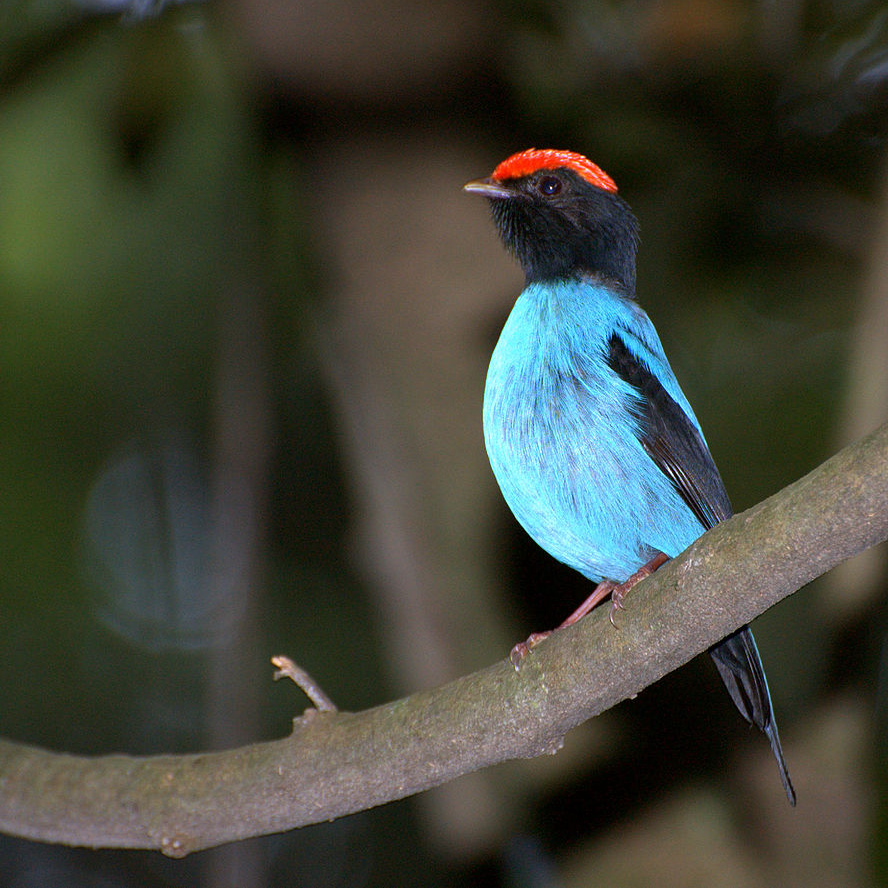
The Wire-tailed Manakin is a small, vibrant bird, measuring approximately 11 cm in length. Adult males are easily identified by their striking plumage: a bright red head, contrasting with a velvety black body and distinctive wire-like tail feathers that can measure up to 10 cm. These features make them unmistakable during courtship displays. Females and juveniles, however, present a different challenge for identification. They are primarily olive-green with a more subdued coloration, lacking the male's vibrant head and wire-like tail. This dimorphism is common among manakins and aids in distinguishing between sexes. In flight, the Wire-tailed Manakin exhibits a rapid, fluttering flight pattern typical of small passerines, with quick wingbeats that contrast with the more gliding flight of larger birds. When perched, the bird's upright stance allows for the clear display of its elongated tail feathers. Confusion with similar species like the Red-capped Manakin (Ceratopipra mentalis) is possible, but the latter lacks the distinctive wire-like tail. Observers should note the Wire-tailed Manakin's unique tail structure and the vibrant red of the male's head as key differentiators.
Having trouble telling birds apart? Upload a photo to our bird identification tool for an instant species match.
Wire-tailed Manakin Habitat and Range
Preferred Habitat
The Wire-tailed Manakin is predominantly found in the lowland tropical rainforests of the Amazon Basin, thriving in the dense understory where sunlight filters through the canopy. These birds prefer areas with rich vegetation, such as forest edges and secondary growth forests. They are typically found at elevations below 1,000 meters, where the climate remains humid and warm year-round. Unlike some bird species that adapt to urban environments, the Wire-tailed Manakin remains a true forest dweller, avoiding human-altered landscapes. During the dry season, these birds may shift slightly to areas with ample fruiting trees, but they generally remain within the forested habitat throughout the year.
Geographic Range
The Wire-tailed Manakin's range stretches across the northern part of the Amazon Basin, encompassing several countries in South America. Its presence is confirmed in Brazil, specifically in the states of Amazonas and Acre, as well as in the eastern regions of Peru, the southern parts of Colombia, and the eastern lowlands of Ecuador. The species does not undertake long migrations, remaining within its established range throughout the year. However, it may exhibit local movements in response to fruit availability, which affects its distribution density within the forest. Population hotspots are typically found in less disturbed areas of the rainforest, where the dense vegetation provides ample resources and nesting sites.
Want to know which birds visit your area? Browse our backyard birds by location guides for region-specific species lists.
What Does the Wire-tailed Manakin Eat?
The Wire-tailed Manakin's diet consists primarily of fruits, which makes it an important seed disperser in its ecosystem. It favors small berries and drupes, often consuming them whole and later regurgitating the seeds. This diet is supplemented by small insects and arthropods, providing essential protein, especially during the breeding season when energy demands increase. The bird forages by hopping agilely through the dense understory, using its keen eyesight to spot ripe fruit. Feeding occurs throughout the day, with peaks in activity during the cooler morning and late afternoon hours. During the wet season, when fruit is more abundant, the Wire-tailed Manakin may expand its diet to include a wider variety of fruiting plants.
Wire-tailed Manakin Behavior and Social Structure
Socially, the Wire-tailed Manakin exhibits fascinating behaviors, particularly during the breeding season. Males are known for their intricate courtship displays, which involve a combination of dance-like movements, vocalizations, and the showcasing of their distinctive tail feathers. These displays occur at traditional sites known as leks, where multiple males gather to perform for visiting females. Territoriality is evident among males, who vigorously defend their display areas within these leks. Outside of the breeding season, Wire-tailed Manakins are more solitary, though they sometimes form small foraging groups. Their response to predators includes swift evasive maneuvers and seeking cover within dense foliage. Daily activity patterns show peak activity during cooler periods of the day, with rest periods during the hottest midday hours.
Wire-tailed Manakin Nesting and Reproduction
The Wire-tailed Manakin constructs simple, cup-shaped nests using fine plant materials, such as grass stems and leaves. These nests are typically positioned on low branches within the dense understory, offering concealment from predators. A typical clutch consists of two eggs, which are incubated primarily by the female for about 18-20 days. Once hatched, the chicks are altricial, requiring considerable parental care. The female assumes most of the feeding and brooding responsibilities, while the male continues to perform displays to attract additional mates. Fledging occurs approximately 16-18 days after hatching, although the young may remain dependent on parental care for some time thereafter. The Wire-tailed Manakin generally breeds once per year, with the breeding season coinciding with periods of higher fruit availability.
Wire-tailed Manakin Sounds and Vocalizations
The Wire-tailed Manakin's vocal repertoire includes a variety of sounds, with its primary song being a series of rapid, high-pitched notes delivered in quick succession. This song serves as both a territorial and courtship signal, often heard during the early morning hours when males are most active in their display areas. Call notes are typically short, metallic 'tinks,' used in communication between individuals, especially when foraging. Alarm calls, slightly harsher in tone, alert others to potential threats. The dawn chorus, a phenomenon where birds collectively sing at the break of dawn, often features the Wire-tailed Manakin's distinct vocalizations, contributing to the vibrant soundscape of the Amazon rainforest.
Interesting Facts About the Wire-tailed Manakin
- 1The Wire-tailed Manakin's name comes from its unique tail feathers, which resemble delicate wires and can measure up to 10 cm long.
- 2Males perform elaborate courtship dances, sometimes involving acrobatic leaps and synchronized movements in small groups.
- 3Wire-tailed Manakins are part of the Pipridae family, known for their vibrant colors and complex mating rituals.
- 4Despite their small size, Wire-tailed Manakins play a crucial role in seed dispersal, affecting forest composition and growth.
- 5The species was first described by the famous ornithologist John Gould in 1852, highlighting its long-standing interest among bird watchers.
- 6Their courtship displays occur at specific sites called leks, where multiple males compete for the attention of females.
- 7The Wire-tailed Manakin is one of the few birds that can consume certain toxic fruits, aiding in seed dispersal without harm.
Wire-tailed Manakin Conservation Status
The Wire-tailed Manakin currently holds a status of Least Concern according to the IUCN Red List, with stable population trends. However, the primary threat to this species is habitat loss due to deforestation in the Amazon Basin. Conservation efforts focus on preserving large tracts of intact rainforest and implementing sustainable land-use practices. Historically, population numbers have shown resilience, but ongoing environmental pressures could alter this stability. Protecting crucial habitats and promoting awareness of the bird's ecological role are vital for ensuring its future survival.
Other Pipridae Species


Birds Similar to the Wire-tailed Manakin
These species are often confused with the Wire-tailed Manakin due to similar appearance or overlapping range.

