
Bar-crested Antshrike
Thamnophilus multistriatus
Order: Passeriformes / Family: Thamnophilidae

Wikimedia Commons
About the Bar-crested Antshrike
The Bar-crested Antshrike (Thamnophilus multistriatus) is a captivating bird species residing primarily in the subtropical and tropical moist lowland forests of northern South America. This member of the Thamnophilidae family exhibits a remarkable adaptation to its environment, often found in dense undergrowth where its striped plumage provides excellent camouflage. Predominantly distributed across Colombia and western Venezuela, the Bar-crested Antshrike plays an important role in the ecosystem by controlling insect populations. Its presence is indicative of healthy forest ecosystems.
This species is particularly significant in the avian community due to its specialized foraging techniques and its role in seed dispersal, albeit indirectly. By preying on insects that interact with various plant species, the Bar-crested Antshrike influences plant growth and distribution. During breeding season, which corresponds with the rainy season to ensure abundance of food, they exhibit increased territorial behavior and vocal activity. Their song, a series of rapid, melodious notes, becomes a common soundscape in their habitat.
The Bar-crested Antshrike's ecological role extends beyond its immediate environment. As a mid-level predator, it helps maintain the balance of insect populations, which in turn affects the plant communities. Their presence is a marker of biodiversity, as these birds thrive in undisturbed habitats. Conservation of their habitats ensures the protection of numerous other species that share this environment. Seasonal behaviors include shifts within microhabitats to adapt to changes in food availability and climatic conditions. The antshrike's ability to navigate and exploit its habitat underlines its evolutionary success in these regions.
The Bar-crested Antshrike belongs to the family Thamnophilidae, within the order Passeriformes. These birds typically live average 5-6 years with a maximum recorded of 8 years..
How to Identify a Bar-crested Antshrike
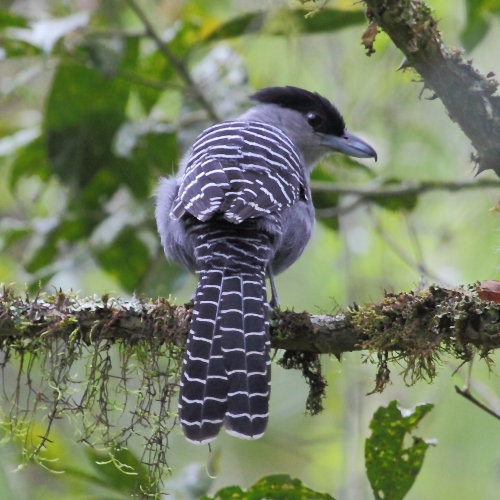
Identifying the Bar-crested Antshrike requires attention to its distinct plumage and body structure. Adults display a striking pattern of black and white bars across their body, particularly prominent on the wings and tail. The bold, black crest, from which the species derives its name, is a key identifying feature. Males and females are similar in coloration, but females may exhibit slightly duller tones. Juveniles, on the other hand, are less distinctly barred and show more muted brownish hues, which gradually develop into the adult plumage.
In terms of posture and silhouette, the Bar-crested Antshrike often perches with an upright stance, showing off its crest. Its habit of staying within the mid to lower canopy layers can make it challenging to spot, but its vocalizations often betray its presence. When in flight, the antshrike displays a swift, direct flight pattern, though it prefers to move through the forest by hopping between branches.
Confusion with similar species, such as the Black-crested Antshrike or other Thamnophilus members, can occur, but close observation of the crest and the barred pattern helps distinguish it. Its vocalizations also differ, providing another clue for correct identification.
Having trouble telling birds apart? Upload a photo to our bird identification tool for an instant species match.
Bar-crested Antshrike Habitat and Range
Preferred Habitat
The Bar-crested Antshrike inhabits subtropical and tropical moist lowland forests, thriving in dense, humid environments. These areas offer ample undergrowth and foliage, essential for its feeding and nesting habits. In Colombia, it is prevalent in regions like the Magdalena Valley and the Pacific slope of the Andes. Elevation-wise, it occupies zones from sea level up to about 1,500 meters.
This species shows a preference for primary forests, where the canopy provides cover and the underbrush teems with insect life. However, it can also adapt to secondary growth, as long as sufficient vegetative cover exists. Seasonal shifts within these habitats may occur, particularly in response to food availability and breeding needs. While not typically found in urban areas, the Bar-crested Antshrike can occasionally be spotted in rural landscapes adjacent to forested regions.
Geographic Range
The Bar-crested Antshrike's range is relatively restricted compared to some other antbird species. It primarily resides in northern Colombia and extends into western Venezuela. In Colombia, its presence is noted in areas such as the Eastern and Central Cordilleras, as well as the lowland regions of the Magdalena Valley.
While it is considered a resident species throughout its range, there may be local movements in response to environmental changes, such as variations in food availability or habitat conditions. Unlike migratory birds, the Bar-crested Antshrike does not undertake long-distance migrations, instead remaining within its established territories throughout the year.
Population density varies within its range, with hotspots in regions where forest cover remains intact. Conservation of these habitats is crucial for maintaining stable populations, given the species' reliance on dense forest environments.
Want to know which birds visit your area? Browse our backyard birds by location guides for region-specific species lists.
What Does the Bar-crested Antshrike Eat?
The Bar-crested Antshrike's diet consists primarily of insects and other arthropods, making it an insectivorous specialist. It actively forages within the dense underbrush, employing a methodical approach to search for prey. Common prey items include beetles, ants, spiders, and caterpillars, which it gleans from foliage and bark.
Seasonal changes in food availability influence its diet, with an increase in caterpillar consumption during the rainy season when these prey are more abundant. The antshrike uses a combination of visual and auditory cues to locate its prey, often using short flights or hops to capture insects disturbed by its movement.
In addition to insects, the Bar-crested Antshrike may occasionally consume small fruits or seeds, though these are not primary components of its diet. Feeding typically occurs throughout the daylight hours, with peaks in activity during the cooler morning and late afternoon periods.
Bar-crested Antshrike Behavior and Social Structure
The Bar-crested Antshrike exhibits intriguing behavioral patterns, particularly in its social and territorial habits. It is generally monogamous, forming long-term pair bonds that are reinforced through mutual preening and vocalizations. These birds maintain well-defined territories, which they defend vigorously against intruders, especially during the breeding season.
Courtship displays involve a combination of vocalizations and visual presentations, including crest raising and wing flicking. These behaviors serve to strengthen pair bonds and signal readiness for breeding. The Bar-crested Antshrike is typically solitary or found in pairs, but during non-breeding seasons, it may join mixed-species foraging flocks, which provides safety in numbers and increased foraging success.
In terms of predator response, the Bar-crested Antshrike relies on its camouflage and alertness. Upon detecting a threat, it may emit alarm calls to warn conspecifics and other birds in the vicinity. Daily activity patterns are diurnal, with peak activity in the early morning and late afternoon, aligning with cooler temperatures and optimal foraging conditions.
Bar-crested Antshrike Nesting and Reproduction
The nesting habits of the Bar-crested Antshrike are well-adapted to its forest environment. It constructs a cup-shaped nest using twigs, leaves, and fibers, typically situated within dense foliage to offer protection from predators. Preferred nesting sites are often located at mid to low heights within shrubs or small trees.
A typical clutch consists of two eggs, which both parents incubate over a period of approximately 14 to 16 days. This shared parental investment extends to feeding and caring for the young post-hatching. Fledging occurs around 12 to 14 days after hatching, although parents continue to feed and protect the juveniles for several weeks thereafter.
The Bar-crested Antshrike may produce one to two broods per year, depending on environmental conditions and food availability. The breeding season aligns with the rainy season to maximize resource availability, which enhances reproductive success.
Bar-crested Antshrike Sounds and Vocalizations
The Bar-crested Antshrike's primary song is a rapid, melodious series of notes that serve both as territorial declarations and as communication between mates. This song is both distinctive and persistent, often repeated in quick succession. Its rhythm can be likened to a musical trill, with a slightly rising and falling pitch that carries well through the dense forest understory.
In addition to its song, the Bar-crested Antshrike produces a variety of call notes, including sharp, staccato chips and whistles. These calls serve to maintain contact between pair members or signal alarms when predators are nearby. During the dawn chorus, the antshrike's song is particularly prominent, adding to the early morning symphony of the forest.
Alarm calls are more abrupt and harsh, aimed at deterring potential threats and alerting other birds in the vicinity. The variation in vocalizations highlights the complexity of their communication and the importance of sound in their social interactions.
Interesting Facts About the Bar-crested Antshrike
- 1The Bar-crested Antshrike's crest is not only decorative but also used in social displays and communication between mates.
- 2Despite being primarily insectivorous, the Bar-crested Antshrike occasionally consumes small fruits, showcasing dietary flexibility.
- 3These antshrikes often join mixed-species flocks outside the breeding season, enhancing foraging success and predator vigilance.
- 4The species' barred plumage provides excellent camouflage in the dappled light of its forest habitat, aiding in predator avoidance.
- 5Bar-crested Antshrikes are known to be particularly vocal during the rainy season, which coincides with their breeding period.
- 6The nest of a Bar-crested Antshrike is an intricate cup made from twigs and plant fibers, showcasing their construction skills.
- 7Unlike many birds, the Bar-crested Antshrike pairs remain together year-round, reflecting strong monogamous bonds.
Bar-crested Antshrike Conservation Status
The Bar-crested Antshrike is currently classified as 'Least Concern' by the IUCN, indicating a stable population trend. Despite its stable status, habitat destruction poses a significant threat, particularly deforestation for agriculture and logging in Colombia and Venezuela. Conservation efforts focus on preserving the bird's natural habitats, which are crucial for its survival and the broader ecosystem. Establishing protected areas and promoting sustainable land-use practices are key strategies in mitigating habitat loss. Historically, the Bar-crested Antshrike has maintained stable populations, but continued vigilance is necessary to ensure that deforestation and habitat degradation do not lead to future declines. Supporting local conservation initiatives and raising awareness about the ecological importance of this species contribute to its ongoing preservation.
Other Thamnophilidae Species



Birds Similar to the Bar-crested Antshrike
These species are often confused with the Bar-crested Antshrike due to similar appearance or overlapping range.
