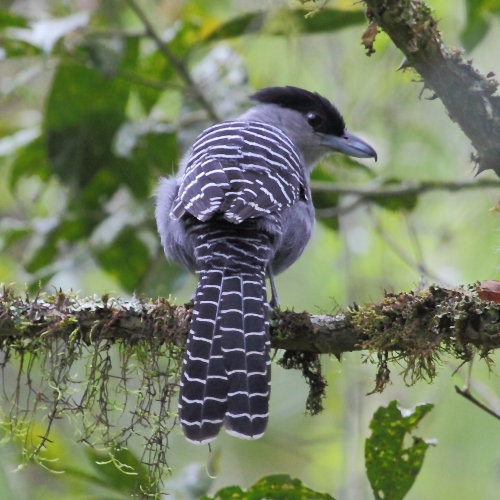
Bare-eyed Antbird
Rhegmatorhina gymnops
Order: Passeriformes / Family: Thamnophilidae

Wikimedia Commons
About the Bare-eyed Antbird
The Bare-eyed Antbird (Rhegmatorhina gymnops) is a striking member of the Thamnophilidae family, notable for its bare, pale blue eye skin that stands out against its otherwise muted plumage. This species inhabits the dense, humid understory of Amazonian rainforest, predominantly found in Brazil, Peru, and Bolivia. The Bare-eyed Antbird plays a crucial role in its ecosystem as an obligate ant-following bird, specializing in feeding on the invertebrates disturbed by marauding army ant swarms. This ecological niche not only highlights the bird's adaptability but also underscores its significance in maintaining the delicate balance within its habitat.
In the vast expanse of the Amazon Basin, the Bare-eyed Antbird is an expert at navigating the dappled light of the forest floor. The bird's adaptation to this environment speaks volumes about its evolutionary journey. Living in one of the world's most biodiverse regions, the Bare-eyed Antbird contributes to the complex food web by controlling invertebrate populations and serving as prey for larger predators. This bird is most active during the wet season, when army ant activity peaks, leading to an increase in food availability.
The Bare-eyed Antbird is not just a biological marvel but also a subject of interest for ornithologists studying mutualistic relationships between species. Its reliance on army ants is a prime example of co-evolution, where both the bird and the ants benefit from each other's presence. The bird's presence is critical in understanding the dynamics of rainforest ecosystems, as it provides insights into the health and biodiversity of these environments. Despite its utility in scientific research, the Bare-eyed Antbird faces threats from habitat destruction and climate change, which could disrupt its delicate ecological niche.
The Bare-eyed Antbird belongs to the family Thamnophilidae, within the order Passeriformes. These birds typically live 5-8 years, with a maximum recorded of 10 years..
How to Identify a Bare-eyed Antbird
The Bare-eyed Antbird's most distinguishing feature is its pale blue, bare orbital skin, which starkly contrasts with its otherwise understated plumage. Adult birds exhibit a generally brown and gray color palette, with males and females appearing similar in coloration, although males may be slightly more vibrant. The upperparts are a mix of brown and gray, providing effective camouflage among the leaf litter and shadowy understory.
Juvenile Bare-eyed Antbirds typically appear duller than adults, with less pronounced blue eye skin and a more uniform brown plumage. This differentiation aids in their survival, as the less conspicuous appearance can help them avoid predators until they attain full maturity. Their flight is usually short and direct, as they seldom venture far from the protective cover of the forest floor.
In terms of silhouette, the Bare-eyed Antbird is a medium-sized bird with a compact, robust body and relatively short tail. Its perching posture is upright, often with a slightly hunched appearance as it intently observes the ground, searching for insects disturbed by ants. While the bird's coloration might initially seem unremarkable, its unique bare eye skin makes it readily identifiable for those familiar with the region's avifauna.
Having trouble telling birds apart? Upload a photo to our bird identification tool for an instant species match.
Bare-eyed Antbird Habitat and Range
Preferred Habitat
The Bare-eyed Antbird is intrinsically linked to the lowland rainforests of the Amazon Basin, favoring dense, humid undergrowth where army ants are prevalent. This bird thrives at elevations generally below 500 meters, where the forest structure provides ample cover and foraging opportunities.
During the rainy season, the increased activity of army ants draws the Bare-eyed Antbird to areas with rich leaf litter and complex undergrowth. The bird remains strictly within the forest, showing no inclination toward urban areas or fragmented habitats, underscoring its sensitivity to environmental changes.
The Bare-eyed Antbird's reliance on undisturbed rainforest means it is an indicator species for habitat integrity. As such, it is rarely found in secondary growth or degraded areas, highlighting the importance of pristine forest conditions for its survival and foraging success.
Geographic Range
The Bare-eyed Antbird's range is confined to the Amazon Basin, a region known for its expansive rainforests and incredible biodiversity. It is predominantly found in southeastern Peru, northern Bolivia, and western Brazil, where its habitat requirements are met by the lush, ant-rich environments of these countries.
While the bird does not migrate in the traditional sense, it does exhibit localized movements in response to the availability of army ant swarms, following these swarms to capitalize on the abundance of prey.
Population densities of the Bare-eyed Antbird are highest in regions where army ants are most active. This bird does not venture outside the tropical rainforest, making it susceptible to local habitat changes and deforestation. Its presence serves as a reliable indicator of healthy ant populations and, by extension, the ecological health of the Amazonian forests.
Want to know which birds visit your area? Browse our backyard birds by location guides for region-specific species lists.
What Does the Bare-eyed Antbird Eat?
The Bare-eyed Antbird maintains a specialized diet heavily reliant on the invertebrates flushed out by army ant swarms. Its primary food sources include insects and other arthropods that scurry away from the advancing ant columns.
During the wet season, when ant activity peaks, the Bare-eyed Antbird's diet becomes particularly rich in terms of prey variety and abundance. The bird methodically follows ant swarms, picking off insects such as spiders, beetles, and grasshoppers, which range in size from a few millimeters to several centimeters.
Although the bird is an opportunistic feeder, its reliance on ants for provisioning food makes it vulnerable to fluctuations in ant populations. The Bare-eyed Antbird's foraging technique involves quick, precise movements to snatch prey from the ground as it perches just above the swarm. The bird feeds throughout the day, with activity peaking during the cooler morning hours when prey is most abundant.
Bare-eyed Antbird Behavior and Social Structure
The Bare-eyed Antbird exhibits a fascinating social structure, often seen in small family groups rather than large flocks. It maintains a highly territorial behavior, with pairs or small groups defending their foraging grounds against conspecifics.
Courtship displays are subtle but involve mutual grooming and vocal exchanges, strengthening pair bonds. The bird's interaction with army ants showcases a unique form of commensalism, where it benefits from the ant's predatory behavior without affecting the ants themselves.
In the presence of predators, the Bare-eyed Antbird displays a mix of freezing and evasive tactics, relying on its camouflage and quick bursts of flight to escape danger. Its daily routine revolves around the movements of army ant swarms, with peak activity in the morning and late afternoon. The bird rests during the hottest parts of the day, conserving energy in the shade of the dense forest.
Bare-eyed Antbird Nesting and Reproduction
The Bare-eyed Antbird constructs its nest with meticulous care, utilizing materials such as leaves, twigs, and moss to blend seamlessly with the rainforest understory. Typically, nests are placed low to the ground, often in dense foliage or a small tree fork, providing security and camouflage from predators.
Clutch sizes are relatively small, usually consisting of two to three eggs. Both parents share incubation duties, which last approximately 14-16 days. The fledging period extends for another 10-12 days after hatching, during which time both parents continue to feed and protect the young.
The Bare-eyed Antbird typically raises one to two broods per year, with breeding synchronized to the wet season when food resources are abundant. Parental roles are well defined, with both sexes taking turns incubating eggs and feeding chicks, showcasing a strong cooperative breeding strategy.
Bare-eyed Antbird Sounds and Vocalizations
The Bare-eyed Antbird's primary song is a series of soft, melodious whistles, characterized by a steady rhythm and moderate pitch. These vocalizations serve both as territorial markers and communication between mates.
Call notes are sharp and distinct, often used in alarm situations or to maintain contact within family groups. The bird's alarm calls are harsher, serving as a warning to nearby conspecifics of potential danger.
During the dawn chorus, the Bare-eyed Antbird participates with a subdued, yet persistent voice, contributing to the symphony of the Amazonian forest. Its vocalizations, though less prominent than some other forest species, play a crucial role in its social interactions and territorial behaviors.
Interesting Facts About the Bare-eyed Antbird
- 1The Bare-eyed Antbird is one of the few bird species that specifically follows army ants, showcasing a fascinating example of avian-insect interaction.
- 2Despite its reliance on ants, the Bare-eyed Antbird does not consume the ants themselves, instead preying on insects disturbed by the ant swarms.
- 3This species is named for its unique bare eye skin, which is a rare trait among birds, providing an unmistakable field mark for identification.
- 4The Bare-eyed Antbird's habitat is limited to the Amazon Basin, making it an indicator species for the health of this crucial biome.
- 5Its vocalizations are surprisingly soft for a bird that thrives in the dense rainforest, reflecting its reliance on subtle auditory cues within its group.
- 6The Bare-eyed Antbird has evolved to rely almost exclusively on army ants, a specialization that highlights the complex interdependencies within rainforest ecosystems.
- 7Juvenile Bare-eyed Antbirds have a less prominent blue eye skin, a trait that becomes more defined as they mature, aiding in age differentiation.
Bare-eyed Antbird Conservation Status
The IUCN currently lists the Bare-eyed Antbird as Near Threatened, with a population trend that appears to be decreasing. The primary threat to this species is habitat loss due to deforestation and land conversion in the Amazon Basin. Conservation efforts focus on preserving large tracts of continuous rainforest, which are essential for maintaining the ecological processes that support army ant populations. Historical data suggests that the Bare-eyed Antbird's range has contracted in some areas, correlating with increased human activity and habitat fragmentation. Efforts to curb deforestation and promote sustainable land use are vital in stabilizing the population. The bird's specialized habitat needs make it particularly sensitive to environmental changes, highlighting the urgency of effective conservation measures.