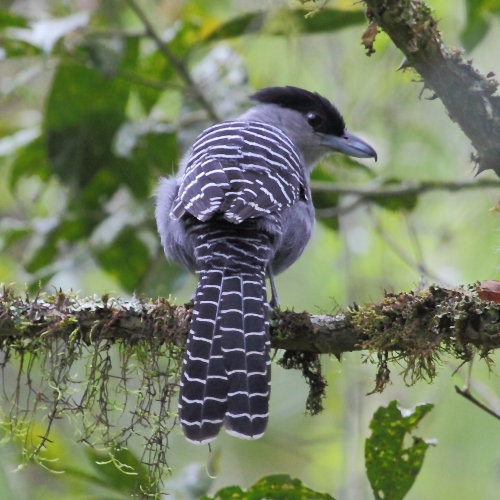
Bertoni's Antbird
Drymophila rubricollis
Order: Passeriformes / Family: Thamnophilidae

Wikimedia Commons
About the Bertoni's Antbird
Bertoni's Antbird (Drymophila rubricollis) is a captivating member of the Thamnophilidae family, predominantly inhabiting the lush Atlantic Forests of southeastern Brazil. This bird plays a crucial role in its ecosystem as an insectivore, helping control insect populations and thus maintaining the ecological balance. Found primarily in the states of Rio de Janeiro, São Paulo, and Minas Gerais, Bertoni's Antbird prefers subtropical and tropical moist lowland forests, often at elevations ranging from 600 to 1,800 meters. The bird's presence in these biodiverse regions highlights its adaptability and specialized role in the forest understory.
The Bertoni's Antbird is significant not only for its ecological role but also for its contribution to the biodiversity of the Atlantic Forest, a biome known for its rich array of flora and fauna. This region is considered one of the most important biodiversity hotspots on the planet, with many species found nowhere else. Bertoni's Antbird, with its distinct vocalizations and vibrant plumage, often serves as an indicator of forest health, as its survival depends on intact forest habitats.
Seasonally, Bertoni's Antbird exhibits behaviors that align with the availability of food resources. During the breeding season, which typically spans from September to February, the bird's activities become more pronounced as it engages in courtship and territorial defense. Outside of this period, Bertoni's Antbird may be less vocal but remains actively engaged in foraging, taking advantage of the insect abundance following seasonal rains. Its adaptability to seasonal changes in its environment underscores its resilience, though habitat loss due to deforestation poses a significant threat.
Ecologically, Bertoni's Antbird contributes to the health of the forest by participating in seed dispersal indirectly through its interactions with insect populations. As a keen forager, it helps maintain a balance between various insect species, which in turn affects the growth and survival of plant species. Its role in the food web showcases the interconnectedness of species within the Atlantic Forest, emphasizing the importance of conserving such habitats.
The Bertoni's Antbird belongs to the family Thamnophilidae, within the order Passeriformes. These birds typically live average 5-7 years with a max recorded of 9 years..
How to Identify a Bertoni's Antbird
Bertoni's Antbird is most easily identified by its striking red throat, a feature that stands out against its otherwise gray and black plumage. Adult males typically exhibit a more pronounced red coloration on the throat compared to females, whose throat may appear slightly duller. The rest of the body is clad in a subtle mix of gray and black, with a barred pattern on the wings and tail that aids in camouflage among the forest undergrowth.
Juveniles, on the other hand, are less vividly colored than adults, displaying a more muted gray with less pronounced red on the throat, making them somewhat challenging to identify at a glance. However, the characteristic barring on the wings and tail is present even in younger birds, providing a useful field mark for differentiation.
In comparison to similar species within the Thamnophilidae family, such as the Ferruginous Antbird or the Scaled Antbird, Bertoni's Antbird's red throat is a definitive distinguishing feature. In flight, this bird's silhouette is relatively nondescript, with short, rounded wings and a slightly elongated tail, allowing for agile maneuvering through dense foliage. Perched, Bertoni's Antbird often adopts a horizontal posture, with its tail slightly cocked, a common trait among antbirds that aids in balance and alertness.
Having trouble telling birds apart? Upload a photo to our bird identification tool for an instant species match.
Bertoni's Antbird Habitat and Range
Preferred Habitat
Bertoni's Antbird thrives in the dense, humid environments of the Atlantic Forest, favoring subtropical and tropical moist lowland forests. These habitats provide the thick undergrowth and ample insect prey that the bird relies upon. Within these forests, Bertoni's Antbird occupies elevations ranging from 600 to 1,800 meters, with a preference for areas rich in bamboo thickets and secondary growth, where it can forage and nest with relative security.
Seasonal habitat shifts are minimal for Bertoni's Antbird, as it tends to remain within its forested territories year-round. However, it may adjust its range within these areas in response to changes in food availability, particularly during the breeding season when it requires more resources. Urban presence is rare for this species, as it is highly sensitive to habitat disturbance and prefers the secluded, undisturbed pockets of forest that offer plentiful cover and foraging opportunities.
Geographic Range
The range of Bertoni's Antbird is largely confined to the Atlantic Forest region of southeastern Brazil, specifically within the states of Rio de Janeiro, São Paulo, and Minas Gerais. This bird is considered non-migratory, residing in these areas throughout the year. Though it does not embark on long-distance migrations, Bertoni's Antbird may undertake local movements within its range to exploit different parts of the forest for food and breeding purposes.
Population density hotspots for Bertoni's Antbird are typically located in areas of well-preserved primary and secondary growth forests. Conservation efforts have focused on protecting these critical habitats to ensure the survival of this species, as it does not adapt well to heavily altered landscapes. The bird's reliance on dense forest cover limits its range expansion, confining it to regions where habitat integrity is maintained.
Want to know which birds visit your area? Browse our backyard birds by location guides for region-specific species lists.
What Does the Bertoni's Antbird Eat?
Bertoni's Antbird primarily feeds on insects, making it an important insectivore within its habitat. Its diet consists of ants, beetles, and various other small invertebrates, which it gleans from the forest floor and low vegetation. This bird employs a methodical foraging technique, meticulously inspecting leaf litter and undergrowth for prey, often in the company of mixed-species foraging flocks.
Seasonal changes in food availability can influence the diet of Bertoni's Antbird. During the breeding season, the bird may increase its intake of protein-rich insects to meet the nutritional demands of raising young. In times of insect scarcity, it might resort to consuming small fruit or seeds, although these are not primary food sources.
The size of prey typically ranges from small ants to medium-sized beetles, reflecting the bird's adaptability in prey selection. Bertoni's Antbird tends to forage during the early morning and late afternoon, aligning its activity with peak insect movement to maximize feeding efficiency.
Bertoni's Antbird Behavior and Social Structure
Bertoni's Antbird exhibits a complex social structure, often seen in pairs or small family groups. It maintains a well-defined territory, which it defends vigorously from intruders with vocalizations and displays. This territorial behavior is especially prominent during the breeding season, when the bird's calls serve both as a deterrent to rivals and an attraction to potential mates.
Courtship displays in Bertoni's Antbird are subtle yet intricate, involving mutual preening, vocal exchanges, and synchronized movements between partners. Such interactions strengthen pair bonds and facilitate successful breeding. Flocking behavior is more common outside of the breeding season, with Bertoni's Antbird occasionally joining mixed-species flocks to enhance foraging efficiency and reduce predation risk.
In the presence of predators, Bertoni's Antbird relies on its cryptic plumage and quick movements to evade detection. It may also employ distraction displays or vocal alarms to alert other birds of the threat. Daily activity patterns show peaks in the early morning and late afternoon, coinciding with cooler temperatures and increased prey activity.
Bertoni's Antbird Nesting and Reproduction
Bertoni's Antbird constructs its nest using a variety of materials, including leaves, twigs, and moss, often positioning it close to the ground within dense vegetation for concealment. The nest is a cup-shaped structure, providing a secure environment for the eggs and chicks.
Preferred nesting locations are typically within bamboo thickets or dense secondary growth, where the bird can take advantage of the natural cover. Clutch size usually ranges from two to three eggs, with both parents sharing incubation duties over a period of about 14 to 16 days.
After hatching, the fledging period extends for another two weeks, during which time both parents participate in feeding and caring for the young. Bertoni's Antbird generally raises one to two broods per year, depending on food availability and environmental conditions. Parental roles are well-defined, with both partners contributing to the nurturing and protection of their offspring.
Bertoni's Antbird Sounds and Vocalizations
The primary song of Bertoni's Antbird is a melodious series of notes, characterized by a steady rhythm and rich tonal quality. This song serves multiple purposes, including territorial defense and mate attraction, and is most frequently heard during the breeding season.
In addition to its song, Bertoni's Antbird produces a variety of call notes, which include sharp, high-pitched chirps used for communication between mates and alarm calls to signal the presence of predators. The bird's vocal repertoire is diverse, allowing it to express a range of behaviors and emotional states.
During the dawn chorus, Bertoni's Antbird contributes with its distinct song, creating a symphony of sounds that fills the forest. Its vocalizations are sometimes compared to the tinkling of small bells, providing a unique auditory signature that aids in its identification.
Interesting Facts About the Bertoni's Antbird
- 1Bertoni's Antbird is named after Arnoldo de Winkelried Bertoni, a Swiss naturalist who contributed significantly to South American ornithology.
- 2The striking red throat of Bertoni's Antbird is not just for show - it plays a vital role in communication and mate attraction.
- 3Despite its small size, Bertoni's Antbird is an important insect predator, helping to control pest populations in the Atlantic Forest.
- 4Bertoni's Antbird often participates in mixed-species foraging flocks, a behavior that enhances its feeding efficiency.
- 5The Atlantic Forest, home to Bertoni's Antbird, is one of the most biodiverse regions in the world, yet it has lost over 85% of its original cover.
- 6Bertoni's Antbird uses its melodious song not only for territory defense but also to strengthen pair bonds with its mate.
- 7This species is particularly sensitive to habitat fragmentation, making it a key indicator of forest health.
Bertoni's Antbird Conservation Status
Bertoni's Antbird is currently classified as Near Threatened by the IUCN. Its population trend is decreasing, primarily due to habitat loss from deforestation and agricultural expansion in the Atlantic Forest region. These threats have led to significant fragmentation of its natural habitat, limiting the bird's range and reproductive success. Conservation efforts are underway to protect the remaining patches of Atlantic Forest, with initiatives focused on habitat restoration and the establishment of protected areas. Historical population declines highlight the need for continued vigilance and support for conservation measures to ensure this species' survival. Organizations and local communities are working together to raise awareness of the importance of preserving the Atlantic Forest, emphasizing the broader ecological benefits of protecting species like Bertoni's Antbird. Continued research and monitoring are crucial for adapting conservation strategies to the changing environmental landscape.