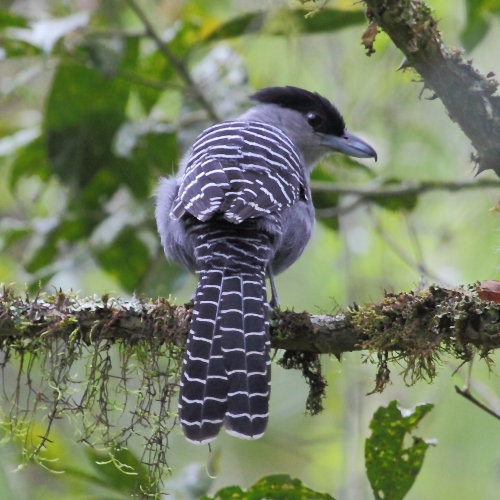
Bicolored Antvireo
Dysithamnus occidentalis
Order: Passeriformes / Family: Thamnophilidae

Wikimedia Commons
About the Bicolored Antvireo
The Bicolored Antvireo, or Dysithamnus occidentalis, stands as a distinctive member of the Thamnophilidae family, a group of birds often referred to as antbirds due to their insectivorous diet and affinity for forest habitats. This species inhabits the humid montane forests of the Andes, specifically in Colombia and Ecuador, where it plays a crucial role as both predator and prey within its ecological niche. The presence of the Bicolored Antvireo signifies the health of its forest environment, as it relies on dense, undisturbed habitats. Its ecological role involves controlling insect populations, which contributes to the balance of the ecosystem. Seasonal behaviors of the Bicolored Antvireo include maintaining territories year-round with minimal migration, as they are primarily sedentary. This lack of migratory behavior ties them tightly to specific microhabitats, making them particularly sensitive to habitat alterations. As such, the Bicolored Antvireo serves as an important indicator species for conservationists monitoring forest health in the regions it inhabits.
The Bicolored Antvireo belongs to the family Thamnophilidae, within the order Passeriformes. These birds typically live average 5-6 years, with a max recorded of 8 years..
How to Identify a Bicolored Antvireo
The Bicolored Antvireo presents a striking appearance with its bicolored plumage, which includes a contrasting gray upper body and white underparts. Adult males and females display similar color patterns, but males tend to have a slightly darker, more pronounced gray on the upperparts. Juveniles can be distinguished by their duller plumage, exhibiting a more muted gray contrasted with a creamier white below. Confusion might arise with the Slaty Antwren, another forest-dwelling bird; however, the Antvireo's distinctive bicolored pattern sets it apart. The flight silhouette of the Bicolored Antvireo is compact and direct, typical of smaller, forest-dwelling passerines. When perched, it often exhibits a slightly hunched posture, which, along with its tail flicking behavior, aids in field identification.
Having trouble telling birds apart? Upload a photo to our bird identification tool for an instant species match.
Bicolored Antvireo Habitat and Range
Preferred Habitat
The Bicolored Antvireo primarily inhabits the humid montane forests of the Andes, thriving at elevations ranging from 1,200 to 2,300 meters. These forests offer dense canopy cover and ample undergrowth, providing the perfect environment for foraging and nesting. Unlike some other antbirds, the Bicolored Antvireo does not frequent urban areas, preferring the undisturbed, lush environments of primary and secondary forests. During the rainy season, when insect activity peaks, the Bicolored Antvireo may expand its range slightly within the forest to take advantage of the increased food supply. However, its reliance on specific habitat parameters means it seldom ventures into open or degraded areas.
Geographic Range
The range of the Bicolored Antvireo is confined to the western slopes of the Andes in Colombia and Ecuador. Within this relatively narrow range, it occupies suitable montane forest habitats. The species is predominantly non-migratory, remaining in its established territories throughout the year. Population density hotspots include the Chocó bioregion, a biodiversity-rich area that offers ideal habitats for the Bicolored Antvireo. As a species with a restricted range, it does not participate in long-distance migrations, instead exhibiting local movements in response to food availability or climatic conditions.
Want to know which birds visit your area? Browse our backyard birds by location guides for region-specific species lists.
What Does the Bicolored Antvireo Eat?
The Bicolored Antvireo primarily feeds on a variety of insects, including beetles, ants, and caterpillars, which it gleans from foliage in the forest understory. During the wet season, when insect activity increases, its diet may expand to include other arthropods such as spiders. The foraging technique of the Bicolored Antvireo involves meticulous examination of leaves and branches, often using short hops and quick flights to access different parts of the understory. Prey size typically ranges from small to medium-sized insects, allowing the Antvireo to exploit a wide range of available food sources. Feeding occurs throughout the day, with peaks in activity during the cooler morning and late afternoon hours.
Bicolored Antvireo Behavior and Social Structure
The Bicolored Antvireo exhibits a solitary or paired social structure, rarely forming large flocks. Territorial behavior is prominent, with males and females actively defending their area from intruders through vocalizations and physical displays. Courtship displays are subtle, involving mutual preening and synchronized movements in the canopy. While generally not a flocking species, the Bicolored Antvireo may temporarily join mixed-species foraging flocks to exploit abundant food resources. It responds to potential threats with alarm calls and evasive maneuvers, retreating to the densest parts of the understory. Daily activity patterns are diurnal, with peak foraging and territorial activities occurring in the early morning and late afternoon.
Bicolored Antvireo Nesting and Reproduction
The Bicolored Antvireo constructs cup-shaped nests using twigs, leaves, and fibers, placed securely in the fork of a tree branch within the dense understory. Nesting locations are chosen for their concealment, providing protection from predators. The typical clutch size consists of two eggs, which are incubated by both parents over a period of approximately 14 days. After hatching, the chicks are cared for by both parents, receiving frequent feedings of regurgitated insect prey. Fledging occurs about 12 to 14 days post-hatching, with young birds remaining dependent on the parents for several weeks. The species generally produces one brood per year, although in years of abundant food supply, a second brood may be attempted.
Bicolored Antvireo Sounds and Vocalizations
The primary song of the Bicolored Antvireo is a series of short, melodic notes that rise and fall in pitch, resembling a gentle whistle. These songs serve both territorial and mate attraction functions. In addition to its song, the Bicolored Antvireo produces sharp call notes that alert others to the presence of intruders or predators. During the dawn chorus, its song becomes more frequent, contributing to the auditory tapestry of the montane forest. The alarm calls are sharper and more staccato, reflecting urgency when potential threats are nearby. Overall, the sounds of the Bicolored Antvireo are integral to its communication and survival strategies.
Interesting Facts About the Bicolored Antvireo
- 1The Bicolored Antvireo belongs to the Thamnophilidae family, a group known for their ant-following behavior, although this species primarily hunts independently.
- 2Unlike many birds, the Bicolored Antvireo does not migrate, making it highly dependent on stable, local habitats year-round.
- 3Both male and female Bicolored Antvireos participate in nest building, a cooperative effort that strengthens pair bonds.
- 4The Bicolored Antvireo's song is not only a territorial display but also a critical component of its pair bonding process.
- 5This antvireo is particularly sensitive to habitat fragmentation, highlighting the importance of large, continuous forest tracts for its survival.
- 6Despite its name, the Bicolored Antvireo feeds on a variety of insects, not just ants, making it a versatile insectivore.
- 7The Bicolored Antvireo's preference for dense undergrowth makes it a challenging bird to observe, often requiring patience and a keen ear to detect.
Bicolored Antvireo Conservation Status
The Bicolored Antvireo is currently listed as Near Threatened by the IUCN. Its population trend is decreasing, primarily due to habitat loss from deforestation and agricultural expansion. Conservation efforts focus on habitat protection and restoration, particularly in key biodiversity areas within its range. Historically, the species faced fewer threats, but recent decades have seen increased pressure from human activities. Initiatives aimed at preserving montane forest habitats will be crucial in stabilizing and potentially increasing its populations in the future.