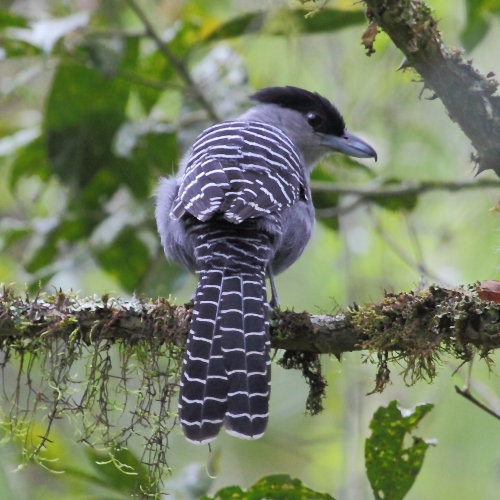
Black-and-white Antbird
Myrmochanes hemileucus
Order: Passeriformes / Family: Thamnophilidae

Wikimedia Commons
About the Black-and-white Antbird
The Black-and-white Antbird, Myrmochanes hemileucus, is a striking member of the Thamnophilidae family, endemic to the Amazon Basin, a region known for its rich biodiversity. This bird thrives in the dense undergrowth of tropical rainforests, particularly favoring areas near riverbanks and swampy grounds where army ants are prevalent. The bird's name aptly describes its bold black-and-white plumage, which serves as a camouflage in the dappled light of the forest floor. As an antbird that specializes in following army ant swarms, it plays a crucial role in the ecosystem by controlling insect populations and indirectly protecting other species from pest outbreaks. Found predominantly in countries like Brazil, Peru, Colombia, and Ecuador, the Black-and-white Antbird is a vital component of the Amazonian avian community. During the wet season, which spans from November to April, these birds often increase their foraging activity to take advantage of the heightened ant activity. In the dry season, from May to October, their range may contract slightly as some riverine habitats become less hospitable. Despite the dense and often impenetrable nature of its habitat, the Black-and-white Antbird is relatively easy to locate for those familiar with its distinctive call and behavior. The rich biodiversity of the Amazon Basin makes it a significant region for avian studies, with the Black-and-white Antbird serving as an excellent indicator species due to its sensitivity to changes in prey availability. Conservationists often use its presence to gauge the health of rainforest ecosystems. As deforestation continues to threaten the Amazon, understanding the ecological role of species like the Black-and-white Antbird becomes increasingly vital.
The Black-and-white Antbird belongs to the family Thamnophilidae, within the order Passeriformes. These birds typically live average 4-6 years, with a maximum recorded of 9 years..
How to Identify a Black-and-white Antbird
The Black-and-white Antbird is a small bird, measuring approximately 13-14 centimeters in length, with a wingspan of around 18 centimeters. Its plumage is predominantly black with striking white markings that are especially prominent on the wings and tail, creating a bold contrast that is hard to miss. Males and females are similar in appearance, though males tend to have more extensive black plumage on the throat and head, while females may exhibit slightly browner tones in these areas. Juveniles resemble adults but can have a duller and more mottled appearance, lacking the stark contrast seen in mature birds. In flight, the Black-and-white Antbird's silhouette is characterized by rapid wingbeats and a short tail that gives it a compact look, which is typical of many understory-dwelling birds. When perched, it often adopts an upright posture, frequently flicking its tail as it scans for prey. Its behavior of following army ant swarms can cause confusion with other ant-following species, such as the White-plumed Antbird or the Bicolored Antbird, but its distinctive coloration and vocalizations help in accurate identification.
Having trouble telling birds apart? Upload a photo to our bird identification tool for an instant species match.
Black-and-white Antbird Habitat and Range
Preferred Habitat
The Black-and-white Antbird is primarily found in tropical lowland rainforests, especially in areas with dense understory vegetation. It favors habitats near water bodies, such as riverbanks and swamps, where army ant swarms are more frequent. The bird's preference for these humid, forested areas means it rarely ventures into open or heavily disturbed habitats. It typically inhabits elevations from sea level up to about 500 meters, although it is most commonly observed in the forest's lower strata. Seasonal habitat shifts are minimal, as these birds remain in the forest year-round, though they may adjust their specific territories in response to changes in army ant activity. Unlike many birds that adapt well to urban environments, the Black-and-white Antbird is rarely seen outside its preferred rainforest habitat.
Geographic Range
The Black-and-white Antbird's range is concentrated within the Amazon Basin, covering parts of Brazil, Peru, Colombia, and Ecuador. It is a non-migratory species, residing year-round in these tropical regions. The bird's presence is most dense along the Amazon River and its tributaries, where its preferred habitats are abundant. Although its range does not extend into the more arid regions of South America, its geographic distribution is fairly stable within the rainforest. Populations are more concentrated in areas of undisturbed primary forest, with fewer numbers found in secondary or fragmented forests. The lack of migratory behavior means that conservation efforts must focus on protecting its static habitat rather than addressing migration corridors.
Want to know which birds visit your area? Browse our backyard birds by location guides for region-specific species lists.
What Does the Black-and-white Antbird Eat?
The diet of the Black-and-white Antbird primarily consists of insects and other arthropods, with a strong reliance on prey flushed out by army ant swarms. It feeds on a variety of insects, including beetles, spiders, and larvae, capturing them from the forest floor as they attempt to escape the advancing ants. This bird employs a sit-and-wait foraging strategy, often perching on low branches or vines before swooping down to seize prey. Its diet can vary slightly with the seasons, as different insect populations fluctuate in response to environmental changes. During the wet season, when insect activity is higher, the Black-and-white Antbird takes advantage of the increased abundance of food. Prey items are typically small, fitting easily into the bird's beak for quick consumption. Feeding activity tends to peak during the cooler hours of the morning and late afternoon.
Black-and-white Antbird Behavior and Social Structure
The Black-and-white Antbird exhibits a range of fascinating behaviors that reflect its adaptation to life in the dense rainforest understory. It is a solitary bird outside the breeding season, often found alone or in pairs. Territorial behavior is pronounced, with males vigorously defending their feeding grounds from intruders, using both vocalizations and physical displays. Courtship displays involve a series of calls and aerial maneuvers, where the male showcases his plumage and agility to attract a mate. Although generally solitary, these birds display a unique form of social behavior by associating with army ant swarms. This association is not one of true flocking but more of opportunistic feeding, where several ant-following species may converge in response to the abundance of prey. The Black-and-white Antbird's response to predators includes a combination of camouflage and erratic flight patterns to evade capture. Daily activity patterns are largely diurnal, with peak activity in early morning and late afternoon. Resting takes place during the hottest part of the day, typically in shaded areas.
Black-and-white Antbird Nesting and Reproduction
The nesting habits of the Black-and-white Antbird involve constructing a cup-shaped nest built from leaves, twigs, and plant fibers. These nests are typically situated low to the ground, often in dense undergrowth or among the roots of trees, providing excellent concealment from predators. The female lays a clutch of 2-3 eggs, which are incubated by both parents. The incubation period lasts approximately 14 days, during which time the parents take turns maintaining the proper temperature and warding off potential threats. Once hatched, the chicks are altricial, requiring constant care and feeding by both parents. Fledging occurs about 12-14 days after hatching, although young birds often remain dependent on their parents for several additional weeks. The Black-and-white Antbird typically produces one brood per year, although favorable conditions may allow for a second in some areas.
Black-and-white Antbird Sounds and Vocalizations
The Black-and-white Antbird's vocalizations are a key identifying feature. Its primary song consists of a series of rapid, high-pitched notes delivered in a rising and falling pattern, somewhat reminiscent of a squeaky wheel. These songs serve to establish territory and attract mates. Call notes are sharp and abrupt, often used in alarm situations or during territorial disputes. Alarm calls are more frantic and harsher, intended to warn of immediate danger. During the dawn chorus, the Black-and-white Antbird contributes with its distinctive song, adding to the rich tapestry of sounds that characterize the Amazonian rainforest.
Interesting Facts About the Black-and-white Antbird
- 1The Black-and-white Antbird is one of the few bird species that rely almost entirely on army ant swarms for food.
- 2Unlike many other antbirds, the Black-and-white Antbird exhibits little sexual dimorphism, with both sexes having similar plumage.
- 3The bird's call is so distinct that experienced birders can identify it without visual confirmation.
- 4Despite its reliance on ant swarms, the Black-and-white Antbird rarely suffers from ant bites due to its foraging technique.
- 5This species' ability to thrive in army ant-following niches exemplifies the complex ecological relationships found in the Amazon.
- 6The Black-and-white Antbird contributes significantly to controlling insect populations in its habitat.
- 7Its presence in a given area can be an indicator of healthy, undisturbed rainforest ecosystems.
Black-and-white Antbird Conservation Status
Currently, the IUCN lists the Black-and-white Antbird as a species of Least Concern, with a stable population trend. Its primary threat is habitat destruction due to deforestation and land conversion in the Amazon Basin. Conservation efforts focus on preserving large tracts of primary rainforest, which are essential for the survival of this and many other species. While historical population changes are not well-documented, deforestation poses a significant risk to future population stability. Protected areas within its range offer some refuge, but ongoing conservation work is crucial to mitigate the impacts of human activity.